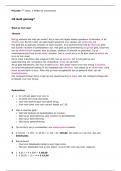
RADICAL SECTS (during Rump)
Providence – belief that everything happens for a reason.
Millenarianism – belief that Jesus will come back.
Interregnum – the period of time where the normal gov is suspended. In this case, it’s from C1’s
death (1649) to the restoration of C2 (1660). RELIGION was the most pressing problem as there were
many groups that rejected the idea of a central State Church.
1640, 2 main Protestant Churches: Anglican (w/Arminian and Puritan wings) and Presbyterian (v Calvinist). By
the 1650’s, none of the religious sects were willing to conform to the established Church – regardless if it was
Anglican or Presbyterian.
None of the radical sects were large in numbers but it was their disruptive ideas that made them a threat.
Many of them didn’t restrict themselves to just one sect.
BAPTISTS:
Particularly prominent during 1640’s.
Believed that faith was a matter of personal experience and acceptance; it couldn’t be taught/learnt.
They disregarded infant baptism and placed huge importance on adult baptism as it was a clearer
expression of one choosing to become one with Christ.
The movement was split between:
General Baptists: would cooperate w/other sects
Particular Baptists: believed in remaining exclusive
1650’s Baptists became detested by religious/political conservatives because it was thought that they
associated w/German Anabaptists (a group renowned for their defiance of the law) but the only
connection between them was the similarity of name.
Baptists tended to rely on Cromwell to protect them, which on a number of occasions he did.
CONGREGATIONALISTS (INDEPENDENTS):
The term refers to the separatist or independent Protestant congregations who rejected the idea of a
national centrally administered Church.
On many occasions where extreme sects threatened to create religious chaos, the Congregationalists
closed ranks (came closer) w/Presbyterians and Anglicans.
Cromwell could’ve been viewed as a representative of this sect as h believed it must be a voluntary
association; it shouldn’t be imposed on believers.
FIFTH MONARCHISTS:
Clearest expression of millenarianism.
Never had over 10,000 members – majority of which were from army (officers and troopers).
Colonel Thomas Harrison – leading spokesman.
Believed that 5 great monarchies would rule the earth: Assyrian, Persian, Greek, Roman and then the
death of C1 led to the 5th and greatest monarchy which was Jesus himself.
Left embittered after the Nominated Assembly 1653. They turned their anger against Cromwell, who
they previously hailed as a 2nd Moses.
Constant nuisance throughout the Protectorate.
Attempted to kill Cromwell on multiple occasions.
Made further unsuccessful challenges to the gov in 1659.
MUGGLETONIANS:
Lodowick Muggleton – strong predestinarian ideas. He thought that Christ had visited him
personally and given him power to save or damn all other men. He made a small sect of people he
had ‘saved’.
Assured of their unique virtue, Muggletonians freely rejected and State or Church laws that affected
them.
Providence – belief that everything happens for a reason.
Millenarianism – belief that Jesus will come back.
Interregnum – the period of time where the normal gov is suspended. In this case, it’s from C1’s
death (1649) to the restoration of C2 (1660). RELIGION was the most pressing problem as there were
many groups that rejected the idea of a central State Church.
1640, 2 main Protestant Churches: Anglican (w/Arminian and Puritan wings) and Presbyterian (v Calvinist). By
the 1650’s, none of the religious sects were willing to conform to the established Church – regardless if it was
Anglican or Presbyterian.
None of the radical sects were large in numbers but it was their disruptive ideas that made them a threat.
Many of them didn’t restrict themselves to just one sect.
BAPTISTS:
Particularly prominent during 1640’s.
Believed that faith was a matter of personal experience and acceptance; it couldn’t be taught/learnt.
They disregarded infant baptism and placed huge importance on adult baptism as it was a clearer
expression of one choosing to become one with Christ.
The movement was split between:
General Baptists: would cooperate w/other sects
Particular Baptists: believed in remaining exclusive
1650’s Baptists became detested by religious/political conservatives because it was thought that they
associated w/German Anabaptists (a group renowned for their defiance of the law) but the only
connection between them was the similarity of name.
Baptists tended to rely on Cromwell to protect them, which on a number of occasions he did.
CONGREGATIONALISTS (INDEPENDENTS):
The term refers to the separatist or independent Protestant congregations who rejected the idea of a
national centrally administered Church.
On many occasions where extreme sects threatened to create religious chaos, the Congregationalists
closed ranks (came closer) w/Presbyterians and Anglicans.
Cromwell could’ve been viewed as a representative of this sect as h believed it must be a voluntary
association; it shouldn’t be imposed on believers.
FIFTH MONARCHISTS:
Clearest expression of millenarianism.
Never had over 10,000 members – majority of which were from army (officers and troopers).
Colonel Thomas Harrison – leading spokesman.
Believed that 5 great monarchies would rule the earth: Assyrian, Persian, Greek, Roman and then the
death of C1 led to the 5th and greatest monarchy which was Jesus himself.
Left embittered after the Nominated Assembly 1653. They turned their anger against Cromwell, who
they previously hailed as a 2nd Moses.
Constant nuisance throughout the Protectorate.
Attempted to kill Cromwell on multiple occasions.
Made further unsuccessful challenges to the gov in 1659.
MUGGLETONIANS:
Lodowick Muggleton – strong predestinarian ideas. He thought that Christ had visited him
personally and given him power to save or damn all other men. He made a small sect of people he
had ‘saved’.
Assured of their unique virtue, Muggletonians freely rejected and State or Church laws that affected
them.