
2.1 Cognition: Thinking & Remembering
Problem 3 – Attention Please!
Attention
= selects among objects and thoughts
- External: environment (objects, specific features); differ in time, space, sensory modality
- Internal: mental life (planning, managing info of short-term WM and LTM
- Protects us from overload
- Exp.: 2 students in lecture read 2 different texts → difficult to listen to both
↑ difficulty when speakers are closer and/or similar pitch
1. Bottleneck at pattern recognition stage
→ interference because same mechanism needed for two tasks simultaneously
→ depends on extent to which tasks use same mechanism
Broadbent´s Filter Model
- Study: dichotic listening task: left and right ear pairs of different digits
o Findings: report digits heard on one ear first, then the other
o Recall digit pairs in order (left & right, left & right…) → longer intervals for better recall; much worse than
first one then other
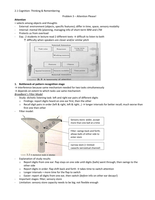
- Filter model:
Sensory store: wider, accept
more than one ball at a time
Filter: swings back and forth;
allows balls of either side to
enter stem
narrow stem (= limited-
capacity perceptual channel)
- Explanation of study results
o Report digits from one ear: flap stays on one side until digits (balls) went through; then swings to the
other side
o Report digits in order: flap shift back and forth → takes time to switch attention
o Longer intervals = more time for the flap to switch
o Easier: report all digits from one ear, then switch (before info on other ear decays!)
- Important stages: filter; sensory store
- Limitation: sensory store capacity needs to be big; not flexible enough
Problem 3 – Attention Please!
Attention
= selects among objects and thoughts
- External: environment (objects, specific features); differ in time, space, sensory modality
- Internal: mental life (planning, managing info of short-term WM and LTM
- Protects us from overload
- Exp.: 2 students in lecture read 2 different texts → difficult to listen to both
↑ difficulty when speakers are closer and/or similar pitch
1. Bottleneck at pattern recognition stage
→ interference because same mechanism needed for two tasks simultaneously
→ depends on extent to which tasks use same mechanism
Broadbent´s Filter Model
- Study: dichotic listening task: left and right ear pairs of different digits
o Findings: report digits heard on one ear first, then the other
o Recall digit pairs in order (left & right, left & right…) → longer intervals for better recall; much worse than
first one then other
- Filter model:
Sensory store: wider, accept
more than one ball at a time
Filter: swings back and forth;
allows balls of either side to
enter stem
narrow stem (= limited-
capacity perceptual channel)
- Explanation of study results
o Report digits from one ear: flap stays on one side until digits (balls) went through; then swings to the
other side
o Report digits in order: flap shift back and forth → takes time to switch attention
o Longer intervals = more time for the flap to switch
o Easier: report all digits from one ear, then switch (before info on other ear decays!)
- Important stages: filter; sensory store
- Limitation: sensory store capacity needs to be big; not flexible enough



