ESSENTIAL HUMAN ANATOMY & PHYSIOLOGY MODULE 2
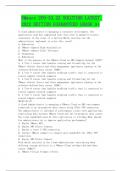
ESSENTIAL HUMAN ANATOMY & PHYSIOLOGY MODULE 2 QUESTIONS & ANSWERS 100% GUARANTEED LATEST UPDATE Pia mater (menix) This layer of the meninges is tightly attached to the brain. Your Answer: Pia Mater Question 1 3 / 3 pts Median longitudinal The fissure separates the right and left cerebral hemispheres. Your Answer: Median Longitudinal Question 2 3 / 3 pts Score for this quiz: 100 out of 100 All the following are functions of the hypothalamus except: Maintain homeostasis Controls the pituitary gland Question 4 2 / 2 pts Question 3 4 / 4 pts What is the purpose of the blood-brain barrier? Describe its maintenance from a cellular level. Your Answer: The blood-brain-barrier is a diffusion barrier that prevents most particules from entering the central nervous system tissue and separating the brain and spinal cord from general blood circulation. It is formed relatively from the impameable brain capillaries due to the glial cell astrocytes. It is important for it to be maintained in order to stabilize the chemical environment of the nervous system because if there is an internal variation in the chemical environment the neutrons will fire uncontrollably The blood-brain barrier is a diffusion barrier which prevents most particles from entering the central nervous system tissue, keeping the brain and spinal cord separate from general blood circulation. The blood-brain barrier is formed by the relatively impermeable brain capillaries, due to the glial cells astrocytes. Maintenance of the blood-brain-barrier is important to provide a stable chemical environment for the nervous system. Correct! Fourth Third Medial Lateral This ventricle is located anterior to the cerebellum. Question 5 2 / 2 pts Correct! Primary sensory cortex Temporal lobe Occipital lobe Cerebellum Frontal lobe This region of the brain controls decision making skills. Question 6 2 / 2 pts Links the nervous and endocrine systems Correct! Relays sensory impulses to the cerebrum Describe how memories are stored and retrieved in the brain. Include a specific brain region. Your Answer: Memories are not stored in one specific area of the brain but they are stored in all the areas of the cerebral hemispheres. The hippocampus helps to retrieve and store our memories. The limbic system is also associated with this process which results in sensory stimulis that awaken our complex memories making them vivid. Question 8 2 / 2 pts Correct! Primary sensory cortex Parietal lobe Occipital lobe Wernicke’s area Broca’s area A patient is having difficulty understanding language but is still able to speak fluently. The patient’s dermatomes are intact. Which area of the brain is most likely damaged? Question 7 2 / 2 pts Correct! The medulla contains reflex centers to regulate vasoconstriction. The midbrain contains the superior and inferior colliculi. The pons helps to regulate breathing. The midbrain portion of the brainstem is continuous with the spinal cord. Which statement is false concerning the brainstem? Question 9 2 / 2 pts Which of the following is true concerning the cerebellum? Question 10 2 / 2 pts Memories are not stored in one specific area within the brain but instead are stored throughout the cerebral hemispheres. The hippocampus acts as a memory center to help with memory storage and retrieval. The involvement of the limbic system explains why emotionally charged events result in our most vivid memories. Correct! All the above Hippocampus Parietal lobe Frontal lobe Occipital lobe Alzheimer’s disease impacts which region(s) of the brain? Question 11 2 / 2 pts Which of the following is true concerning a CVA? Question 12 2 / 2 pts The gray matter is internal while the white mater is external. The cerebellum works to plan body movements by relaying information spinal cord. Correct! The anterior lobe receives information from the body trunk. The vermis coordinates the trunk and shoulder movements. Correct! Anterior spinal cord injury Ulnar nerve damage Carpal tunnel syndrome CVA in the frontal lobe A patient is unable to extend his fourth and fifth digits when asked to open his hand. What is most likely the cause? Question 13 2 / 2 pts Label the following spinal cord regions in the diagram below: 1: 5: Question 14 10 / 10 pts An ischemic stroke is also known as a “brain bleed”. A TIA is a form of hemorrhagic stroke. Stroke survivors never regain any lost function. Correct! A hemorrhagic stroke is due to a broken blood vessel. 6: 9: 11: Your Answer: 1 - Posterior Column 5 - Anterior Median Fissure 6 - Posterior Horn 9 - Dorsal Root 11 - DRG (Dorsal root ganglion) 1: Posterior (Dorsal) column 5: Anterior median fissure 6: Posterior (Dorsal) horn 9: Dorsal root 11: DRG (Dorsal Root ganglion) Question 16 3 / 3 pts What cranial nerve is highlighted in blue (also indicated by the arrow) in the figure below? Optic Oculomotor Trochlear Correct! Abducens Spinal Accessory Question 15 3 / 3 pts What type of nerve is the cranial nerve below and what does it control? (Highlighted in blue, also indicated by the arrow) Mixed: Sensation of digestive tract and Regulation of heart rate Motor: Tongue movement Sensory: Hearing/balance Correct! Mixed: Facial muscles and Taste The maxillary branch of the trigeminal nerve: Question 17 4 / 4 pts Use the figure below to answer the following questions. Answer by writing the letter (A-J) from the figure that corresponds with the correct cranial nerve. Question 18 10 / 10 pts receives sensory information from the eyebrows Correct! receives sensory information from the upper lip and upper gums is a mixed sensory and motor branch controls the muscles of mastication 1. This cranial nerve receives information from the retina. 2. This cranial nerve is responsible for the sensation of the digestive tract. 3. This cranial nerve controls movement of the eye laterally. 4. This cranial nerve receives sensory information for hearing. 5. This cranial nerve is responsible for voluntarily moving the tongue. Your Answer: 1. B 2. I Label the nerves (A-C) in the figure below: A: B: C: Question 19 10 / 10 pts 3. E 4. G 5. J 1. B. (Optic) 2. I. (Vagus) 3. E. (Abducens) 4. G. (Vestibulocochlear) 5. J. (Hypoglossal) Question 20 2 / 2 pts Your Answer: A. Radial Nerve B. Ulnar Nerve C. Median Nerve A-Radial B- Ulnar C- Median Correct! Median Sciatic Phrenic Radial A patient is on a ventilator post a car accident. What nerve is most likely damaged? Question 21 2 / 2 pts A patient is not able to extend his left wrist or fingers. What nerve is most likely damaged? Ulnar Axillary Correct! Radial Question 22 2 / 2 pts The lumbar plexus is from spinal nerves: Correct! L01-L04 L04- S04 C01-C05 L01-S01 Correct! Common fibular nerve Saphenous Sciatic Femoral A patient has decreased sensation over the posterior surface of the thigh. What nerve is most likely damaged? Question 23 2 / 2 pts Correct! The anterior division forms the femoral nerve. (F) There are two divisions: anterior and posterior. There are three cords: medial, lateral and posterior It arises from L2-S2 spinal nerves. Which of the following is true concerning the lumbar plexus? Question 24 2 / 2 pts Median Correct! It inhibits the digestive tract. The primary neurotransmitter is norepinephrine. It is also called the craniosacral division. It is also called the thoracolumbar division. Which of the following is false concerning the sympathetic nervous system? Question 26 3 / 3 pts If you were hiking in the woods and came across a mountain lion, which division of your nervous system would have increased activity? Explain your answer. Question 27 4 / 4 pts Correct! Ciliary ganglion Inferior mesenteric ganglion Superiomesenteric ganglion Celiac ganglion Sympathetic trunk ganglia These contain the ganglia for the sympathetic nervous system that controls the effector organs in the trunk, head and limbs. Question 25 3 / 3 pts If someone sustains an injury to the area of the spinal cord, as shown below by the blue oval, would you be more likely to see paralysis or decreased sensation? Explain your answer. Your Answer: Question 28 5 / 5 pts Your Answer: The Sympathetic division of my nervous system would have increased activity because this is the division of the nervous system that works during emergency and help with our Flight-or-fight hormones in stressful situation. It assists us during stress and emergency situations by helping to accelerate our heart rate, dialate our bronchis and increase rate of breathing, also inhibiting digestion and breaking down glycogen into glucose for the body The sympathetic nervous system would have increased activity as it is responsible for preparing our bodies to respond to stressful situations. Apraxia, or impaired motor planning. Apraxia results in rigid movements and difficulty executing a motor plan. The basal ganglia is responsible for executing a motor plan and to slow and control fine movements (creating the rigid movements). One of your patients sustained a hemorrhagic CVA. You notice they have rigid movements when moving their arms. They also have difficulty forming a plan to move their body. What area of the brain is most likely impacted? Explain your reasoning. Your Answer: Basial ganglia is most likely impacted because it is responsible for coordinating our motor planning movements including slow and controlling fine movements; Apraxia which is also known as impaired motor planning will bring about rigid movements and difficulty in forming a plan to move their body. Question 29 5 / 5 pts I would be more likely to see paralysis because our motor neurons go out through the ventral root, the anterior side of the spinal cord. Motor neurons which are resposible for our movements response You would be more likely to see paralysis (muscular weakness) because motor neurons exit the spinal cord anteriorly.

Geschreven voor
- Instelling
- ESSENTIAL HUMAN ANATOMY & PHYSIOLOGY
- Vak
- ESSENTIAL HUMAN ANATOMY & PHYSIOLOGY
Documentinformatie
- Geüpload op
- 23 juli 2023
- Aantal pagina's
- 20
- Geschreven in
- 2022/2023
- Type
- Tentamen (uitwerkingen)
- Bevat
- Vragen en antwoorden
Onderwerpen
-
essential human anatomy amp physiology module 2