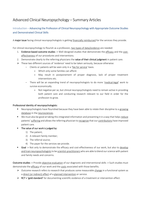
Advanced Clinical Neuropsychology – Summary Articles
Introduction – Advancing the Profession of Clinical Neuropsychology with Appropriate Outcome Studies
and Demonstrated Clinical Skills
A major issue facing clinical neuropsychologists is getting financially reimbursed for the services they provide.
For clinical neuropsychology to flourish as a profession, two types of data/evidence are needed:
1. Evidence-based outcome studies -> Well designed studies that demonstrate the efficacy and the cost-
effectiveness of our procedures and interventions.
2. Demonstrate clearly to the referring physicians the value of their clinical judgment in patient care.
➢ These two different sources of ‘evidence’ need to be taken seriously, because otherwise:
– Clients or patients will be seen only in a ‘fee for service’ basis.
» Which only some families can afford.
» May result in postponement of proper diagnosis, lack of proper treatment
interventions etc.
– There will be an expanding trend of neuropsychologists to do more ‘medical-legal’ work to
survive economically.
» Not negative per se, but clinical neuropsychologists need to remain active in providing
both patient care and conducting research relevant to our field in order for the
profession to grow.
Professional identity of neuropsychologists:
▪ Neuropsychologists have flourished because they have been able to relate their discipline to a growing
database in the neurosciences.
▪ We must also be good at taking this integrated information and presenting it in a way that helps reduce
patients’ suffering and allows the referring physician to recognize that our contributions have improved
patient care.
▪ The value of our work is judged by:
1) The patient;
2) A relevant family member;
3) The referral source;
4) The payer for the services we provide.
▪ Goal -> Not only to demonstrate the efficacy and cost-effectiveness of our work, but also to develop
and train neuropsychologists to be scientist-practitioners who are able to blend our science with patient
and family needs and concerns.
Outcome studies -> Provide objective evaluation of our diagnostic and interventional skills -> Such studies must
demonstrate the efficacy of our work and the costs associated with those benefits.
➢ Outcome research refers to research that produces some measurable change in a functional system as
a direct (or indirect) effect of a planned intervention or service.
➢ RCT = ‘gold standard’ for documenting scientific evidence of a treatment or intervention effect.
, ➢ Cost-outcome studies -> When considering an economic effect -> Four basic types:
1) Cost-efficiency or minimization;
2) Cost-benefit;
3) Cost-effectiveness;
4) Cost-utilization.
➢ Healthcare economic studies -> Often deal with cost-effectiveness issues -> Measure the relative
healthcare benefit of at least two different treatments, and relate the degree of benefit relative to the
costs involved.
➢ Value -> Refers to the ‘worth’ of the service (e.g. also QoL) -> Can be measured both objectively and
subjectively.
➢ Goal of neuropsychologists -> To obtain ‘fair value’ for their services.
Work of neuropsychologists:
▪ Frequently asked to help neurologists to determine if a patient’s subjective complaints correlate with
objective measures of brain functioning.
▪ Aid in the differential diagnosis of neurological vs psychiatric disorders.
→ Studies have appeared which demonstrate that how patients report their subjective symptoms
can be studied in relationship to their level of performance on neuropsychological tests.
▪ Impacts medical decision making -> When neurosurgeons request objective information about change
and neuropsychological functioning after surgery, or when we conduct pre-surgical evaluations (e.g. in
PD considered for DBS).
▪ Rehabilitation -> Psychiatrists, as well as other physicians, may refer patients to document disturbances
in higher cerebral functioning after known disorders that have relevance for rehabilitation planning and
patient management.
→ E.g. to predict the time that is needed for patients to achieve certain rehabilitation goals.
→ E.g. educating family members in order to manage a person with known neurological
disturbances.
▪ Attorneys also request neuropsychological evaluations in a variety of medical-legal cases.
▪ Practical decisions answered trough neuropsych. testing -> E.g. whether the patient is safe to return
home after medical treatment or care, or whether the patient is safe to operate a motor vehicle.
Neuropsychologists need to conduct outcome studies to demonstrate that (examples in article):
▪ …neuropsychological testing/evaluations lead to the development of new knowledge relevant to
patient diagnosis and care.
▪ …neuropsychological knowledge/tests can be combined to improve patient care.
▪ …intervention programs, based on neuropsychological and psychological principles, result in important
cognitive and behavioral changes for the patient, and these changes are mirrored in brain structure and
activation pattern changes.
▪ …neuropsychologist interventions with patients not only reduce disability and improve the QoL of the
patient, but also improve the QoL of caregivers.
▪ …the economic impact of not receiving neuropsychological assessment and interventions in a timely
fashion.
,Primary clinical skills -> Skills that need to be identified and developed in all clinicians (many of these skills take
years to develop).
Professional skills -> Skills that describe how they relate to other professions and how we relate to one another
(learned mainly by observing experienced clinical neuropsychologists).
Final points:
1. Find your personal niche -> Doing something that meets your professional needs while meeting the
needs of others.
2. Recognize that neuropsychologists are not ‘mini’ neurologists, psychiatrists, or radiologists.
3. Evaluate the concept of value in healthcare economics -> Strive to provide ‘good value’.
,1.1 – Fatigue in Multiple Sclerosis: Mechanisms, Evaluation, and Treatment
Multiple Sclerosis (MS) -> MS is an inflammatory disease of the CNS, that results in myelin destruction and axonal
degeneration in the brain and spinal cord.
Treatment -> Therapies available can decrease the frequency of clinical relapses and new radiological lesion
formation. However, none of these therapies reverse preexisting tissue damage or control chronic symptoms,
such as fatigue, that are common to all subtypes of MS.
Fatigue -> Considered to be one of the main causes of impaired QoL among MS patients (independent of
depression or disability), and it’s also a very common symptom (75% of patients report fatigue at some point).
It also has significant socio-economic consequences, e.g. loss of employment.
Reasons for poor understanding and underemphasizing of MS fatigue:
1. Fatigue is a subjective symptom without a unified definition;
2. No gold standard exists by which to measure fatigue;
3. Fatigue in MS may be multifactorial.
→ In addition to immunologic abnormalities, MS is associated with an increased prevalence of
other conditions that contribute to fatigue, including depression and several sleep disorders.
Separation of treatable from untreatable causes of fatigue can be challenging in MS.
Mechanisms proposed for fatigue in MS:
▪ Primary mechanisms -> The most commonly proposed primary mechanisms of fatigue in MS involve the
immune system or sequelae from CNS damage.
Specific possible causes:
1) Cytokine influences -> Significantly increased TNF-α levels, and interferon-γ levels are found in
fatigued MS patients compared to non-fatigued patients.
» BUT, TNF-α antagonists that have been shown to reduce sleepiness may worsen MS.
» In addition, both cytokines are relatively nonspecific and may be elevated in a variety
of inflammatory conditions.
2) Endocrine influences:
* An association between fatigue and dysregulation of ACTH levels has been proposed,
but results are mixed.
* Lower levels of DHEA (dehydroepiandrosterone) and its sulfated compound, DHEAS,
have been demonstrated in MS patients with sustained fatigue than their non-fatigued
counterparts.
* Although no definitive conclusions can be drawn based solely on these studies, these
results suggest a possible endocrine contribution to fatigue in MS.
* Further support comes from reports of increases energy while taking corticosteroids
(in MS). However because of the chronic nature of MS and the risks of long-term
steroid-use, this is not advocated as a treatment.
3) Axonal loss and altered cerebral activation:
, * PET -> Demonstrated decreased regional glucose metabolism in the frontal cortex and
basal ganglia of fatigued MS patients has suggested that neuronal dysfunction in these
regions may play a role.
* Magnetic resonance spectroscopy (MRS) studies have suggested axonal loss as a
contributing factor.
* Compensatory reorganization and increased brain recruitment -> fMRI studies that have
demonstrated increased volumes and patterns of activation in fatigued MS patients
compared to non-fatigued patients.
▪ Secondary mechanisms -> Fatigue in MS also can arise from associated conditions or accumulation of
disease burden.
Specific possible causes:
− Sleep disorders:
* Restless legs syndrome (RLS) -> Prevalence among MS 3-5x that of general population
(higher when more severe MS).
Correlation between spinal cord pathology and RLS suggested -> Dysfunction
of dopaminergic pathways could decrease sensory thresholds and increase
susceptibility to RLS.
* Sleep disordered breathing -> Can result from MS lesions that affect medullary
respiratory centers (central sleep apnea).
Conflicting results.
* Chronic insomnia and circadian rhythm abnormalities -> Frequency increased in MS,
compared to general population.
Can arise secondary to pain, spasticity, depression, anxiety, nocturia,
medication effects, or primary sleep disorders (e.g. RLS) -> Potential causes
such as these must be addressed, as insomnia and poor sleep quality in MS
patients correlate significantly with QoL.
MS related fatigue may arise, at least in part, from circadian rhythm
disturbances.
Sleep efficiency and sleep continuity are decreased in MS + MS has higher total
arousal index.
– Depression -> Commonly accompanies MS -> Difficult to distinguish from MS-associated
fatigue, because depression itself can manifest with fatigue symptoms (e.g. anhedonia, loss of
motivation).
» Correlation between fatigue and depression in MS found (but mixed results).
– MS subtype -> Subtype and severity can affect the risk of fatigue -> More severe fatigue in
progressive subtypes (but this may partly be confounded by differences in disability levels).
– Latrogenic mechanisms -> Medications used to treat symptoms of MS have the potential to
cause fatigue (e.g. drowsiness). Immunomodulatory and immunosuppressive therapies also
have the potential to cause or exacerbate fatigue.
Fatigue rating scales commonly used for MS:
▪ The Fatigue Scale (Chalder):
– Created for chronic fatigue syndrome patients;
– 14 item scale that quantifies fatigue intensity in terms of physical and mental domains;
– Advantages -> Ease of use and brevity;
, – MS-specific assessments of validity and consistency are lacking.
▪ Fatigue Severity Scale (FSS, Krupp):
– Initially designed to identify common features of fatigue in both MS and lupus patients;
– Assesses the impact of fatigue on multiple outcomes (physical focus);
– Acceptable internal consistency and stability over time, and sensitivity to change from clinical
improvement.
– Differentiates between subgroups of MS, CFS, and primary depression.
▪ The Modified Fatigue Impact Scale (MFIS):
– 21 items;
– Multidimensional assessment: physical, cognitive, and psychosocial functioning;
– Other advantages -> Ease of use, good reproducibility, and strong correlation with FSS results.
Diagnostic approach to fatigue -> An open ended
question, followed by a series of more focused
inquiries will often prove to be a productive approach.
Initial questioning:
▪ If patient does not volunteer fatigue, ask the
patient about his/her level of energy (patient
should be allowed to provide their own
descriptions).
▪ Quantification with one of the above fatigue
scales may be helpful to clarify severity or
establish a baseline from which future
progression or response to intervention can
be assessed.
Sleepiness assessment:
▪ Fatigue and sleepiness can be difficult to
distinguish.
▪ If the problem is worse during sedentary, monotonous activities than during extended physical activity,
sleepiness is more likely.
▪ If the patient endorses what appears to be sleepiness, describes poor sleep quality, or reports the use
of sleep as a recovery mechanism, screening for excessive daytime sleepiness is recommended.
→ E.g. with the Epworth Sleepiness Scale (ESS).
▪ A patient’s perception of sleep quality can be quantified with e.g. the Pittsburgh Sleep Quality Index
(PSQI).
▪ If excessive daytime sleepiness or poor sleep quality is endorsed, patients should be screened for
potential sleep disorders.
Depression screening:
▪ Multiple screening tools exist.
▪ Observation of the patient’s demeanor or a few simple questions will alert the clinician that depression
may be present.
Introduction – Advancing the Profession of Clinical Neuropsychology with Appropriate Outcome Studies
and Demonstrated Clinical Skills
A major issue facing clinical neuropsychologists is getting financially reimbursed for the services they provide.
For clinical neuropsychology to flourish as a profession, two types of data/evidence are needed:
1. Evidence-based outcome studies -> Well designed studies that demonstrate the efficacy and the cost-
effectiveness of our procedures and interventions.
2. Demonstrate clearly to the referring physicians the value of their clinical judgment in patient care.
➢ These two different sources of ‘evidence’ need to be taken seriously, because otherwise:
– Clients or patients will be seen only in a ‘fee for service’ basis.
» Which only some families can afford.
» May result in postponement of proper diagnosis, lack of proper treatment
interventions etc.
– There will be an expanding trend of neuropsychologists to do more ‘medical-legal’ work to
survive economically.
» Not negative per se, but clinical neuropsychologists need to remain active in providing
both patient care and conducting research relevant to our field in order for the
profession to grow.
Professional identity of neuropsychologists:
▪ Neuropsychologists have flourished because they have been able to relate their discipline to a growing
database in the neurosciences.
▪ We must also be good at taking this integrated information and presenting it in a way that helps reduce
patients’ suffering and allows the referring physician to recognize that our contributions have improved
patient care.
▪ The value of our work is judged by:
1) The patient;
2) A relevant family member;
3) The referral source;
4) The payer for the services we provide.
▪ Goal -> Not only to demonstrate the efficacy and cost-effectiveness of our work, but also to develop
and train neuropsychologists to be scientist-practitioners who are able to blend our science with patient
and family needs and concerns.
Outcome studies -> Provide objective evaluation of our diagnostic and interventional skills -> Such studies must
demonstrate the efficacy of our work and the costs associated with those benefits.
➢ Outcome research refers to research that produces some measurable change in a functional system as
a direct (or indirect) effect of a planned intervention or service.
➢ RCT = ‘gold standard’ for documenting scientific evidence of a treatment or intervention effect.
, ➢ Cost-outcome studies -> When considering an economic effect -> Four basic types:
1) Cost-efficiency or minimization;
2) Cost-benefit;
3) Cost-effectiveness;
4) Cost-utilization.
➢ Healthcare economic studies -> Often deal with cost-effectiveness issues -> Measure the relative
healthcare benefit of at least two different treatments, and relate the degree of benefit relative to the
costs involved.
➢ Value -> Refers to the ‘worth’ of the service (e.g. also QoL) -> Can be measured both objectively and
subjectively.
➢ Goal of neuropsychologists -> To obtain ‘fair value’ for their services.
Work of neuropsychologists:
▪ Frequently asked to help neurologists to determine if a patient’s subjective complaints correlate with
objective measures of brain functioning.
▪ Aid in the differential diagnosis of neurological vs psychiatric disorders.
→ Studies have appeared which demonstrate that how patients report their subjective symptoms
can be studied in relationship to their level of performance on neuropsychological tests.
▪ Impacts medical decision making -> When neurosurgeons request objective information about change
and neuropsychological functioning after surgery, or when we conduct pre-surgical evaluations (e.g. in
PD considered for DBS).
▪ Rehabilitation -> Psychiatrists, as well as other physicians, may refer patients to document disturbances
in higher cerebral functioning after known disorders that have relevance for rehabilitation planning and
patient management.
→ E.g. to predict the time that is needed for patients to achieve certain rehabilitation goals.
→ E.g. educating family members in order to manage a person with known neurological
disturbances.
▪ Attorneys also request neuropsychological evaluations in a variety of medical-legal cases.
▪ Practical decisions answered trough neuropsych. testing -> E.g. whether the patient is safe to return
home after medical treatment or care, or whether the patient is safe to operate a motor vehicle.
Neuropsychologists need to conduct outcome studies to demonstrate that (examples in article):
▪ …neuropsychological testing/evaluations lead to the development of new knowledge relevant to
patient diagnosis and care.
▪ …neuropsychological knowledge/tests can be combined to improve patient care.
▪ …intervention programs, based on neuropsychological and psychological principles, result in important
cognitive and behavioral changes for the patient, and these changes are mirrored in brain structure and
activation pattern changes.
▪ …neuropsychologist interventions with patients not only reduce disability and improve the QoL of the
patient, but also improve the QoL of caregivers.
▪ …the economic impact of not receiving neuropsychological assessment and interventions in a timely
fashion.
,Primary clinical skills -> Skills that need to be identified and developed in all clinicians (many of these skills take
years to develop).
Professional skills -> Skills that describe how they relate to other professions and how we relate to one another
(learned mainly by observing experienced clinical neuropsychologists).
Final points:
1. Find your personal niche -> Doing something that meets your professional needs while meeting the
needs of others.
2. Recognize that neuropsychologists are not ‘mini’ neurologists, psychiatrists, or radiologists.
3. Evaluate the concept of value in healthcare economics -> Strive to provide ‘good value’.
,1.1 – Fatigue in Multiple Sclerosis: Mechanisms, Evaluation, and Treatment
Multiple Sclerosis (MS) -> MS is an inflammatory disease of the CNS, that results in myelin destruction and axonal
degeneration in the brain and spinal cord.
Treatment -> Therapies available can decrease the frequency of clinical relapses and new radiological lesion
formation. However, none of these therapies reverse preexisting tissue damage or control chronic symptoms,
such as fatigue, that are common to all subtypes of MS.
Fatigue -> Considered to be one of the main causes of impaired QoL among MS patients (independent of
depression or disability), and it’s also a very common symptom (75% of patients report fatigue at some point).
It also has significant socio-economic consequences, e.g. loss of employment.
Reasons for poor understanding and underemphasizing of MS fatigue:
1. Fatigue is a subjective symptom without a unified definition;
2. No gold standard exists by which to measure fatigue;
3. Fatigue in MS may be multifactorial.
→ In addition to immunologic abnormalities, MS is associated with an increased prevalence of
other conditions that contribute to fatigue, including depression and several sleep disorders.
Separation of treatable from untreatable causes of fatigue can be challenging in MS.
Mechanisms proposed for fatigue in MS:
▪ Primary mechanisms -> The most commonly proposed primary mechanisms of fatigue in MS involve the
immune system or sequelae from CNS damage.
Specific possible causes:
1) Cytokine influences -> Significantly increased TNF-α levels, and interferon-γ levels are found in
fatigued MS patients compared to non-fatigued patients.
» BUT, TNF-α antagonists that have been shown to reduce sleepiness may worsen MS.
» In addition, both cytokines are relatively nonspecific and may be elevated in a variety
of inflammatory conditions.
2) Endocrine influences:
* An association between fatigue and dysregulation of ACTH levels has been proposed,
but results are mixed.
* Lower levels of DHEA (dehydroepiandrosterone) and its sulfated compound, DHEAS,
have been demonstrated in MS patients with sustained fatigue than their non-fatigued
counterparts.
* Although no definitive conclusions can be drawn based solely on these studies, these
results suggest a possible endocrine contribution to fatigue in MS.
* Further support comes from reports of increases energy while taking corticosteroids
(in MS). However because of the chronic nature of MS and the risks of long-term
steroid-use, this is not advocated as a treatment.
3) Axonal loss and altered cerebral activation:
, * PET -> Demonstrated decreased regional glucose metabolism in the frontal cortex and
basal ganglia of fatigued MS patients has suggested that neuronal dysfunction in these
regions may play a role.
* Magnetic resonance spectroscopy (MRS) studies have suggested axonal loss as a
contributing factor.
* Compensatory reorganization and increased brain recruitment -> fMRI studies that have
demonstrated increased volumes and patterns of activation in fatigued MS patients
compared to non-fatigued patients.
▪ Secondary mechanisms -> Fatigue in MS also can arise from associated conditions or accumulation of
disease burden.
Specific possible causes:
− Sleep disorders:
* Restless legs syndrome (RLS) -> Prevalence among MS 3-5x that of general population
(higher when more severe MS).
Correlation between spinal cord pathology and RLS suggested -> Dysfunction
of dopaminergic pathways could decrease sensory thresholds and increase
susceptibility to RLS.
* Sleep disordered breathing -> Can result from MS lesions that affect medullary
respiratory centers (central sleep apnea).
Conflicting results.
* Chronic insomnia and circadian rhythm abnormalities -> Frequency increased in MS,
compared to general population.
Can arise secondary to pain, spasticity, depression, anxiety, nocturia,
medication effects, or primary sleep disorders (e.g. RLS) -> Potential causes
such as these must be addressed, as insomnia and poor sleep quality in MS
patients correlate significantly with QoL.
MS related fatigue may arise, at least in part, from circadian rhythm
disturbances.
Sleep efficiency and sleep continuity are decreased in MS + MS has higher total
arousal index.
– Depression -> Commonly accompanies MS -> Difficult to distinguish from MS-associated
fatigue, because depression itself can manifest with fatigue symptoms (e.g. anhedonia, loss of
motivation).
» Correlation between fatigue and depression in MS found (but mixed results).
– MS subtype -> Subtype and severity can affect the risk of fatigue -> More severe fatigue in
progressive subtypes (but this may partly be confounded by differences in disability levels).
– Latrogenic mechanisms -> Medications used to treat symptoms of MS have the potential to
cause fatigue (e.g. drowsiness). Immunomodulatory and immunosuppressive therapies also
have the potential to cause or exacerbate fatigue.
Fatigue rating scales commonly used for MS:
▪ The Fatigue Scale (Chalder):
– Created for chronic fatigue syndrome patients;
– 14 item scale that quantifies fatigue intensity in terms of physical and mental domains;
– Advantages -> Ease of use and brevity;
, – MS-specific assessments of validity and consistency are lacking.
▪ Fatigue Severity Scale (FSS, Krupp):
– Initially designed to identify common features of fatigue in both MS and lupus patients;
– Assesses the impact of fatigue on multiple outcomes (physical focus);
– Acceptable internal consistency and stability over time, and sensitivity to change from clinical
improvement.
– Differentiates between subgroups of MS, CFS, and primary depression.
▪ The Modified Fatigue Impact Scale (MFIS):
– 21 items;
– Multidimensional assessment: physical, cognitive, and psychosocial functioning;
– Other advantages -> Ease of use, good reproducibility, and strong correlation with FSS results.
Diagnostic approach to fatigue -> An open ended
question, followed by a series of more focused
inquiries will often prove to be a productive approach.
Initial questioning:
▪ If patient does not volunteer fatigue, ask the
patient about his/her level of energy (patient
should be allowed to provide their own
descriptions).
▪ Quantification with one of the above fatigue
scales may be helpful to clarify severity or
establish a baseline from which future
progression or response to intervention can
be assessed.
Sleepiness assessment:
▪ Fatigue and sleepiness can be difficult to
distinguish.
▪ If the problem is worse during sedentary, monotonous activities than during extended physical activity,
sleepiness is more likely.
▪ If the patient endorses what appears to be sleepiness, describes poor sleep quality, or reports the use
of sleep as a recovery mechanism, screening for excessive daytime sleepiness is recommended.
→ E.g. with the Epworth Sleepiness Scale (ESS).
▪ A patient’s perception of sleep quality can be quantified with e.g. the Pittsburgh Sleep Quality Index
(PSQI).
▪ If excessive daytime sleepiness or poor sleep quality is endorsed, patients should be screened for
potential sleep disorders.
Depression screening:
▪ Multiple screening tools exist.
▪ Observation of the patient’s demeanor or a few simple questions will alert the clinician that depression
may be present.