Summary chapter 5 advanced management
Business strategy
This chapter is about strategic choices at the level of strategic business units.
Strategic business units (SBU’s): supplier goods or services for a distinct domain of activity.
Example SBU: Unilever has a range of strategic business units, for example its ice cream business or
its hair products business. Each of these business units must decide how it should operate in its own
particular market. Unilever’s ice cream business has to decide how it will compete against Nestlé’s ice
cream business on a range of dimensions including product features, pricing, branding and distribution
channels.
These kinds of business strategy issues are distinct from the question as to whether Unilever
should own an ice-cream business in the first place: this is a matter of corporate strategy.
5.2 Generic competitive strategies
Competitive strategy: is concerned with how an SBU achieve competitive advantage in its domain of
activity (involves costs, product/service features and branding)
Competitive advantage: about how an SBU creates value for its users both greater than the costs of
supplying them and superior to that of rival SBUs.
Two important features of competitive advantage: to be competitive at all, the SBU must
ensure that customers see sufficient value that they are prepared to pay more than the costs
of supply. To have an advantage, the SBU must be able to create greater value than
competitors.
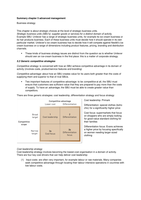
There are three generic strategies: cost leadership, differentiation strategy and focus strategy
Cost leadership: Primark
Differentiation: special clothes (boho
chic) for a significantly higher price
Cost focus: supermarkets that focus
on shoppers who are simply looking
for good-value standard clothing for
their families
Differentiation focus: Evans achieves
a higher price by focusing specifically
on women needing larger-sized
clothing
Cost leadership strategy
Cost-leadership strategy involves becoming the lowest-cost organisation in a domain of activity.
There are four key cost drivers that can help deliver cost leadership:
(1) Input costs: are often very important, for example labour or raw materials. Many companies
seek competitive advantage through locating their labour-intensive operations in countries with
low labour costs.
Business strategy
This chapter is about strategic choices at the level of strategic business units.
Strategic business units (SBU’s): supplier goods or services for a distinct domain of activity.
Example SBU: Unilever has a range of strategic business units, for example its ice cream business or
its hair products business. Each of these business units must decide how it should operate in its own
particular market. Unilever’s ice cream business has to decide how it will compete against Nestlé’s ice
cream business on a range of dimensions including product features, pricing, branding and distribution
channels.
These kinds of business strategy issues are distinct from the question as to whether Unilever
should own an ice-cream business in the first place: this is a matter of corporate strategy.
5.2 Generic competitive strategies
Competitive strategy: is concerned with how an SBU achieve competitive advantage in its domain of
activity (involves costs, product/service features and branding)
Competitive advantage: about how an SBU creates value for its users both greater than the costs of
supplying them and superior to that of rival SBUs.
Two important features of competitive advantage: to be competitive at all, the SBU must
ensure that customers see sufficient value that they are prepared to pay more than the costs
of supply. To have an advantage, the SBU must be able to create greater value than
competitors.
There are three generic strategies: cost leadership, differentiation strategy and focus strategy
Cost leadership: Primark
Differentiation: special clothes (boho
chic) for a significantly higher price
Cost focus: supermarkets that focus
on shoppers who are simply looking
for good-value standard clothing for
their families
Differentiation focus: Evans achieves
a higher price by focusing specifically
on women needing larger-sized
clothing
Cost leadership strategy
Cost-leadership strategy involves becoming the lowest-cost organisation in a domain of activity.
There are four key cost drivers that can help deliver cost leadership:
(1) Input costs: are often very important, for example labour or raw materials. Many companies
seek competitive advantage through locating their labour-intensive operations in countries with
low labour costs.