
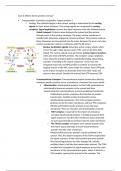
Case 6: Where do the proteins end up?
Transportation of proteins (organelles, helper proteins, )
o Sorting: The synthesis begins in the cytosol, sorting is determined by the sorting
signals on their amino sequence. The sorting signals are recognized by sorting
receptors. Signal peptidases removes the signal sequence from the finished protein.
- Gated transport: Proteins move between the cytosol and the nucleus
through pores in the nuclear envelope. The outer nuclear membrane is
studded with ribosomes engaged in protein synthesis. The proteins made on
these ribosomes are transported into the space between the inner and outer
nuclear membranes, which is continuous with the ER lumen
Nuclear localization signals determine active nuclear import which
occurs through a large aqueous pore, NPC, and can be done fully
folded. The nuclear signals must be bind by nuclear import receptors,
which also bind with NPC proteins. The receptor–cargo complexes
move along the transport path by repeatedly binding, dissociating,
and then re-binding to FG-repeat sequences. In this way, the
complexes hop from one NPC protein to another to traverse the
tangled interior of the NPC. Once inside the nucleus, Ran-GTP binds
to the import receptors to dissociate them from their cargo and
return to the cytosol. Outside the nucleus Ran-GTP becomes GDP
- Transmembrane transport: Transmembrane protein translocators directly
transport specific proteins across a membrane, therefore they must unfold.
Mitochondria: Mitochondrial proteins are first fully synthesized as
mitochondrial precursor proteins in the cytosol and then
translocated into mitochondria by a post-translational mechanism
Multisubunit protein complexes that function as protein
translocators mediate protein translocation across
mitochondrial membranes. The TOM complex transfers
proteins across the outer membrane, and two TIM complexes
(TIM23 and TIM22) transfer proteins across the inner
membrane. They are receptors and translocation channels.
o TOM complex is required for the import of all nucleus-
encoded mitochondrial proteins. It initially transports their
signal sequences into the inter-membrane space and helps
to insert transmembrane proteins into the outer membrane.
o The TIM23 complex transports some soluble proteins into
the matrix space and helps to insert transmembrane
proteins into the inner membrane.
Mitochondrial precursor proteins remain unfolded in the
cytosol. First, the import receptors of the TOM complex bind
the signal sequence of the mitochondrial precursor protein.
The interacting proteins are then stripped off, and the
unfolded chain is fed into the translocation channel. The TOM
complex first transports the signal sequence across the outer
membrane to the intermembrane space, where it binds to a
TIM complex, opening the channel in the complex. The
, polypeptide chain then either enters the matrix space or
inserts into the inner membrane.
Stop-transfer sequence prevents from further translocation
into the inner membrane.
Peroxisomes: When cytosolic proteins attach to signal sequences,
they are imported, folded, in peroxisomes, by peroxins. Peroxin Pex-
5 has the same function as Pan-GTP
Endoplasmic reticulum: In co-translational transport, the ribosome
that is synthesizing the protein is attached directly to the ER
membrane, enabling one end of the protein to be translocated into
the ER while the rest of the polypeptide
chain is being assembled. These
proteins are of two types:
transmembrane proteins, which are
only partly translocated across the ER
membrane and become embedded in
it, and water-soluble proteins, which
are fully translocated across the ER
membrane and are released into the ER
lumen. Some of the transmembrane
proteins function in the ER, but many are destined to reside in the
plasma membrane or the membrane of another organelle. The
water-soluble proteins are destined either for secretion or for
residence in the lumen of an organelle
All of the proteins are directed to the ER membrane via the ER signal
sequence, which follows the signal recognition particle, SRP, and
binds to the SRP receptor in the membrane. The group than moves
to the protein translocator and the SRP and receptor are removed.
The signal sequence gets removed by signal peptidase once in the
membrane
o Multipass transmembrane proteins: PP chain passes
through bilayer repeatedly due to one or more start-stop
alternating sequences
o Cis maturation model:
- Vesicular transport: Membrane enclosed transport, mostly from one
membrane to the other
o Budding: The cytoplasmic surfaces of transport vesicles are
coated
with proteins, and
it appears to be the
assembly of these
protein coats that
drives vesicle
budding by
distorting
membrane
conformation. It is the adaptor proteins that are involved in
selecting the specific molecules to be incorporated into the
Transportation of proteins (organelles, helper proteins, )
o Sorting: The synthesis begins in the cytosol, sorting is determined by the sorting
signals on their amino sequence. The sorting signals are recognized by sorting
receptors. Signal peptidases removes the signal sequence from the finished protein.
- Gated transport: Proteins move between the cytosol and the nucleus
through pores in the nuclear envelope. The outer nuclear membrane is
studded with ribosomes engaged in protein synthesis. The proteins made on
these ribosomes are transported into the space between the inner and outer
nuclear membranes, which is continuous with the ER lumen
Nuclear localization signals determine active nuclear import which
occurs through a large aqueous pore, NPC, and can be done fully
folded. The nuclear signals must be bind by nuclear import receptors,
which also bind with NPC proteins. The receptor–cargo complexes
move along the transport path by repeatedly binding, dissociating,
and then re-binding to FG-repeat sequences. In this way, the
complexes hop from one NPC protein to another to traverse the
tangled interior of the NPC. Once inside the nucleus, Ran-GTP binds
to the import receptors to dissociate them from their cargo and
return to the cytosol. Outside the nucleus Ran-GTP becomes GDP
- Transmembrane transport: Transmembrane protein translocators directly
transport specific proteins across a membrane, therefore they must unfold.
Mitochondria: Mitochondrial proteins are first fully synthesized as
mitochondrial precursor proteins in the cytosol and then
translocated into mitochondria by a post-translational mechanism
Multisubunit protein complexes that function as protein
translocators mediate protein translocation across
mitochondrial membranes. The TOM complex transfers
proteins across the outer membrane, and two TIM complexes
(TIM23 and TIM22) transfer proteins across the inner
membrane. They are receptors and translocation channels.
o TOM complex is required for the import of all nucleus-
encoded mitochondrial proteins. It initially transports their
signal sequences into the inter-membrane space and helps
to insert transmembrane proteins into the outer membrane.
o The TIM23 complex transports some soluble proteins into
the matrix space and helps to insert transmembrane
proteins into the inner membrane.
Mitochondrial precursor proteins remain unfolded in the
cytosol. First, the import receptors of the TOM complex bind
the signal sequence of the mitochondrial precursor protein.
The interacting proteins are then stripped off, and the
unfolded chain is fed into the translocation channel. The TOM
complex first transports the signal sequence across the outer
membrane to the intermembrane space, where it binds to a
TIM complex, opening the channel in the complex. The
, polypeptide chain then either enters the matrix space or
inserts into the inner membrane.
Stop-transfer sequence prevents from further translocation
into the inner membrane.
Peroxisomes: When cytosolic proteins attach to signal sequences,
they are imported, folded, in peroxisomes, by peroxins. Peroxin Pex-
5 has the same function as Pan-GTP
Endoplasmic reticulum: In co-translational transport, the ribosome
that is synthesizing the protein is attached directly to the ER
membrane, enabling one end of the protein to be translocated into
the ER while the rest of the polypeptide
chain is being assembled. These
proteins are of two types:
transmembrane proteins, which are
only partly translocated across the ER
membrane and become embedded in
it, and water-soluble proteins, which
are fully translocated across the ER
membrane and are released into the ER
lumen. Some of the transmembrane
proteins function in the ER, but many are destined to reside in the
plasma membrane or the membrane of another organelle. The
water-soluble proteins are destined either for secretion or for
residence in the lumen of an organelle
All of the proteins are directed to the ER membrane via the ER signal
sequence, which follows the signal recognition particle, SRP, and
binds to the SRP receptor in the membrane. The group than moves
to the protein translocator and the SRP and receptor are removed.
The signal sequence gets removed by signal peptidase once in the
membrane
o Multipass transmembrane proteins: PP chain passes
through bilayer repeatedly due to one or more start-stop
alternating sequences
o Cis maturation model:
- Vesicular transport: Membrane enclosed transport, mostly from one
membrane to the other
o Budding: The cytoplasmic surfaces of transport vesicles are
coated
with proteins, and
it appears to be the
assembly of these
protein coats that
drives vesicle
budding by
distorting
membrane
conformation. It is the adaptor proteins that are involved in
selecting the specific molecules to be incorporated into the



