1JK00
Management van Menselijk Gedrag in Organisaties
Eindhoven, June 17, 2016
Summary
Organizational
Behavior
for the MMGO course 2015-2016
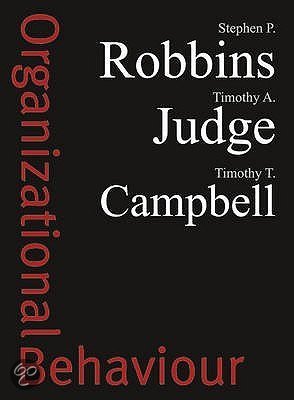
Title: Organizational Behaviour
Authors: Stephen P. Robbins
Timothy A. Judge
Timothy T. Campbell
Edition European Edition
,Organizational Behaviour What is organizational behaviour?
1 What is organizational behaviour?
1.1 Demonstrate the importance of interpersonal skills in the workplace
The importance of interpersonal skills has become more recognized since the 80’s. Managers
with good interpersonal skills are likely to make the workplace more pleasant, which makes
it easier to hire and keep qualified employees. While technical skills are necessary, they are
not enough to succeed in management.
1.2 Describe the manager’s functions, roles and skills
Managers get things done through other people; they make decisions, allocate resources and
direct the activities of others to attain a goal. Managers work in organizations, consciously
coordinated social units composed of multiple people that function to achieve a common (set
of) goal(s). In non-profit organizations, managers are sometimes called administrators.
According to Henri Fayol, all managers perform five management functions: planning, orga-
nizing, commanding, coordinating and controlling. Today, we have four: planning, organiz-
ing, leading and controlling.
Managers perform ten roles that can be divided into three kinds of roles:
• interpersonal roles
– figurehead: symbolic head, performing routine duties of legal/social nature
– leader: responsible for motivation and direction of employees
– liaison: maintaining a network of outside contacts who provide favors and infor-
mation
• informational roles
– monitor: serves as never center of internal and external information
– disseminator: transmits outside information to the inside of the company
– spokesperson: transmits inside information to the outer world
• decisional roles
– entrepreneur: searches for opportunities
– disturbance handler: responsible for corrective actions
– resource allocator: approves significant organizational decisions
– negotiator: representative of the organization at major negotiations
Managers need technical skills, the ability to apply knowledge of an expertise; human skills,
the ability to work with, understand and motivate other people (individually and in groups);
and conceptual skills, the mental ability to analyze and diagnose complex situations.
1.3 Define organizational behaviour
Organizational behavior is a field of study that investigates the impacts that individuals,
groups and structure have on behavior within organizations, for the purpose of applying
such knowledge toward improving an organization’s effectiveness.
1
,Organizational Behaviour What is organizational behaviour?
1.4 Show the value to OB of systematic study
We have all grown up “reading” people’s behavior. However, these intuitive readings can be
incorrect, thus in order to improve your reading abilities, you can supplement those intuitive
readings with a more systematic approach. The underlying though of the systematic ap-
proach is that behavior is not random, but based on fundamental consistencies. Systematic
study is looking at relationships, attempting to attribute causes and effects and drawing
conclusions based on scientific evidence.
An approach that complements systematic study is evidence-based management (EBM),
which is basing managerial decisions on the best available scientific evidence.
1.5 Identify the major behavioural science disciplines that contribute to
OB
Psychology is the science that seeks to measure, explain and influence behavior of humans
and animals. Early influence of psychologist was often about boredom and other factors rel-
evant to the working environment. Nowadays, psychologists are also focusing on perception,
personality, training and many other aspects.
Social psychology blends concepts form psychology and sociology, although it is generally
a branch of psychology. Social psychology focusses on the influence people have on each
other.
Sociology is the study of people in relation to their social environment or culture. The in-
fluence of sociology in management is visible in the study of group behavior in organizations.
Anthropology is the study of societies to learn about human beings and their activities.
It helps us to understand differences between organizations.
1.6 Demonstrate why there are few absolutes in OB
Human beings are complex, and thus there are no absolute rules in organizational behavior
studies. We cannot say for sure that x leads to y; however it is possible to say that x leads
to y under condition z. This is the contingency variable, a variable that moderates the
relationship between two or more variables.
1.7 Identify the challenges and opportunities managers have in applying
OB concepts
• responding to globalization
• managing workforce diversity
• improving quality and productivity
• improving customer service
• improving people skills
• stimulating innovation and change
• coping with ’temporariness’
2
, Organizational Behaviour What is organizational behaviour?
• working in networked organizations
• helping employees balance work-life conflicts
• creating a positive work environment
• improving ethical behaviour
1.8 Compare the three levels of analysis in this book’s OB model
Dependent variables:
• productivity
• absenteeism
• turnover
• deviant workplace behaviour
• organizational citizenship behaviour
• job satisfaction
Independent Variables:
• individual-level variables
• group-level variables
• organization system-lever variables
2 Foundations of individual behaviour
2.1 Contrast the two types of ability
Ability is an individual’s capacity to perform the various tasks in a job. There are two types
of ability: intellectual ability and physical ability.
Physical abilities are the capacity to do tasks that demand stamina, dexterity, strength
and similar characteristics.
2.2 Define intellectual ability and demonstrate its relevance to OB
Intellectual abilities are abilities needed to perform mental activities; thinking, reasoning
and problem solving. Although intelligence has different dimensions, these dimensions are
correlated, so someone with a high score on one dimension would most likely also have a high
score on another dimension. The general mental ability is an overall factor of intelligence,
as suggested by the positive correlations among specific intellectual ability dimensions. Jobs
differ immensely in the requirements regarding intellectual ability.
3
Management van Menselijk Gedrag in Organisaties
Eindhoven, June 17, 2016
Summary
Organizational
Behavior
for the MMGO course 2015-2016
Title: Organizational Behaviour
Authors: Stephen P. Robbins
Timothy A. Judge
Timothy T. Campbell
Edition European Edition
,Organizational Behaviour What is organizational behaviour?
1 What is organizational behaviour?
1.1 Demonstrate the importance of interpersonal skills in the workplace
The importance of interpersonal skills has become more recognized since the 80’s. Managers
with good interpersonal skills are likely to make the workplace more pleasant, which makes
it easier to hire and keep qualified employees. While technical skills are necessary, they are
not enough to succeed in management.
1.2 Describe the manager’s functions, roles and skills
Managers get things done through other people; they make decisions, allocate resources and
direct the activities of others to attain a goal. Managers work in organizations, consciously
coordinated social units composed of multiple people that function to achieve a common (set
of) goal(s). In non-profit organizations, managers are sometimes called administrators.
According to Henri Fayol, all managers perform five management functions: planning, orga-
nizing, commanding, coordinating and controlling. Today, we have four: planning, organiz-
ing, leading and controlling.
Managers perform ten roles that can be divided into three kinds of roles:
• interpersonal roles
– figurehead: symbolic head, performing routine duties of legal/social nature
– leader: responsible for motivation and direction of employees
– liaison: maintaining a network of outside contacts who provide favors and infor-
mation
• informational roles
– monitor: serves as never center of internal and external information
– disseminator: transmits outside information to the inside of the company
– spokesperson: transmits inside information to the outer world
• decisional roles
– entrepreneur: searches for opportunities
– disturbance handler: responsible for corrective actions
– resource allocator: approves significant organizational decisions
– negotiator: representative of the organization at major negotiations
Managers need technical skills, the ability to apply knowledge of an expertise; human skills,
the ability to work with, understand and motivate other people (individually and in groups);
and conceptual skills, the mental ability to analyze and diagnose complex situations.
1.3 Define organizational behaviour
Organizational behavior is a field of study that investigates the impacts that individuals,
groups and structure have on behavior within organizations, for the purpose of applying
such knowledge toward improving an organization’s effectiveness.
1
,Organizational Behaviour What is organizational behaviour?
1.4 Show the value to OB of systematic study
We have all grown up “reading” people’s behavior. However, these intuitive readings can be
incorrect, thus in order to improve your reading abilities, you can supplement those intuitive
readings with a more systematic approach. The underlying though of the systematic ap-
proach is that behavior is not random, but based on fundamental consistencies. Systematic
study is looking at relationships, attempting to attribute causes and effects and drawing
conclusions based on scientific evidence.
An approach that complements systematic study is evidence-based management (EBM),
which is basing managerial decisions on the best available scientific evidence.
1.5 Identify the major behavioural science disciplines that contribute to
OB
Psychology is the science that seeks to measure, explain and influence behavior of humans
and animals. Early influence of psychologist was often about boredom and other factors rel-
evant to the working environment. Nowadays, psychologists are also focusing on perception,
personality, training and many other aspects.
Social psychology blends concepts form psychology and sociology, although it is generally
a branch of psychology. Social psychology focusses on the influence people have on each
other.
Sociology is the study of people in relation to their social environment or culture. The in-
fluence of sociology in management is visible in the study of group behavior in organizations.
Anthropology is the study of societies to learn about human beings and their activities.
It helps us to understand differences between organizations.
1.6 Demonstrate why there are few absolutes in OB
Human beings are complex, and thus there are no absolute rules in organizational behavior
studies. We cannot say for sure that x leads to y; however it is possible to say that x leads
to y under condition z. This is the contingency variable, a variable that moderates the
relationship between two or more variables.
1.7 Identify the challenges and opportunities managers have in applying
OB concepts
• responding to globalization
• managing workforce diversity
• improving quality and productivity
• improving customer service
• improving people skills
• stimulating innovation and change
• coping with ’temporariness’
2
, Organizational Behaviour What is organizational behaviour?
• working in networked organizations
• helping employees balance work-life conflicts
• creating a positive work environment
• improving ethical behaviour
1.8 Compare the three levels of analysis in this book’s OB model
Dependent variables:
• productivity
• absenteeism
• turnover
• deviant workplace behaviour
• organizational citizenship behaviour
• job satisfaction
Independent Variables:
• individual-level variables
• group-level variables
• organization system-lever variables
2 Foundations of individual behaviour
2.1 Contrast the two types of ability
Ability is an individual’s capacity to perform the various tasks in a job. There are two types
of ability: intellectual ability and physical ability.
Physical abilities are the capacity to do tasks that demand stamina, dexterity, strength
and similar characteristics.
2.2 Define intellectual ability and demonstrate its relevance to OB
Intellectual abilities are abilities needed to perform mental activities; thinking, reasoning
and problem solving. Although intelligence has different dimensions, these dimensions are
correlated, so someone with a high score on one dimension would most likely also have a high
score on another dimension. The general mental ability is an overall factor of intelligence,
as suggested by the positive correlations among specific intellectual ability dimensions. Jobs
differ immensely in the requirements regarding intellectual ability.
3