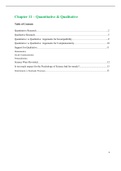
Chapter 10 – Is Psychology a Science?
Table of Contents
Arguments in Favor of the Scientific Status…………………………………………………… 2
Demarcation Criteria……………………………………………………………………………… 2
Arguments Against the Scientific Status………………………………………………………...3
Hermeneutics…………………………………………………………………………………….4
Critical Psychology…………………………………………………………………………………6
1
, Arguments in Favor of Psychology’s Scientific Status
Psychology is promoted as an academic discipline on the basis of:
• Respectful past: “long past” it is a continuation of the old and respectful tradition of
mental and moral philosophy.
• Scientific method: “sound method” it uses the scientific method, so successful in other
disciplines (e.g., natural sciences).
Psychology curriculum
Because of the emphasis on the 2 messages above, ‘history of psychology’ and ‘research
methods’ were major components of the curriculum.
Scientific method as demarcation: science is defined by its method
what distinguishes science from non-science is the method (how) rather than its content (what).
Because of this emphasis, psychology invested in developing research designs and analysis
techniques at the expense of theory building (methodolatry: bias toward methodological rigor
rather than theory formation). One reason for this has to do with the aftermath of positivism:
psychologists were trying too hard to be good scientists.
Freshen up the core advice by positivists:
- from fact to knowledge on the basis of observation, induction, and verification
- exclusion of non-observables, unless operationally defined
- theories describe observed facts (ideally in the form of a mathematical law)
Demarcation Criteria
Psychologists keep using the scientific method because so far it has been working.
The scientific method stresses:
1. Systematicity and cumulativeness of knowledge: knowledge builds on existing
knowledge; new findings must be coherent with existing information. Systematicity
refers to the collection of observations.
2. Well-defined methods: information is gathered in line with agreed methods that are
clearly outlined (described in such detail that they can be replicated).
3. Clarity: findings are stated in such a way that they are interpreted in the same way by
different readers.
4. Predictability: must-have ability to predict what will happen (under well-controlled
circumstances) rather than just explaining events post hoc.
2
Table of Contents
Arguments in Favor of the Scientific Status…………………………………………………… 2
Demarcation Criteria……………………………………………………………………………… 2
Arguments Against the Scientific Status………………………………………………………...3
Hermeneutics…………………………………………………………………………………….4
Critical Psychology…………………………………………………………………………………6
1
, Arguments in Favor of Psychology’s Scientific Status
Psychology is promoted as an academic discipline on the basis of:
• Respectful past: “long past” it is a continuation of the old and respectful tradition of
mental and moral philosophy.
• Scientific method: “sound method” it uses the scientific method, so successful in other
disciplines (e.g., natural sciences).
Psychology curriculum
Because of the emphasis on the 2 messages above, ‘history of psychology’ and ‘research
methods’ were major components of the curriculum.
Scientific method as demarcation: science is defined by its method
what distinguishes science from non-science is the method (how) rather than its content (what).
Because of this emphasis, psychology invested in developing research designs and analysis
techniques at the expense of theory building (methodolatry: bias toward methodological rigor
rather than theory formation). One reason for this has to do with the aftermath of positivism:
psychologists were trying too hard to be good scientists.
Freshen up the core advice by positivists:
- from fact to knowledge on the basis of observation, induction, and verification
- exclusion of non-observables, unless operationally defined
- theories describe observed facts (ideally in the form of a mathematical law)
Demarcation Criteria
Psychologists keep using the scientific method because so far it has been working.
The scientific method stresses:
1. Systematicity and cumulativeness of knowledge: knowledge builds on existing
knowledge; new findings must be coherent with existing information. Systematicity
refers to the collection of observations.
2. Well-defined methods: information is gathered in line with agreed methods that are
clearly outlined (described in such detail that they can be replicated).
3. Clarity: findings are stated in such a way that they are interpreted in the same way by
different readers.
4. Predictability: must-have ability to predict what will happen (under well-controlled
circumstances) rather than just explaining events post hoc.
2