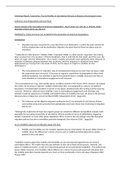
Chapter 9 – Philosophy of Science
Table of Contents
Back in Time 2
Attempts to Demarcation 4
Attempt 1: Logical Positivism 4
Attempt 2: Falsificationism 5
Attempt 3: Relativism 7
Lakatos 8
Science Wars: Science vs Postmodernism 9
Pragmatism 10
Lecture Notes 12
Wittgenstein 12
Logical Positivism 14
the structure of a scientific theory 16
Problems with Logical Positivism 17
Appendix I: Popper 19
Appendix II: Kuhn 21
1
, BACK IN TIME – Pre 20th Century
Aristotle’s Correspondence theory of truth: a statement is true when it corresponds to reality.
Assumption that a physical reality exists and can be discovered by the human mind.
Pyrrho’s Skepticism: view that does not deny the existence of a physical reality but denies that
humans can have reliable knowledge of it.
Augustine claims that knowledge comes from God’s revelations.
Galileo’s thought experiments: they are successful because easily relatable, in that they depend
on reason. He claims that true knowledge is demonstrated knowledge.
Bacon’s induction: starting point is observation.
From there you collect a large number of facts and put them into tables for understanding. You use the ‘Essence and Presence’
table (1st) to find all instances of a phenomenon. Then you use the ‘Deviation or Absence’ table (2nd) to find all the matching
circumstances for presence where the phenomenon is absent. By doing so, you find which instances are critical for the
phenomenon. Then you use the ‘Degrees of Comparison’ table (3rd) to find the instances in which the phenomenon is present in
different degrees.
This examination, carried out through careful tabulation and induction, leads to true and
scientific conclusions.
Newton: theory and observation have ambivalent roles. At some point, he shifts his preference
from deduction to induction. He uses deduction for the laws of physics, whereas he uses
induction for the study of the diffraction of light. For him, science is about mathematical
descriptions of observations (even if the variables are ill-defined). Newton sees science as the
application of deduction (mathematics), later demonstrated through observation and experiment.
Deduction Induction
• From premises (known statements) to conclusions • From convergent observations to likely
• Conclusion is guaranteed to be true if the premises conclusions (probabilistic reasoning)
are true and if one follows the rules of logic • Conclusions are not necessarily true (often
• In the form of a syllogism (logical argument made educated guesses)
up of two premises and a conclusion) • Generalization from a few observations to a
• Rationalism conclusion
• Theory testing (formulation of hypotheses on the • Detection of correlations & causal inference
basis of existing theories) • Empiricism
• To make predictions about specific instances on • Theory generation (workout explanations for
the basis of general information observed phenomena)
2
, Huygens defends induction:
• Verification of principles from their effects with a degree of probability (more
observations, more accuracy)
• Truth is guaranteed when the principles allow researchers to make new predictions and
verify them
Leibniz compares probabilistic reasoning to legal practice: the aim is not absolute truth but ‘truth
beyond reasonable doubt’.
Gradually, natural philosophers start to argue that induction can lead to conclusions as probable
as truth, when facts are collected in large numbers and without bias.
Probability
Two definitions:
1. Objective
Mathematic definition, easy to calculate when the underlying method is known. However, there is the inverse
probability problem: determining the probability of a theory given a set of observations. Bayes solves this with his
theorem.
2. Subjective
the probability of a scientific theory depends on the researcher’s degree of belief in the theory (i.e., how certain the
scientist feels about it).
Herschel says that scientific reasoning was becoming more abstract and observation-
independent, which was a good thing if done carefully. He also says that the co-existence of
competing theories is good since it requires a choice to be made on the basis of which hypothesis
best accounts for the findings.
Whewell says that observation and theory influence each other (deduction leads to necessary
truths, and induction results in truths from experience). He calls this distinction the fundamental
antithesis of philosophy (thoughts vs things, theory vs fact) and claims it is wrong since they
cannot be separated.
Positivism dominates by the end of the 19th century: they idealize science but received a lot of
criticism, which they swept under the carpet, leading them to lose credibility.
To sum up: the rise of the scientific approach can be seen as a shift in balance from
deduction to induction. Before, deduction was the only reasoning thought to lead to the truth
(Plato & Aristotle).
3
Table of Contents
Back in Time 2
Attempts to Demarcation 4
Attempt 1: Logical Positivism 4
Attempt 2: Falsificationism 5
Attempt 3: Relativism 7
Lakatos 8
Science Wars: Science vs Postmodernism 9
Pragmatism 10
Lecture Notes 12
Wittgenstein 12
Logical Positivism 14
the structure of a scientific theory 16
Problems with Logical Positivism 17
Appendix I: Popper 19
Appendix II: Kuhn 21
1
, BACK IN TIME – Pre 20th Century
Aristotle’s Correspondence theory of truth: a statement is true when it corresponds to reality.
Assumption that a physical reality exists and can be discovered by the human mind.
Pyrrho’s Skepticism: view that does not deny the existence of a physical reality but denies that
humans can have reliable knowledge of it.
Augustine claims that knowledge comes from God’s revelations.
Galileo’s thought experiments: they are successful because easily relatable, in that they depend
on reason. He claims that true knowledge is demonstrated knowledge.
Bacon’s induction: starting point is observation.
From there you collect a large number of facts and put them into tables for understanding. You use the ‘Essence and Presence’
table (1st) to find all instances of a phenomenon. Then you use the ‘Deviation or Absence’ table (2nd) to find all the matching
circumstances for presence where the phenomenon is absent. By doing so, you find which instances are critical for the
phenomenon. Then you use the ‘Degrees of Comparison’ table (3rd) to find the instances in which the phenomenon is present in
different degrees.
This examination, carried out through careful tabulation and induction, leads to true and
scientific conclusions.
Newton: theory and observation have ambivalent roles. At some point, he shifts his preference
from deduction to induction. He uses deduction for the laws of physics, whereas he uses
induction for the study of the diffraction of light. For him, science is about mathematical
descriptions of observations (even if the variables are ill-defined). Newton sees science as the
application of deduction (mathematics), later demonstrated through observation and experiment.
Deduction Induction
• From premises (known statements) to conclusions • From convergent observations to likely
• Conclusion is guaranteed to be true if the premises conclusions (probabilistic reasoning)
are true and if one follows the rules of logic • Conclusions are not necessarily true (often
• In the form of a syllogism (logical argument made educated guesses)
up of two premises and a conclusion) • Generalization from a few observations to a
• Rationalism conclusion
• Theory testing (formulation of hypotheses on the • Detection of correlations & causal inference
basis of existing theories) • Empiricism
• To make predictions about specific instances on • Theory generation (workout explanations for
the basis of general information observed phenomena)
2
, Huygens defends induction:
• Verification of principles from their effects with a degree of probability (more
observations, more accuracy)
• Truth is guaranteed when the principles allow researchers to make new predictions and
verify them
Leibniz compares probabilistic reasoning to legal practice: the aim is not absolute truth but ‘truth
beyond reasonable doubt’.
Gradually, natural philosophers start to argue that induction can lead to conclusions as probable
as truth, when facts are collected in large numbers and without bias.
Probability
Two definitions:
1. Objective
Mathematic definition, easy to calculate when the underlying method is known. However, there is the inverse
probability problem: determining the probability of a theory given a set of observations. Bayes solves this with his
theorem.
2. Subjective
the probability of a scientific theory depends on the researcher’s degree of belief in the theory (i.e., how certain the
scientist feels about it).
Herschel says that scientific reasoning was becoming more abstract and observation-
independent, which was a good thing if done carefully. He also says that the co-existence of
competing theories is good since it requires a choice to be made on the basis of which hypothesis
best accounts for the findings.
Whewell says that observation and theory influence each other (deduction leads to necessary
truths, and induction results in truths from experience). He calls this distinction the fundamental
antithesis of philosophy (thoughts vs things, theory vs fact) and claims it is wrong since they
cannot be separated.
Positivism dominates by the end of the 19th century: they idealize science but received a lot of
criticism, which they swept under the carpet, leading them to lose credibility.
To sum up: the rise of the scientific approach can be seen as a shift in balance from
deduction to induction. Before, deduction was the only reasoning thought to lead to the truth
(Plato & Aristotle).
3