

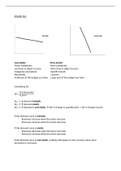
Elasticity:
Elastic Inelastic
Less elastic: More elastic:
Fewer substitutes. More substitutes
Less time to adjust to price. More time to adjust to price
Categories of products. Specific brands
Necessities. Luxuries
Small part of the budget you have. Large part of the budget you have
Calculating Ed:
% Q demanded
Ed =
% price
Eq < 1 demand inelastic
Eq > 1 demand elastic
Eq = 1 demand is unit elastic the % change in quantity dem. = the % change in price
If the demand curve is inelastic:
- Revenues increase when the prices increase
- Revenues increase when the prices decrease
If the demand curve is elastic:
- Revenues decrease when the prices increase
- Revenues increase when the prices decrease
If the demand curve is unit elastic, nothing will happen to the revenues when price
decreases or increases.
, Less elastic supply: More elastic supply:
Difficult to increase production. Easy to increase production at constant unit cost
at constant unit cost
Large share of the market for inputs. Small share of market input
Global supply Local supply
Short run Long run
Calculating the Est:
% supplied
Est =
% price
Chapter 6: Taxes and subsidies
Tax = price paid by buyers – price received by sellers
When demand is more elastic than supply, demanders pay less of the tax than sellers
This is because an elastic demand curve means that demanders have lots of substitutes to
choose from. If taxes increase for one product, demanders will switch to another substitute
sellers will end up paying most of the tax
A commodity tax raises revenue and creates deadweight loss. It reduces the gains from
trade.
Price Price
Ptax
Ptax
Tax rev. DWL Tax rev. DWL
S S
D
Q Q
D
DWL from taxation DWL from taxation with inelastic
with elastic demand curve is larger Demand is smaller
Subsidy = price received by sellers – price paid by buyers
Elastic Inelastic
Less elastic: More elastic:
Fewer substitutes. More substitutes
Less time to adjust to price. More time to adjust to price
Categories of products. Specific brands
Necessities. Luxuries
Small part of the budget you have. Large part of the budget you have
Calculating Ed:
% Q demanded
Ed =
% price
Eq < 1 demand inelastic
Eq > 1 demand elastic
Eq = 1 demand is unit elastic the % change in quantity dem. = the % change in price
If the demand curve is inelastic:
- Revenues increase when the prices increase
- Revenues increase when the prices decrease
If the demand curve is elastic:
- Revenues decrease when the prices increase
- Revenues increase when the prices decrease
If the demand curve is unit elastic, nothing will happen to the revenues when price
decreases or increases.
, Less elastic supply: More elastic supply:
Difficult to increase production. Easy to increase production at constant unit cost
at constant unit cost
Large share of the market for inputs. Small share of market input
Global supply Local supply
Short run Long run
Calculating the Est:
% supplied
Est =
% price
Chapter 6: Taxes and subsidies
Tax = price paid by buyers – price received by sellers
When demand is more elastic than supply, demanders pay less of the tax than sellers
This is because an elastic demand curve means that demanders have lots of substitutes to
choose from. If taxes increase for one product, demanders will switch to another substitute
sellers will end up paying most of the tax
A commodity tax raises revenue and creates deadweight loss. It reduces the gains from
trade.
Price Price
Ptax
Ptax
Tax rev. DWL Tax rev. DWL
S S
D
Q Q
D
DWL from taxation DWL from taxation with inelastic
with elastic demand curve is larger Demand is smaller
Subsidy = price received by sellers – price paid by buyers



