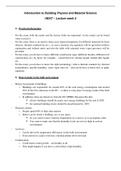
Introduction to Building Physics and Material Science
HEAT – Lecture week 5
1) Practical information
- For the exam, both the reader and the lecture slides are important! (in the reader can be found
some exercises)
- For the exam, there is no need to learn exact material properties for different materials by heart
(density, thermal conductivity etc.), or exact constants; the equations will be provided (without
explanation and without units) and also the table with saturated water vapor pressures will be
provided
- For the exam, you do have to know different construction types (different facades, different roof
constructions etc.) by heart: for example – warm/cold roof, climate façade, double-skin façade
etc.
- For the exam, you do have to know the right terminology: what is thermal conductivity, thermal
transmittance, specific humidity, water vapor ratio etc. ; and you do have to know how to apply
equations
2) Heat transfer in the built environment
- Energy losses/gains in buildings
o Buildings are responsible for around 40% of the total energy consumption and around
36% of the CO2 emissions in the EU – so there is a big share of energy inside of the built
environment
o In addition, there are directives from the EU (EPBD) that prescribe that:
▪ all new buildings should be nearly zero-energy buildings by the end of 2020
▪ the national building stocks should be decarbonized by 2050
- Thermal comfort
o People spend 90% of their time indoors
o Indoor can be inside a building, car, or any space
▪ So you want to know what the temperature in a room is or in an airplane cabin
▪ You want to make sure that the humidity levels are not too high in such an
environment
- Air flows
o Can be driven by temperature differences in the built environment
o Every person in a glass room has a thermal plume above his head
- Condensation
o Could lead to mold growth – not healthy at all
o That might happen if you have a cold surface, high humidity
, 3) Heat flows within a building
a. Transmission heat
- This occurs to the building’s façades, floors or roof etc.
o So if you have a closed part, there will be heat
loss through that part
b. Ventilation
- You can ventilate with cold outside air, and there will
be heat loss because you introduced cold air into your
enclosure and also you get rid of warm air
c. Solar irradiance
- It can be beneficial, for example in winter because is free you can get and that can reduce
heating demand
- However, in summer it can be a problem if you have a lot of glass windows, solar radiation
will come in and will heat the inside environment and the indoor temperature becomes too high
d. Internal heat gain sources
- Every person emits heat, but also heat can come from light, from appliances etc.
It can be made a heat balance in a room based on the formula: Out = In
ᶲt + ᶲv = ᶲi + ᶲs + ᶲacc , for ᶿi ≥ ᶿe (if the indoor air temperature is higher than the outdoor)
ᶲt = heat loss by transmission [W] ᶲs = heat gain by solar radiation [W]
ᶲv = heat loss by ventilation [W] ᶲacc = heat accumulated (can be from concrete
ᶲi = heat gain by internal sources [W] wall/floor) [W]
Additionally, if we have a heating device in our room the formula becomes:
ᶲt + ᶲv = ᶲi + ᶲs + ᶲacc + ᶲ
ᶲ = heat gain by radiation [W]
In the end, these 6 components, determine the heating demand.
Use of heat balance:
- To calculate the heat capacity of a heating system (heat loss calculation): ᶲ measured in [W or
kW]
- To calculate the energy usage (energy loss calculation): ᶲ ∙ t = Q measured in [J or MJ], where
t – time
HEAT – Lecture week 5
1) Practical information
- For the exam, both the reader and the lecture slides are important! (in the reader can be found
some exercises)
- For the exam, there is no need to learn exact material properties for different materials by heart
(density, thermal conductivity etc.), or exact constants; the equations will be provided (without
explanation and without units) and also the table with saturated water vapor pressures will be
provided
- For the exam, you do have to know different construction types (different facades, different roof
constructions etc.) by heart: for example – warm/cold roof, climate façade, double-skin façade
etc.
- For the exam, you do have to know the right terminology: what is thermal conductivity, thermal
transmittance, specific humidity, water vapor ratio etc. ; and you do have to know how to apply
equations
2) Heat transfer in the built environment
- Energy losses/gains in buildings
o Buildings are responsible for around 40% of the total energy consumption and around
36% of the CO2 emissions in the EU – so there is a big share of energy inside of the built
environment
o In addition, there are directives from the EU (EPBD) that prescribe that:
▪ all new buildings should be nearly zero-energy buildings by the end of 2020
▪ the national building stocks should be decarbonized by 2050
- Thermal comfort
o People spend 90% of their time indoors
o Indoor can be inside a building, car, or any space
▪ So you want to know what the temperature in a room is or in an airplane cabin
▪ You want to make sure that the humidity levels are not too high in such an
environment
- Air flows
o Can be driven by temperature differences in the built environment
o Every person in a glass room has a thermal plume above his head
- Condensation
o Could lead to mold growth – not healthy at all
o That might happen if you have a cold surface, high humidity
, 3) Heat flows within a building
a. Transmission heat
- This occurs to the building’s façades, floors or roof etc.
o So if you have a closed part, there will be heat
loss through that part
b. Ventilation
- You can ventilate with cold outside air, and there will
be heat loss because you introduced cold air into your
enclosure and also you get rid of warm air
c. Solar irradiance
- It can be beneficial, for example in winter because is free you can get and that can reduce
heating demand
- However, in summer it can be a problem if you have a lot of glass windows, solar radiation
will come in and will heat the inside environment and the indoor temperature becomes too high
d. Internal heat gain sources
- Every person emits heat, but also heat can come from light, from appliances etc.
It can be made a heat balance in a room based on the formula: Out = In
ᶲt + ᶲv = ᶲi + ᶲs + ᶲacc , for ᶿi ≥ ᶿe (if the indoor air temperature is higher than the outdoor)
ᶲt = heat loss by transmission [W] ᶲs = heat gain by solar radiation [W]
ᶲv = heat loss by ventilation [W] ᶲacc = heat accumulated (can be from concrete
ᶲi = heat gain by internal sources [W] wall/floor) [W]
Additionally, if we have a heating device in our room the formula becomes:
ᶲt + ᶲv = ᶲi + ᶲs + ᶲacc + ᶲ
ᶲ = heat gain by radiation [W]
In the end, these 6 components, determine the heating demand.
Use of heat balance:
- To calculate the heat capacity of a heating system (heat loss calculation): ᶲ measured in [W or
kW]
- To calculate the energy usage (energy loss calculation): ᶲ ∙ t = Q measured in [J or MJ], where
t – time