Readings
Raymond Williams, Television, Technology and
Cultural Form
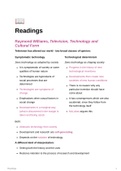
Television has altered our world - two broad classes of opinion:
Symptomatic technology Technological determinism
Sees technology as adopted by society Sees technology as shaping society
It is symptomatic of society or some Progress is the history of new
qualities of human nature technological inventions
Technologies are byproducts of Developments then create new
social processes that are societies of new human conditions
determined
There is no reason why any
Technologies are symptoms of particular invention should have
change come about
Emphasises other casual factors in It has consequences which are also
social change accidental, since they follow from
the technology itself
Developments in a marginal way
(what is discovered in the margin is McLuhan argues this
taken and being used)
Both:
Abstracts technology from society
Development and research are self-generating
Depends on the isolation of technology
A different kind of interpretation:
Seeing both the history and the uses
Restores intention to the process of research and development
Readings 1
, /different from technological determinism: Technology is developed with certain
purposes and practices already in mind
/different from symptomatic technology: These are seen as direct: known social
needs, purposes and practices to which the technology is not marginal but
central, it is not a byproduct
Social history of television as technology
Televisions development depended on a complex of inventions
New needs - new solutions
Industrial Revolution: urbanization, increased need caused by mobility and
extension of the scale of organisations
In different fields, systems of mobility and transfer in production and
communication were incentives and responses within a phase of general social
transformation
There was a crucial community of selected emphasis and intention in society
Communication systems were all foreseen - not in utopian but in technical ways
- before the crucial components of the developed systems had been discovered
and refined
Social history of the uses of television
Two phases:
Operational Broadcasting
Modern electric technology was A technology of varied messages to a
oriented to users of person to person, general public
operator to operative within established
specific structures
A technology of specific messages to
specific person
Predestinated by the technology
Examples: military system, commercial system
Challenging both Technical Determinism “predestined by the technology and
inevitable” as well as Symptomatic Technology, as television in its current cultural
form is based on “social decisions, in particular circumstances”
Readings 2
Raymond Williams, Television, Technology and
Cultural Form
Television has altered our world - two broad classes of opinion:
Symptomatic technology Technological determinism
Sees technology as adopted by society Sees technology as shaping society
It is symptomatic of society or some Progress is the history of new
qualities of human nature technological inventions
Technologies are byproducts of Developments then create new
social processes that are societies of new human conditions
determined
There is no reason why any
Technologies are symptoms of particular invention should have
change come about
Emphasises other casual factors in It has consequences which are also
social change accidental, since they follow from
the technology itself
Developments in a marginal way
(what is discovered in the margin is McLuhan argues this
taken and being used)
Both:
Abstracts technology from society
Development and research are self-generating
Depends on the isolation of technology
A different kind of interpretation:
Seeing both the history and the uses
Restores intention to the process of research and development
Readings 1
, /different from technological determinism: Technology is developed with certain
purposes and practices already in mind
/different from symptomatic technology: These are seen as direct: known social
needs, purposes and practices to which the technology is not marginal but
central, it is not a byproduct
Social history of television as technology
Televisions development depended on a complex of inventions
New needs - new solutions
Industrial Revolution: urbanization, increased need caused by mobility and
extension of the scale of organisations
In different fields, systems of mobility and transfer in production and
communication were incentives and responses within a phase of general social
transformation
There was a crucial community of selected emphasis and intention in society
Communication systems were all foreseen - not in utopian but in technical ways
- before the crucial components of the developed systems had been discovered
and refined
Social history of the uses of television
Two phases:
Operational Broadcasting
Modern electric technology was A technology of varied messages to a
oriented to users of person to person, general public
operator to operative within established
specific structures
A technology of specific messages to
specific person
Predestinated by the technology
Examples: military system, commercial system
Challenging both Technical Determinism “predestined by the technology and
inevitable” as well as Symptomatic Technology, as television in its current cultural
form is based on “social decisions, in particular circumstances”
Readings 2