Untitled Document
Module 3 : Frequency Control in a Power System
Lecture 10 : Introduction
Objectives
In this lecture you will learn the following
Why is maintenance of frequency important?
An example of typical load and frequency variation in an Indian grid.
Introduction
Frequency all over a synchronous power grid
is the same in steady state. Maintaining a
near-constant frequency (one may allow
frequency to vary over a very narrow band)
is considered an important requirement of
power system operation.
Frequency in a power system is intimately
related to the electrical speed of synchronous
generators. The difference between
mechanical and electrical torques govern
acceleration of a rotor of a generator.
Therefore to maintain a constant speed,
mechanical input and electrical output power
need to be continually matched. Electrical
load can vary randomly, but the total load
versus time roughly follows a trend . For
example, total load in a grid can vary over
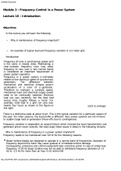
twenty four hours as shown in the figure on (click to enlarge)
the right.
There is a distinctive peak at about 8 pm. This is the typical variation for a particular season of
the year. For other seasons, the load profile is different. Also, power systems are not immune
to sudden large load or generation throw-offs due to contingencies.
Frequency variation is dependent on several factors which includes the load characteristics and
generator prime mover controls. We shall study these issues in detail in the following lectures.
Why is maintenance of frequency in a power system important?
Frequency needs to be maintained near 50 Hz for the following reasons:
Steam turbine blades are designed to operate in a narrow band of frequencies. Deviation of
frequency beyond this band may cause gradual or immediate turbine damage.
Consequently, protective and control equipment take corrective action in case of under/over
frequency. A 50 Hz steam turbine may not be able to withstand frequency deviation of +2
Hz to -2.5 Hz for more than an hour in its entire life!
file:///E|/HTML-PDF-conversion/6--108101040/module%203/html/Lec-10.html[4/19/2012 1:03:49 PM]
Module 3 : Frequency Control in a Power System
Lecture 10 : Introduction
Objectives
In this lecture you will learn the following
Why is maintenance of frequency important?
An example of typical load and frequency variation in an Indian grid.
Introduction
Frequency all over a synchronous power grid
is the same in steady state. Maintaining a
near-constant frequency (one may allow
frequency to vary over a very narrow band)
is considered an important requirement of
power system operation.
Frequency in a power system is intimately
related to the electrical speed of synchronous
generators. The difference between
mechanical and electrical torques govern
acceleration of a rotor of a generator.
Therefore to maintain a constant speed,
mechanical input and electrical output power
need to be continually matched. Electrical
load can vary randomly, but the total load
versus time roughly follows a trend . For
example, total load in a grid can vary over
twenty four hours as shown in the figure on (click to enlarge)
the right.
There is a distinctive peak at about 8 pm. This is the typical variation for a particular season of
the year. For other seasons, the load profile is different. Also, power systems are not immune
to sudden large load or generation throw-offs due to contingencies.
Frequency variation is dependent on several factors which includes the load characteristics and
generator prime mover controls. We shall study these issues in detail in the following lectures.
Why is maintenance of frequency in a power system important?
Frequency needs to be maintained near 50 Hz for the following reasons:
Steam turbine blades are designed to operate in a narrow band of frequencies. Deviation of
frequency beyond this band may cause gradual or immediate turbine damage.
Consequently, protective and control equipment take corrective action in case of under/over
frequency. A 50 Hz steam turbine may not be able to withstand frequency deviation of +2
Hz to -2.5 Hz for more than an hour in its entire life!
file:///E|/HTML-PDF-conversion/6--108101040/module%203/html/Lec-10.html[4/19/2012 1:03:49 PM]