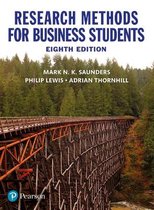
Research Methods for Business Students
2.2 Characteristics of a good research topic
Appropriateness
Capability
Fulfilment
2.4 Developing your research proposal
Expressing your topic as a research question
= what is the issue/problem that you wish to study + what your research project will seek to find out.
Could be: Exploratory (What, How)
Descriptive (Who, What, Where, When, How)
Explanatory (Why, How)
Evaluative (What, How, Why) or Comparing: (Which, When, Who, Where)
Writing a research aim and set of research objectives
= a brief statement of the purpose of the research project.
(The aim of this research is to explore…) or (To explore ….)
4.4 Three management philosophies
1. Positivism
Observable and measurable facts
2. Interpretivism
Multiple meanings, interpretations, perceptions
3. Pragmatism
Problem solving, relevance, explaining
5.3 Quantitative, qualitative or mixed methods
- Quantitative: associated with positivism. Used with data collection techniques. Survey.
- Qualitative: associated with interpretivism. Subjective and in-depth. Interviews.
- Mixed: Sequential exploratory: Qualitative Quantitative.
Sequential explanatory: Quantitative Qualitative.
7.1 Introduction
Consider: do you need one or more samples?
If you need to collect data from every possible case or group member = census.
However for most this will be impossible. This means you need to select data for a subgroup/
sample of all possible cases.
The full set of cases or elements from which a sample is taken is called the population.
Consequently, the researcher may redefine the population as something more manageable:
a subset of the population called the target population.
TARGET POPULATION AND POPULATION IS THE SAME>!!!
Sampling techniques:
1. Probability or representative sampling;
2. Non-probability sampling
2.2 Characteristics of a good research topic
Appropriateness
Capability
Fulfilment
2.4 Developing your research proposal
Expressing your topic as a research question
= what is the issue/problem that you wish to study + what your research project will seek to find out.
Could be: Exploratory (What, How)
Descriptive (Who, What, Where, When, How)
Explanatory (Why, How)
Evaluative (What, How, Why) or Comparing: (Which, When, Who, Where)
Writing a research aim and set of research objectives
= a brief statement of the purpose of the research project.
(The aim of this research is to explore…) or (To explore ….)
4.4 Three management philosophies
1. Positivism
Observable and measurable facts
2. Interpretivism
Multiple meanings, interpretations, perceptions
3. Pragmatism
Problem solving, relevance, explaining
5.3 Quantitative, qualitative or mixed methods
- Quantitative: associated with positivism. Used with data collection techniques. Survey.
- Qualitative: associated with interpretivism. Subjective and in-depth. Interviews.
- Mixed: Sequential exploratory: Qualitative Quantitative.
Sequential explanatory: Quantitative Qualitative.
7.1 Introduction
Consider: do you need one or more samples?
If you need to collect data from every possible case or group member = census.
However for most this will be impossible. This means you need to select data for a subgroup/
sample of all possible cases.
The full set of cases or elements from which a sample is taken is called the population.
Consequently, the researcher may redefine the population as something more manageable:
a subset of the population called the target population.
TARGET POPULATION AND POPULATION IS THE SAME>!!!
Sampling techniques:
1. Probability or representative sampling;
2. Non-probability sampling