Case 1: Microbiota in Health
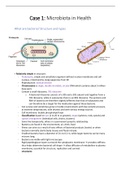
What are bacteria? Structure and types
= Relatively simple in structure:
- Prokaryotic, simple and unicellular organism without nuclear membrane and cell
nucleus, mitochondria, Golgi apparatus from ER
- Reproduction: asexual division
- Chromosome is single, double stranded, circular DNA which contains about 5 million
base pairs
- Contain a small ribosome, 70S ribosome
o A bacterial ribosome consists of a 30S and a 50S subunit and together form a
70S ribosome, while in eukaryotes there is an 80S ribosome. The proteins and
RNA of bacteria are therefore slightly different than that of eukaryotes and
can therefore be a target for the medication against these bacteria.
- Can survive and sometimes grow in hostile environments with low osmotic pressure,
at extreme temperatures, with dryness and with various energy sources.
- Cell membrane: double phospholipid layer
- Classification based on size (1 to 20 m or greater), shape (spheres, rods, spirals) and
spatial arrangement (individual cells, chains, clusters).
- Some live temporarily, others in a permanent parasitic relationship.
- Bacteria are found in the environment, air, drink, food
- Illness can arise as a result of toxic effects of bacterial products (toxins) or when
bacteria normally sterile body tissues and fluids intrude.
- Smallest bacteria have a diameter of 0.1 to 0.2 m, while larger bacteria can be many
microns long.
- Bacteria are visible with light microscope
- Rigid peptidoglycan layers surround the cytoplasmic membrane → provides stiffness
thus helps determine bacterial cell shape → allow diffusion of metabolites to plasma
membrane, essential for structure, replication and survival.
- structures:
,o Capsule: loose polysaccharide layers → not necessary for the growth of
bacteria, but important for host survival and barrier to toxic molecules →
important virulence factor
▪ Hard to wash away
o Slime layer / S-layer: Also, a polysaccharide layer, but it differs from a in
being more diffuse and unorganized,
▪ More easily removed from the cell.
o Glycocalyx: also describes a polysaccharide layer extending from the cell
surface. The term encompasses both capsules and slime layers because both
are composed of polysaccharides
▪ Aids in attachment to solid surfaces + mobility
o Biofilm: produced by some bacteria when sufficient numbers are present →
protects against antibiotics and immune system
o Flagella:
▪ A kind of propellers that consist of protein subunits (flagellin) that are
anchored in the bacterial membranes, they are driven by the
membrane potential. Different types of bacteria have different
numbers of flagella and are also located in different places.
▪ Function:
• Movement
• Attachment → virulence factor (can contribute to causing a
disease)
▪ Flagelles are recognizable by a host as antigens and are ligand (free
electron pair) for pathogen pattern receptors of host
o Fimbriae (pili):
▪ Hair-like structures on the outside of a bacterium and they consist of
protein subunits (pilin) and are 9-10 nm in diameter
▪ Hundreds of pili on surface bacteria
▪ Function: stimulate bonding with other bacteria or host + motility +
transfer mechanism
▪ Important virulence factor
▪ F. pili bind to other bacteria and are a conduit for transporting large
segments of bacterial chromosomes between bacteria. It is called
conjugation when bacteria exchange things such as plasmids with each
other via pili.
o Plasmids (small circular extrachromosomal pieces of DNA)
▪ Double stranded both circular as linear, most are circular
▪ Episomes: plasmids that integrate into chromosome
▪ Not essential for cell survival
▪ Provide a selective advantage → often carry the resistance to one or
more antibiotics
▪ Among others ESBL genes are encoded on plasmids
▪ Horizontal gene transfer
o Cytoplasmic membrane
▪ Has a lipid bilayer/lipid bilayer structure similar to eukaryotic
membranes, it does not contain steroids such as cholesterol. The
membrane has many functions such as electron transport, energy
, production, absorption and release of metabolites and other
substances, ion pumps maintain membrane potential, maintain
enzymes.
▪ The inside of the membrane is lined with actin-like protein filaments
that help determine the shape of the bacteria and the location of
septal formation for cell division.
- Inclusions: common in all cells → formed by the aggregation of substances that may
be either organic or inorganic
o Function: to segregate certain cellular components so they do not diffuse
freely in the cytoplasm
- Endospores: dormant cells formed within a so-called mother cell, are fascinating
bacterial structures produced by certain bacteria within the phylum Firmicutes
o Bacteria that produce endospores make a single endospore per cell that later
geminates to a single cell → no increase in the number of cells
o Sporulation: making endospores → several hours
o Mostly gram-positive bacteria
o Response to nutrient depletion → dormant stage of bacteria
▪ Can withstand greater exposure to heat, ultraviolet radiation, gamma
radiation, chemical disinfectants, and desiccation → dense protein
coat that protects it from lysozymes
o From endospore to active vegetative cell → 3 stages:
▪ Activation: prepares endospore for germination
▪ Germination: the breaking of the endospore’s dormant state
▪ Outgrowth: release of the Ca-DPA complexes and water uptake →
water levels inside the germinating cell reach those characteristic of
vegetative cells → reactivation enzymes in the core
, - Complex cell wall: network-like peptidoglycan cell wall surrounds the membranes of
bacteria for environmental protection
o Gram positive:
▪ Thick peptidoglycan layer/cell wall (protection from the environment)
• Mesh-like exoskeleton that is porous to allow diffusion of
substances
• Essential for structure, replication, and survival in the hostile
environment conditions in which bacteria grow
• Lysozymes found in human cells can break apart the
peptidoglycan cracks. Without the peptidoglycan, the bacteria
succumb to the large differences in osmotic pressure across
the cytoplasmic membrane and lyse
• Each subunit within the sacculus contains two sugar
derivatives, N-acetylglucosamine (NAG) and N-acetylmuramic
acid (NAM
▪ Other components:
• Proteins
• Teichoic acids: water-soluble negative polymers of polyol
phosphates that are covalent bound to the peptidoglycan and
are important for cell viability, in addition, they are important
factors for virulence. Essential for Viability
• Lipoteichoic acids: contain a fatty acid and are anchored in the
cytoplasmic membrane. They are molecules recognizable as
antigens and important for attachment to other bacteria or
mammalian cell surfaces (promoting adhesion to other
bacteria). Complex polysaccharides
o Lipoteichoic acid and teichoic acid difference: Teichoic
acid is contained in cytoplasmic membrane.
Lipoteichoic acid connects cytoplasmic membrane and
polypeptide glycan layer. Pores: certain antibiotics can
pass through these pores, others cannot, depending on
which pore and its size
o Gram negative:
▪ Gram-negative cell walls are chemically and structurally much more
complex than positive cell walls
▪ Gram-negative cell wall has two layers that are external to the
cytoplasmic membrane
• Immediately adjacent to cytoplasmic membrane → thin
peptidoglycan layer
• Outer membrane → outside the peptidoglycan layer
o Maintains bacterial structure
o Permeability barrier for large molecules (e.g. proteins
such as lysozyme) and hydrophobic molecules (e.g.
some antimicrobials) Protection against adverse
What are bacteria? Structure and types
= Relatively simple in structure:
- Prokaryotic, simple and unicellular organism without nuclear membrane and cell
nucleus, mitochondria, Golgi apparatus from ER
- Reproduction: asexual division
- Chromosome is single, double stranded, circular DNA which contains about 5 million
base pairs
- Contain a small ribosome, 70S ribosome
o A bacterial ribosome consists of a 30S and a 50S subunit and together form a
70S ribosome, while in eukaryotes there is an 80S ribosome. The proteins and
RNA of bacteria are therefore slightly different than that of eukaryotes and
can therefore be a target for the medication against these bacteria.
- Can survive and sometimes grow in hostile environments with low osmotic pressure,
at extreme temperatures, with dryness and with various energy sources.
- Cell membrane: double phospholipid layer
- Classification based on size (1 to 20 m or greater), shape (spheres, rods, spirals) and
spatial arrangement (individual cells, chains, clusters).
- Some live temporarily, others in a permanent parasitic relationship.
- Bacteria are found in the environment, air, drink, food
- Illness can arise as a result of toxic effects of bacterial products (toxins) or when
bacteria normally sterile body tissues and fluids intrude.
- Smallest bacteria have a diameter of 0.1 to 0.2 m, while larger bacteria can be many
microns long.
- Bacteria are visible with light microscope
- Rigid peptidoglycan layers surround the cytoplasmic membrane → provides stiffness
thus helps determine bacterial cell shape → allow diffusion of metabolites to plasma
membrane, essential for structure, replication and survival.
- structures:
,o Capsule: loose polysaccharide layers → not necessary for the growth of
bacteria, but important for host survival and barrier to toxic molecules →
important virulence factor
▪ Hard to wash away
o Slime layer / S-layer: Also, a polysaccharide layer, but it differs from a in
being more diffuse and unorganized,
▪ More easily removed from the cell.
o Glycocalyx: also describes a polysaccharide layer extending from the cell
surface. The term encompasses both capsules and slime layers because both
are composed of polysaccharides
▪ Aids in attachment to solid surfaces + mobility
o Biofilm: produced by some bacteria when sufficient numbers are present →
protects against antibiotics and immune system
o Flagella:
▪ A kind of propellers that consist of protein subunits (flagellin) that are
anchored in the bacterial membranes, they are driven by the
membrane potential. Different types of bacteria have different
numbers of flagella and are also located in different places.
▪ Function:
• Movement
• Attachment → virulence factor (can contribute to causing a
disease)
▪ Flagelles are recognizable by a host as antigens and are ligand (free
electron pair) for pathogen pattern receptors of host
o Fimbriae (pili):
▪ Hair-like structures on the outside of a bacterium and they consist of
protein subunits (pilin) and are 9-10 nm in diameter
▪ Hundreds of pili on surface bacteria
▪ Function: stimulate bonding with other bacteria or host + motility +
transfer mechanism
▪ Important virulence factor
▪ F. pili bind to other bacteria and are a conduit for transporting large
segments of bacterial chromosomes between bacteria. It is called
conjugation when bacteria exchange things such as plasmids with each
other via pili.
o Plasmids (small circular extrachromosomal pieces of DNA)
▪ Double stranded both circular as linear, most are circular
▪ Episomes: plasmids that integrate into chromosome
▪ Not essential for cell survival
▪ Provide a selective advantage → often carry the resistance to one or
more antibiotics
▪ Among others ESBL genes are encoded on plasmids
▪ Horizontal gene transfer
o Cytoplasmic membrane
▪ Has a lipid bilayer/lipid bilayer structure similar to eukaryotic
membranes, it does not contain steroids such as cholesterol. The
membrane has many functions such as electron transport, energy
, production, absorption and release of metabolites and other
substances, ion pumps maintain membrane potential, maintain
enzymes.
▪ The inside of the membrane is lined with actin-like protein filaments
that help determine the shape of the bacteria and the location of
septal formation for cell division.
- Inclusions: common in all cells → formed by the aggregation of substances that may
be either organic or inorganic
o Function: to segregate certain cellular components so they do not diffuse
freely in the cytoplasm
- Endospores: dormant cells formed within a so-called mother cell, are fascinating
bacterial structures produced by certain bacteria within the phylum Firmicutes
o Bacteria that produce endospores make a single endospore per cell that later
geminates to a single cell → no increase in the number of cells
o Sporulation: making endospores → several hours
o Mostly gram-positive bacteria
o Response to nutrient depletion → dormant stage of bacteria
▪ Can withstand greater exposure to heat, ultraviolet radiation, gamma
radiation, chemical disinfectants, and desiccation → dense protein
coat that protects it from lysozymes
o From endospore to active vegetative cell → 3 stages:
▪ Activation: prepares endospore for germination
▪ Germination: the breaking of the endospore’s dormant state
▪ Outgrowth: release of the Ca-DPA complexes and water uptake →
water levels inside the germinating cell reach those characteristic of
vegetative cells → reactivation enzymes in the core
, - Complex cell wall: network-like peptidoglycan cell wall surrounds the membranes of
bacteria for environmental protection
o Gram positive:
▪ Thick peptidoglycan layer/cell wall (protection from the environment)
• Mesh-like exoskeleton that is porous to allow diffusion of
substances
• Essential for structure, replication, and survival in the hostile
environment conditions in which bacteria grow
• Lysozymes found in human cells can break apart the
peptidoglycan cracks. Without the peptidoglycan, the bacteria
succumb to the large differences in osmotic pressure across
the cytoplasmic membrane and lyse
• Each subunit within the sacculus contains two sugar
derivatives, N-acetylglucosamine (NAG) and N-acetylmuramic
acid (NAM
▪ Other components:
• Proteins
• Teichoic acids: water-soluble negative polymers of polyol
phosphates that are covalent bound to the peptidoglycan and
are important for cell viability, in addition, they are important
factors for virulence. Essential for Viability
• Lipoteichoic acids: contain a fatty acid and are anchored in the
cytoplasmic membrane. They are molecules recognizable as
antigens and important for attachment to other bacteria or
mammalian cell surfaces (promoting adhesion to other
bacteria). Complex polysaccharides
o Lipoteichoic acid and teichoic acid difference: Teichoic
acid is contained in cytoplasmic membrane.
Lipoteichoic acid connects cytoplasmic membrane and
polypeptide glycan layer. Pores: certain antibiotics can
pass through these pores, others cannot, depending on
which pore and its size
o Gram negative:
▪ Gram-negative cell walls are chemically and structurally much more
complex than positive cell walls
▪ Gram-negative cell wall has two layers that are external to the
cytoplasmic membrane
• Immediately adjacent to cytoplasmic membrane → thin
peptidoglycan layer
• Outer membrane → outside the peptidoglycan layer
o Maintains bacterial structure
o Permeability barrier for large molecules (e.g. proteins
such as lysozyme) and hydrophobic molecules (e.g.
some antimicrobials) Protection against adverse