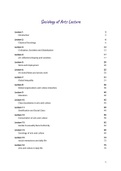
Sociology of Arts Lecture
Lecture 1: 2
Introduction 2
Lecture 2: 6
Classical Sociology 6
Lecture 3: 12
Civilization, Societies and Globalization 12
Lecture 4: 17
Art, reflection/shaping and societies 17
Lecture 5: 20
Work and Employment 20
Lecture 6: 25
Art world/fields and artistic work 25
Lecture 7: 31
Global Inequality 31
Lecture 8: 36
Global organizations and culture industries 36
Lecture 9: 40
Education 40
Lecture 10: 45
Class boundaries in arts and culture 45
Lecture 11: 49
Stratification and Social Class 49
Lecture 12: 55
Consumption of arts and culture 55
Lecture 13: 62
Gender & sexuality Race & ethnicity 62
Lecture 14: 68
Sociology of arts and culture 68
Lecture 15: 73
social interactions and daily life 73
Lecture 16: 75
Arts and culture in daily life 75
1
, Lecture 1:
Introduction
Sociology of arts:
What is art?
It is hard to define art.
Becker: the context is the most important aspect to the definition of arts.
Five elements that characterize most forms of art:
● There is an artistic product: may be tangible, visible, or audible. Can be a physical
object or even a performance.
● Th communicates publicly: to be art the cultural
product must not only exist, it must be seen, heard,
or experienced by an audience, either in public or
private setting. Art is communication but not all
com. is art.
● It is experienced for enjoyment: “Enjoyment”
can take many forms. Art might be consumed
for aesthetic pleasure, for sociability and fun,
for mental stimulation, or for escape.
● Art is an expressive form: when art relates to
real life, it presents a fiction or an interpretation.
Sometimes it claims to tell the “truth,” but if it
takes the idea too literally it moves into the area
of documentary, non-fiction, or news.
● Art is defined by its context: both physical and
social. Different social groups view the same
expressive product and they may disagree on
whether or not it is art.
What is culture?
Culture is one on the most complicated words in the English language
Discussion on exact definition is fruitless, but it can be defined in two ways:
● Culture as a way of life → (cultural sociology)
○ implicit culture
● Culture as a form of artistic expression and communication → (sociology of
culture)
○ explicit culture
2
, General sociology:
What is sociology:
“the scientific study of social groups, whole societies and the human world as such”
and “understanding the quite subtle but complex and profound ways in which our
individual lives reflect the contexts of our social experience”
● Sociological Imagination
Founding fathers:
● Auguste Comte:
○ through positivist science, we can discover social laws and use these to
improve society (=enhance cohesion) based on observation, comparison
and experimentation
○ → “Social physics” (but later used “sociology”)
● Emile Durkhime:
○ Objective study of social facts
○ = institutions and rules of action which constrain or channel human
behavior (money, school, government, greeting customs etc.)
○ Also preoccupied with cohesion, or solidarity
○ Nature of solidarity changed with the increasing division of labor
○ Too much social change would lead to anomie
○ → functionalism:
■ Society is complex system, a set of interconnected subsystems
that work together to ensure the stability of the system
■ Society works as a body with different organs, (intellectuals are the
head, laborers are hands, bureaucrats are bowels)
■ Emphasis on solidarity, social integration, consensus
■ Emphasis on balance or homeostasis
■ In arts: Functionalist questions could be:
● What is the role of art in society?
● What role can art play in socialization?
● What function can be distinguished within the art world?
● Karl Marx:
○ Main concern was growing inequality and exploitation of workers in
developing industries
○ Theory of base and superstructure:
3
Lecture 1: 2
Introduction 2
Lecture 2: 6
Classical Sociology 6
Lecture 3: 12
Civilization, Societies and Globalization 12
Lecture 4: 17
Art, reflection/shaping and societies 17
Lecture 5: 20
Work and Employment 20
Lecture 6: 25
Art world/fields and artistic work 25
Lecture 7: 31
Global Inequality 31
Lecture 8: 36
Global organizations and culture industries 36
Lecture 9: 40
Education 40
Lecture 10: 45
Class boundaries in arts and culture 45
Lecture 11: 49
Stratification and Social Class 49
Lecture 12: 55
Consumption of arts and culture 55
Lecture 13: 62
Gender & sexuality Race & ethnicity 62
Lecture 14: 68
Sociology of arts and culture 68
Lecture 15: 73
social interactions and daily life 73
Lecture 16: 75
Arts and culture in daily life 75
1
, Lecture 1:
Introduction
Sociology of arts:
What is art?
It is hard to define art.
Becker: the context is the most important aspect to the definition of arts.
Five elements that characterize most forms of art:
● There is an artistic product: may be tangible, visible, or audible. Can be a physical
object or even a performance.
● Th communicates publicly: to be art the cultural
product must not only exist, it must be seen, heard,
or experienced by an audience, either in public or
private setting. Art is communication but not all
com. is art.
● It is experienced for enjoyment: “Enjoyment”
can take many forms. Art might be consumed
for aesthetic pleasure, for sociability and fun,
for mental stimulation, or for escape.
● Art is an expressive form: when art relates to
real life, it presents a fiction or an interpretation.
Sometimes it claims to tell the “truth,” but if it
takes the idea too literally it moves into the area
of documentary, non-fiction, or news.
● Art is defined by its context: both physical and
social. Different social groups view the same
expressive product and they may disagree on
whether or not it is art.
What is culture?
Culture is one on the most complicated words in the English language
Discussion on exact definition is fruitless, but it can be defined in two ways:
● Culture as a way of life → (cultural sociology)
○ implicit culture
● Culture as a form of artistic expression and communication → (sociology of
culture)
○ explicit culture
2
, General sociology:
What is sociology:
“the scientific study of social groups, whole societies and the human world as such”
and “understanding the quite subtle but complex and profound ways in which our
individual lives reflect the contexts of our social experience”
● Sociological Imagination
Founding fathers:
● Auguste Comte:
○ through positivist science, we can discover social laws and use these to
improve society (=enhance cohesion) based on observation, comparison
and experimentation
○ → “Social physics” (but later used “sociology”)
● Emile Durkhime:
○ Objective study of social facts
○ = institutions and rules of action which constrain or channel human
behavior (money, school, government, greeting customs etc.)
○ Also preoccupied with cohesion, or solidarity
○ Nature of solidarity changed with the increasing division of labor
○ Too much social change would lead to anomie
○ → functionalism:
■ Society is complex system, a set of interconnected subsystems
that work together to ensure the stability of the system
■ Society works as a body with different organs, (intellectuals are the
head, laborers are hands, bureaucrats are bowels)
■ Emphasis on solidarity, social integration, consensus
■ Emphasis on balance or homeostasis
■ In arts: Functionalist questions could be:
● What is the role of art in society?
● What role can art play in socialization?
● What function can be distinguished within the art world?
● Karl Marx:
○ Main concern was growing inequality and exploitation of workers in
developing industries
○ Theory of base and superstructure:
3