Week 1
Hoofdstuk 1: Understanding integration
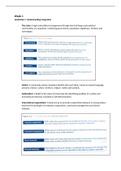
- The state: A legal and political arrangement through which all large-scale political
communities are organized, combining government, population, legitimacy, territory and
sovereignty.
- Nation: A community whose members identify with each other, based on shared language,
ancestry, history, culture, territory, religion, myths and symbols.
- Nationalism: A belief in the value of preserving the identifying qualities of a nation and
promoting its interests, founded on self-determination.
- International organization: A body set up to promote cooperation between or among states,
based on the principles of voluntary cooperation, communal management and shared
interests.
,- Regional integration: The promotion of cooperation and collective action among a group of
states based on the identification of shared interests, common goals, promotion of
efficiency, the pooling of resources, and the creation of opportunity. Although states may be
motivated by broad philosophical goals such as peace and unity, integration is usually
focused on economic cooperation, including the promotion of trade and investment. The
arrangements made to achieve this usually include treaties outlining goals and terms, and
the creation of new regional institutions charged with working towards those goals.
- Regional integration association: An organization within which independent states work to
encourage co-operation and the pooling of authority and resources for the mutual benefit of
its members.
- Federalism: Federalism means promotion of, or support for, the idea of federation. For
European federalists, this means a belief in the merits of working towards replacing the
European state system with a new European federation, or a United States of Europe. In
conceptional terms, however, it is not really a theory, and falls victim to the confusion
between its explanatory role in analysing the nature of today’s EU and its prescriptive role in
explaining what some would like the EU to become.
- Functionalism: The theory that if states create functionally specific interstate institutions and
agencies, regional integration will develop its own internal dynamic, and peace can be
achieved through the creation of a web of interstate ties without the need for grand
intergovernmental agreements.
- Grand theory: A theory that explains the entirety of a phenomenon, which has so far been
lacking in efforts to explain and understand European integration.
- Neofunctionalism: The theory that states are not the only important actors in efforts to
integrate, and that supranational institutions, interest groups and political parties all play a
key role.
, - Spillover: A key element in neo functionalist theory, describing the pressures through which
cooperation among states in one area of policy will lead to pressures to cooperate in other
areas.
- Integrative potential: A measure of the extent to which states will be able to integrate
successfully, based on a combination of economic and political factors.
- International Relations (IR): The study of relations among states, focusing on alliances,
diplomacy, war and peace, and the dynamics of decisions reached by states working together
or in competition with each other.
- Realism: A theory which argues that we live in an anarchic global system (one without rules
or an authority above the level of the state), and that international relations are driven by a
struggle for power among self-interested states.
- Intergovernmentalism: This is both a theory and a model, underpinned by realism, which
sees the EU primarily as a meeting place in which representatives from the member states
negotiate with each other in an attempt to achieve a consensus, but pursue state interests
while paying less attention to the broader interests of the community of states. Key
cooperative decisions are made as a result of negotiations among representatives of the
states involved.
- Supranationalism: Another theory and model based on the idea that intergovernmental
organizations (IGO’s) become the forum for the promotion of the joined interests of the
states involved in cooperation, and that there is a transfer of authority to those IGO’s. In the
example of the EU, governments of the member states compromise state interests in the
common good, and transfer authority to institutions that work in the interest of the EU as a
whole.
- Liberal intergovernmentalism: A theory combining elements of neofunctionalism and
intergovernmentalism, arguing that intergovernmental bargains are driven by pressures
coming from the domestic level.
Hoofdstuk 2: What is the European Union?
- Institution: A formal organization or practice with a political purpose or effect, marked by
durability and internal complexity. Institutions can be both formal, as in the case of the
United Nations or the administrative bodies of the EU, and informal, as in the case of the
family, schools and religions. They can also be governmental, with states as members, or
non-governmental, meaning that they are made up of national or local interest groups,
professions, private associations or individuals.
- Polity: An organized and structured system for the government and administration of a
political unit, such as a state or a city.
- Comparative politics: The systematic study of government and politics in different settings,
designed to better understand them by drawing out their contrasts and similarities.
Hoofdstuk 1: Understanding integration
- The state: A legal and political arrangement through which all large-scale political
communities are organized, combining government, population, legitimacy, territory and
sovereignty.
- Nation: A community whose members identify with each other, based on shared language,
ancestry, history, culture, territory, religion, myths and symbols.
- Nationalism: A belief in the value of preserving the identifying qualities of a nation and
promoting its interests, founded on self-determination.
- International organization: A body set up to promote cooperation between or among states,
based on the principles of voluntary cooperation, communal management and shared
interests.
,- Regional integration: The promotion of cooperation and collective action among a group of
states based on the identification of shared interests, common goals, promotion of
efficiency, the pooling of resources, and the creation of opportunity. Although states may be
motivated by broad philosophical goals such as peace and unity, integration is usually
focused on economic cooperation, including the promotion of trade and investment. The
arrangements made to achieve this usually include treaties outlining goals and terms, and
the creation of new regional institutions charged with working towards those goals.
- Regional integration association: An organization within which independent states work to
encourage co-operation and the pooling of authority and resources for the mutual benefit of
its members.
- Federalism: Federalism means promotion of, or support for, the idea of federation. For
European federalists, this means a belief in the merits of working towards replacing the
European state system with a new European federation, or a United States of Europe. In
conceptional terms, however, it is not really a theory, and falls victim to the confusion
between its explanatory role in analysing the nature of today’s EU and its prescriptive role in
explaining what some would like the EU to become.
- Functionalism: The theory that if states create functionally specific interstate institutions and
agencies, regional integration will develop its own internal dynamic, and peace can be
achieved through the creation of a web of interstate ties without the need for grand
intergovernmental agreements.
- Grand theory: A theory that explains the entirety of a phenomenon, which has so far been
lacking in efforts to explain and understand European integration.
- Neofunctionalism: The theory that states are not the only important actors in efforts to
integrate, and that supranational institutions, interest groups and political parties all play a
key role.
, - Spillover: A key element in neo functionalist theory, describing the pressures through which
cooperation among states in one area of policy will lead to pressures to cooperate in other
areas.
- Integrative potential: A measure of the extent to which states will be able to integrate
successfully, based on a combination of economic and political factors.
- International Relations (IR): The study of relations among states, focusing on alliances,
diplomacy, war and peace, and the dynamics of decisions reached by states working together
or in competition with each other.
- Realism: A theory which argues that we live in an anarchic global system (one without rules
or an authority above the level of the state), and that international relations are driven by a
struggle for power among self-interested states.
- Intergovernmentalism: This is both a theory and a model, underpinned by realism, which
sees the EU primarily as a meeting place in which representatives from the member states
negotiate with each other in an attempt to achieve a consensus, but pursue state interests
while paying less attention to the broader interests of the community of states. Key
cooperative decisions are made as a result of negotiations among representatives of the
states involved.
- Supranationalism: Another theory and model based on the idea that intergovernmental
organizations (IGO’s) become the forum for the promotion of the joined interests of the
states involved in cooperation, and that there is a transfer of authority to those IGO’s. In the
example of the EU, governments of the member states compromise state interests in the
common good, and transfer authority to institutions that work in the interest of the EU as a
whole.
- Liberal intergovernmentalism: A theory combining elements of neofunctionalism and
intergovernmentalism, arguing that intergovernmental bargains are driven by pressures
coming from the domestic level.
Hoofdstuk 2: What is the European Union?
- Institution: A formal organization or practice with a political purpose or effect, marked by
durability and internal complexity. Institutions can be both formal, as in the case of the
United Nations or the administrative bodies of the EU, and informal, as in the case of the
family, schools and religions. They can also be governmental, with states as members, or
non-governmental, meaning that they are made up of national or local interest groups,
professions, private associations or individuals.
- Polity: An organized and structured system for the government and administration of a
political unit, such as a state or a city.
- Comparative politics: The systematic study of government and politics in different settings,
designed to better understand them by drawing out their contrasts and similarities.