
Corporate responsbility summary
Lecture 1: introduction
The corporation in the Neo-Classic model
There are different forms of a corporation:
- Sole proprietorship (eenmanszaak): the owner is the firm and has all (unlimited)
(personal) liability.
- Partnership (vennootschap): all partners are liable for the debt.
- Limited liability companies (BV/NV): firm is the legal entity with contractual rights
and obligations. All owners have limited liabilities. There is a separation between
ownership and control and there is joint stock.
o Joint stock company: a business entity in which shares of the company's stock
can be bought and sold by shareholders. Each shareholder owns company
stock in proportion, evidenced by their shares (certificates of ownership).[1]
Shareholders can transfer their shares to others without any effects to the
continued existence of the company. Stocks can be publicly traded or
privately.
The limited liability firm came into existence with the VOC. There was a need for a lot of
capital and this brought a lot of risk (will the sail to India work?). Any saint person will not
invest in this project, that is why the limited liability was introduced. In this way, multiple
persons gather and raise capital but if the investment fails, the investors will not suffer their
whole lives for it.
This benefit of a limited liability corporation also led to the rise of corporations:
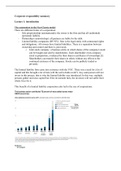
,Corporate profits flow to households
- Labor income
- Investments
- Taxes
- Capital income
- Suppliers
- Consumer surplus
- Positive spillovers
- Negative spillovers
The picture on the right shows how much of
corporate profits flow through which
sectors and institutions to households. It
shows how businesses create value and
welfare for society.
2 systems
- Adam Smith: the invisible hand,
people are self-interested and
pursue their own self-interest.
- A central planner decides what is produced and how much everyone gets.
- The first system is more efficient.
The company and its stakeholders
In the perfect world, we would work with complete contracts, where all rights and obligations
of all parties and all possible future states of the world are specified and where there is
perfect information and, thus, no agency costs. A complete contract also includes animals.
Therefore, we can allocate who gets what in this perfect world.
- Creditors: A creditor or lender is a party that has a claim on the services of a second
party. It is a person or institution to whom money is owed. The first party, in general,
has provided some property or service to the second party under the assumption that
the second party will return an equivalent property and service.
- Creditors do not have voting rights, shareholders have (and have residual claim):
, Shareholders
Creditor
Firm value
Maximizing shareholder vs. stakeholder value
- Milton Friendman: the one and only one social responsibility of business — to use its
resources and engage in activities designed to increase its profits..!” shareholder
value maximization.
- According to him, by maximizing shareholder value, all other stakeholders also
improve their welfare in the Neo-Classic Model.
- Friedman Doctrine:
o That responsibility is to conduct the business in accordance with their desires,
which generally will be to make as much money as possible while conforming
to the basic rules of the society, both those embodied in law and those
embodied in ethical custom.
Enron: this way of working is not allowed according to Friedman
because companies should adhere to the laws and regulations.
o He (the manager) is spending his own money or time or energy, not the money
of his employers or the time or energy he has contracted to devote to their
purposes. If these are “social responsibilities,” they are the social
responsibilities of individuals, not of business.
According to Friedman, it is not good to spend money as a business on
CSR!
The Neo-Classic Model externalities
- Positive externalities: i.e., employee training increase productivity and employee
loyalty, but also benefits other employers.
- Negative externalities: i.e., fertilizers from farming lead to “dead zones” in the ocean.
- Pacific Gas & Electric company contaminating water for the neighbourhood (Film-
Erin Brockovich, 2000)
- There are different ways to deal with these externalities:
o The Pigouvian Tax
To offset the negative externalities with a tax
To encourage positive externalities with a subsidy
Government plays a central role in welfare economics
The tax can be imposed on consumers or producers.
The challenges with this tax are that it is not popular among consumers
(which can have an influence/determine the political agenda) and that
the main problem (environmental damages) is not tackled.
, o Coase Theorem
The producer purchases rights to pollute
The producer invests in new technology or cleans up pollution
Or the community is compensated for the negative externalities
Government taxes the polluter and compensates the victims
If there are no transaction costs (which always are there), parties can
always find efficient solutions (by negotiating themselves).
The Neo-Classic model challenges
- Incomplete contract
o Future generations and mother nature could not join the negotiation today
o Impossible to contract all possible future scenarios
o Hard to measure and quantify the externalities
o Accountability is a challenge
Who is responsible for the melting glaciers?
How much compensation should be paid by whom?
Who should be compensated by how much?
Are the companies doing what they claim to do?
….????
- Information asymmetry
o It is hard to monitor and verify firm’s clean-up activities.
Shareholder value maximization
Shareholders are the residual owners of the firm, have voting rights about firm decisions and
nominate the board of directors.
Challenges with shareholder maximization:
- Incomplete contract
o Separation of ownership and control: misalignment of incentives
o Managers pursue self-interest
- Information asymmetry
o Hard to monitor and verify
Lecture 1: introduction
The corporation in the Neo-Classic model
There are different forms of a corporation:
- Sole proprietorship (eenmanszaak): the owner is the firm and has all (unlimited)
(personal) liability.
- Partnership (vennootschap): all partners are liable for the debt.
- Limited liability companies (BV/NV): firm is the legal entity with contractual rights
and obligations. All owners have limited liabilities. There is a separation between
ownership and control and there is joint stock.
o Joint stock company: a business entity in which shares of the company's stock
can be bought and sold by shareholders. Each shareholder owns company
stock in proportion, evidenced by their shares (certificates of ownership).[1]
Shareholders can transfer their shares to others without any effects to the
continued existence of the company. Stocks can be publicly traded or
privately.
The limited liability firm came into existence with the VOC. There was a need for a lot of
capital and this brought a lot of risk (will the sail to India work?). Any saint person will not
invest in this project, that is why the limited liability was introduced. In this way, multiple
persons gather and raise capital but if the investment fails, the investors will not suffer their
whole lives for it.
This benefit of a limited liability corporation also led to the rise of corporations:
,Corporate profits flow to households
- Labor income
- Investments
- Taxes
- Capital income
- Suppliers
- Consumer surplus
- Positive spillovers
- Negative spillovers
The picture on the right shows how much of
corporate profits flow through which
sectors and institutions to households. It
shows how businesses create value and
welfare for society.
2 systems
- Adam Smith: the invisible hand,
people are self-interested and
pursue their own self-interest.
- A central planner decides what is produced and how much everyone gets.
- The first system is more efficient.
The company and its stakeholders
In the perfect world, we would work with complete contracts, where all rights and obligations
of all parties and all possible future states of the world are specified and where there is
perfect information and, thus, no agency costs. A complete contract also includes animals.
Therefore, we can allocate who gets what in this perfect world.
- Creditors: A creditor or lender is a party that has a claim on the services of a second
party. It is a person or institution to whom money is owed. The first party, in general,
has provided some property or service to the second party under the assumption that
the second party will return an equivalent property and service.
- Creditors do not have voting rights, shareholders have (and have residual claim):
, Shareholders
Creditor
Firm value
Maximizing shareholder vs. stakeholder value
- Milton Friendman: the one and only one social responsibility of business — to use its
resources and engage in activities designed to increase its profits..!” shareholder
value maximization.
- According to him, by maximizing shareholder value, all other stakeholders also
improve their welfare in the Neo-Classic Model.
- Friedman Doctrine:
o That responsibility is to conduct the business in accordance with their desires,
which generally will be to make as much money as possible while conforming
to the basic rules of the society, both those embodied in law and those
embodied in ethical custom.
Enron: this way of working is not allowed according to Friedman
because companies should adhere to the laws and regulations.
o He (the manager) is spending his own money or time or energy, not the money
of his employers or the time or energy he has contracted to devote to their
purposes. If these are “social responsibilities,” they are the social
responsibilities of individuals, not of business.
According to Friedman, it is not good to spend money as a business on
CSR!
The Neo-Classic Model externalities
- Positive externalities: i.e., employee training increase productivity and employee
loyalty, but also benefits other employers.
- Negative externalities: i.e., fertilizers from farming lead to “dead zones” in the ocean.
- Pacific Gas & Electric company contaminating water for the neighbourhood (Film-
Erin Brockovich, 2000)
- There are different ways to deal with these externalities:
o The Pigouvian Tax
To offset the negative externalities with a tax
To encourage positive externalities with a subsidy
Government plays a central role in welfare economics
The tax can be imposed on consumers or producers.
The challenges with this tax are that it is not popular among consumers
(which can have an influence/determine the political agenda) and that
the main problem (environmental damages) is not tackled.
, o Coase Theorem
The producer purchases rights to pollute
The producer invests in new technology or cleans up pollution
Or the community is compensated for the negative externalities
Government taxes the polluter and compensates the victims
If there are no transaction costs (which always are there), parties can
always find efficient solutions (by negotiating themselves).
The Neo-Classic model challenges
- Incomplete contract
o Future generations and mother nature could not join the negotiation today
o Impossible to contract all possible future scenarios
o Hard to measure and quantify the externalities
o Accountability is a challenge
Who is responsible for the melting glaciers?
How much compensation should be paid by whom?
Who should be compensated by how much?
Are the companies doing what they claim to do?
….????
- Information asymmetry
o It is hard to monitor and verify firm’s clean-up activities.
Shareholder value maximization
Shareholders are the residual owners of the firm, have voting rights about firm decisions and
nominate the board of directors.
Challenges with shareholder maximization:
- Incomplete contract
o Separation of ownership and control: misalignment of incentives
o Managers pursue self-interest
- Information asymmetry
o Hard to monitor and verify



