Chapter 7: Mergers, acquisitions and alliances
Mergers, acquisitions and alliances are all common methods for achieving
growth strategies.
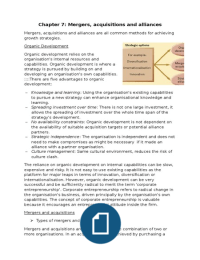
Organic Development
Organic development relies on the
organisation's internal resources and
capabilities. Organic development is where a
strategy is pursued by building on and
developing an organisation's own capabilities.
::::There are five advantages to organic
development:
Knowledge and learning: Using the organisation's existing capabilities
to pursue a new strategy can enhance organisational knowledge and
learning.
Spreading investment over time: There is not one large investment, it
allows the spreading of investment over the whole time span of the
strategy's development.
No availability constraints: Organic development is not dependent on
the availability of suitable acquisition targets or potential alliance
partners.
Strategic independence: The organisation is independent and does not
need to make compromises as might be necessary if it made an
alliance with a partner organisation.
Culture management: Same cultural environment, reduces the risk of
culture clash.
The reliance on organic development on internal capabilities can be slow,
expensive and risky. It is not easy to use existing capabilities as the
platform for major leaps in terms of innovation, diversification or
internationalisation. However, organic development can be very
successful and be sufficiently radical to merit the term 'corporate
entrepreneurship'. Corporate entrepreneurship refers to radical change in
the organisation's business, driven principally by the organisation's own
capabilities. The concept of corporate entrepreneurship is valuable
because it encourages an entrepreneurial attitude inside the firm.
Mergers and acquisitions
Types of mergers and acquisitions
Mergers and acquisitions are typically about the combination of two or
more organisations. In an acquisition this is achieved by purchasing a
Mergers, acquisitions and alliances are all common methods for achieving
growth strategies.
Organic Development
Organic development relies on the
organisation's internal resources and
capabilities. Organic development is where a
strategy is pursued by building on and
developing an organisation's own capabilities.
::::There are five advantages to organic
development:
Knowledge and learning: Using the organisation's existing capabilities
to pursue a new strategy can enhance organisational knowledge and
learning.
Spreading investment over time: There is not one large investment, it
allows the spreading of investment over the whole time span of the
strategy's development.
No availability constraints: Organic development is not dependent on
the availability of suitable acquisition targets or potential alliance
partners.
Strategic independence: The organisation is independent and does not
need to make compromises as might be necessary if it made an
alliance with a partner organisation.
Culture management: Same cultural environment, reduces the risk of
culture clash.
The reliance on organic development on internal capabilities can be slow,
expensive and risky. It is not easy to use existing capabilities as the
platform for major leaps in terms of innovation, diversification or
internationalisation. However, organic development can be very
successful and be sufficiently radical to merit the term 'corporate
entrepreneurship'. Corporate entrepreneurship refers to radical change in
the organisation's business, driven principally by the organisation's own
capabilities. The concept of corporate entrepreneurship is valuable
because it encourages an entrepreneurial attitude inside the firm.
Mergers and acquisitions
Types of mergers and acquisitions
Mergers and acquisitions are typically about the combination of two or
more organisations. In an acquisition this is achieved by purchasing a