Aantekeningen Organizational Psychology
45MC (3 answer options)
,Lecture 1 (introduction to Organizational Psychology)
- George & Jones (2011) Chapter 1
- George & Jones (2011) Appendix to Chapter 1
- Mullins (2010) Chapter 2
Organization= a collection of people who work together and coordinate their actions in order
to achieve individual and organizational goals.
“Are companies are organizations, but not all organizations are companies”.
An organization as:
- A machine: rational structure of activities, objectives
- An organism: biological synergy
- A brain: information processing, learning
- A political system: power dynamics
Components of organizations
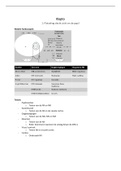
(Mintzberg) → looks like a fly from
above.
Organization is composed in five
parts (about people in the
organization):
- Strategic apex (top
management who decides
the strategy, ultimate
goals)
- Middle line (middle
management)
- Operating core (people on
the workfloor, bigger than
strategic apex, middle line)
→ these three parts are busy with the core tasks of the organization.
- Technostructure (assists the core to do their jobs, logistics, IT, planning, training)
- Support staff (cleaners, reception desks, people in the canteen)
,→ the stripes around are the ideology (sixth part). Values, what is really important to the
organization?
Organizational behavior (OB)= examining the factors that influence how individuals and
groups act in organizations and how organizations respond to their environment.
Psychology Organizational behavior helps us answer questions, such as...
- Why do people want to work for one particular organization and not for another?
- Why do some teams work effectively while other do not?
- How do you ensure that employees are motivated to do their work?
- Which structure is best suited to an organization?
Why should we study OB?
- In order to understand behavior in organizations
- In order to learn how apply concepts, theories and techniques that can improve or
change behavior
- In order to enable managers to direct and supervise the activities of their
employees.
Three levels of organizational behavior (levels of analysis)
1. Individual levels
2. Group level
3. Organizational level
→ these three levels will influence each other.
Organizational theory (approaches)
Organizations become bigger. How to design this in a good way?
, 1. Classical approach
- Bureaucracy
- Scientific management
- Fordism
▪ Objective: to improve the organizational structure in order to increase efficiency
▪ Normative → how it should be
▪ ‘Big’ names → you have to remember this in the exam:
Objections to the classical approach
- Ignores the psychological and social processes of employees
o Limits the psychological growth of the employee
▪ Boredom (need for variety)
▪ Limited development and use of skills
▪ Limited participation
▪ Limited freedom to determine your own working methods
- Inflexibility
o Rules must be followed obediently (gehoorzaam)
o Ignores the external environment of the organization
Management from the classic approach
Mooney & Reiley
4 principles:
1. Principle of coordination → act together, exercising authority, need for discipline
2. ‘Scalar principle’ → vertical division, hierarchy
3. Functional principle → horizontal division
4. The difference between line and staff (line: people whose work is involved with the
core business of the organization, staff: can support the line, but have not any formal
voice in the core business (HR))
Taylor, Ford
- In accordance with which principles did Taylor believe work needed to be
classified?
45MC (3 answer options)
,Lecture 1 (introduction to Organizational Psychology)
- George & Jones (2011) Chapter 1
- George & Jones (2011) Appendix to Chapter 1
- Mullins (2010) Chapter 2
Organization= a collection of people who work together and coordinate their actions in order
to achieve individual and organizational goals.
“Are companies are organizations, but not all organizations are companies”.
An organization as:
- A machine: rational structure of activities, objectives
- An organism: biological synergy
- A brain: information processing, learning
- A political system: power dynamics
Components of organizations
(Mintzberg) → looks like a fly from
above.
Organization is composed in five
parts (about people in the
organization):
- Strategic apex (top
management who decides
the strategy, ultimate
goals)
- Middle line (middle
management)
- Operating core (people on
the workfloor, bigger than
strategic apex, middle line)
→ these three parts are busy with the core tasks of the organization.
- Technostructure (assists the core to do their jobs, logistics, IT, planning, training)
- Support staff (cleaners, reception desks, people in the canteen)
,→ the stripes around are the ideology (sixth part). Values, what is really important to the
organization?
Organizational behavior (OB)= examining the factors that influence how individuals and
groups act in organizations and how organizations respond to their environment.
Psychology Organizational behavior helps us answer questions, such as...
- Why do people want to work for one particular organization and not for another?
- Why do some teams work effectively while other do not?
- How do you ensure that employees are motivated to do their work?
- Which structure is best suited to an organization?
Why should we study OB?
- In order to understand behavior in organizations
- In order to learn how apply concepts, theories and techniques that can improve or
change behavior
- In order to enable managers to direct and supervise the activities of their
employees.
Three levels of organizational behavior (levels of analysis)
1. Individual levels
2. Group level
3. Organizational level
→ these three levels will influence each other.
Organizational theory (approaches)
Organizations become bigger. How to design this in a good way?
, 1. Classical approach
- Bureaucracy
- Scientific management
- Fordism
▪ Objective: to improve the organizational structure in order to increase efficiency
▪ Normative → how it should be
▪ ‘Big’ names → you have to remember this in the exam:
Objections to the classical approach
- Ignores the psychological and social processes of employees
o Limits the psychological growth of the employee
▪ Boredom (need for variety)
▪ Limited development and use of skills
▪ Limited participation
▪ Limited freedom to determine your own working methods
- Inflexibility
o Rules must be followed obediently (gehoorzaam)
o Ignores the external environment of the organization
Management from the classic approach
Mooney & Reiley
4 principles:
1. Principle of coordination → act together, exercising authority, need for discipline
2. ‘Scalar principle’ → vertical division, hierarchy
3. Functional principle → horizontal division
4. The difference between line and staff (line: people whose work is involved with the
core business of the organization, staff: can support the line, but have not any formal
voice in the core business (HR))
Taylor, Ford
- In accordance with which principles did Taylor believe work needed to be
classified?