Pain
Lecture 1: Psychological Factors and Treatments
Myths
1) Myth 1: Women handle pain better than men FALSE
➔ Men handle pain better than women
• Increased pain sensitivity and risk for clinical pain observed in women
2) Myth 2: If you’re in pain you should not move FALSE
➔ When injured stop moving, when injury is gone you should move
• Inactivity and not moving leads to chronic pain
3) Myth 3: If there is no source of pain, it is not real FALSE
➔ There can be the experience of pain without a source
• No source of pain does not mean they cannot feel pain
4) Myth 4: Your mood can affect pain TRUE
➔ Emotions can affect pain
• Can be used in treating pain
Adaptive vs Maladaptive Function
• Adaptive:
- Functions of (acute) pain:
➔ Warning
➔ Support of healing process
• Maladaptive:
- Chronic pain:
➔ Persists longer than 6 months
➔ Lost its warning function
➔ Occurs even in the absence of a noxious stimulus
➔ Occurs even after successful healing
Definition of Pain
• Pain: an unpleasant sensory and emotional experience associated with actual or
potential tissue damage, or described in terms of such damage
- Sensory and affective component
➔ Intensity/quality
➔ e.g. unpleasant/annoying/distressing
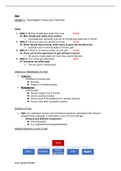
Multiple Response Levels of Pain
PAIN
Facial
Brain Reflexes VNS
Expression
Iman Shadid 540667
,Nociception: A Universal Protective System
• Nociception: processing and transmission of signals detected by nociceptors
- Sensory basis for adaptive protective behaviour
• Nociceptors: specific sensors with high sensory threshold, only excited by
stimulation which is tissue-damaging or threat of tissue damage
- Free-ending nerve fibers
➔ Aδ- and C-fibers
- Mostly polymodal
➔ Respond to thermal, mechanical and chemical stimulation
- Found in every tissue of the human body
• Activity induced in the nociceptor and nociceptive pathways by a noxious stimulus
is not pain
• Pain is always a psychological phenomenon
• Pain is highly subjective
Nociception vs Pain
• Nociception: detection and processing of noxious (harmful) stimuli by a highly
specialized part of the somatosensory system (nociceptive system)
• Pain: conscious experience of this perception, emerging from cognitive and
emotional evaluation of the information gathered through the nociceptive system
Phases of Acute (Nociceptive) Pain
• Trauma → Signal → Pain
- Painful event is detected by nociceptors, transmitted along nerves to spinal
cord and then to brain
1) Phase 1: Trauma
• Stimulation of nociceptors
- Found in skin, internal organs, muscles, joints and membranes around
the brain and spinal cord
2) Phase 2: Signal
• Pain signal is transmitted along axons of nociceptive nerve cells to the
dorsal horn of the spinal cord
- Signals from the dorsal horn then pass to the brain
3) Phase 3: Feeling the pain
• Nociceptive inputs to the dorsal horn are subject to powerful descending
control from a network of areas in the brain
- Signals combine in the brainstem, then travel down to alter ascending
nociceptive signals
➔ Painkillers, e.g. opioids and antidepressants, act at this junction
Iman Shadid 540667
, Pain in the Brain – Ascending Pathways
• Afferent nociceptive information enters the brain from the spinal cord
- Afferent spinal pathways include the spino-thalamic, and the spino-
amygdaloid pathways.
• Nociceptive information from the thalamus is projected to the insula, anterior
cingulate cortex (ACC), primary somatosensory cortex (S1) and secondary
somatosensory cortex (S2)
• Nociceptive information from the amygdala (AMY) is projected via the prefrontal
cortex (PFC), and from there to the basal ganglia (BG)
Descending Pain Modulatory System
• Ascending pain signals can be modulated (i.e. enhanced or inhibited) via
descending pathways:
1) Descending input from the anterior cingulate cortex (ACC) to the prefrontal
cortex (PFC) and then to the periaqueductal gray (PAG)
2) Descending input from the insula via the amygdala to the PAG
3) Descending pathway from the PAG through the rostroventral medulla (RVM)
to the dorsal horn of the spinal cord
- Influences nociceptive afferent transmission
Ascending Pathway: Descending Pathway:
1) Thalamus → Insula → ACC → S1 → S2 1) ACC → PFC → PAG
2) Amygdala → PFC → BG 2) Insula → Amygdala → PAG
3) PAG → RVM → Dorsal horn
Iman Shadid 540667
Lecture 1: Psychological Factors and Treatments
Myths
1) Myth 1: Women handle pain better than men FALSE
➔ Men handle pain better than women
• Increased pain sensitivity and risk for clinical pain observed in women
2) Myth 2: If you’re in pain you should not move FALSE
➔ When injured stop moving, when injury is gone you should move
• Inactivity and not moving leads to chronic pain
3) Myth 3: If there is no source of pain, it is not real FALSE
➔ There can be the experience of pain without a source
• No source of pain does not mean they cannot feel pain
4) Myth 4: Your mood can affect pain TRUE
➔ Emotions can affect pain
• Can be used in treating pain
Adaptive vs Maladaptive Function
• Adaptive:
- Functions of (acute) pain:
➔ Warning
➔ Support of healing process
• Maladaptive:
- Chronic pain:
➔ Persists longer than 6 months
➔ Lost its warning function
➔ Occurs even in the absence of a noxious stimulus
➔ Occurs even after successful healing
Definition of Pain
• Pain: an unpleasant sensory and emotional experience associated with actual or
potential tissue damage, or described in terms of such damage
- Sensory and affective component
➔ Intensity/quality
➔ e.g. unpleasant/annoying/distressing
Multiple Response Levels of Pain
PAIN
Facial
Brain Reflexes VNS
Expression
Iman Shadid 540667
,Nociception: A Universal Protective System
• Nociception: processing and transmission of signals detected by nociceptors
- Sensory basis for adaptive protective behaviour
• Nociceptors: specific sensors with high sensory threshold, only excited by
stimulation which is tissue-damaging or threat of tissue damage
- Free-ending nerve fibers
➔ Aδ- and C-fibers
- Mostly polymodal
➔ Respond to thermal, mechanical and chemical stimulation
- Found in every tissue of the human body
• Activity induced in the nociceptor and nociceptive pathways by a noxious stimulus
is not pain
• Pain is always a psychological phenomenon
• Pain is highly subjective
Nociception vs Pain
• Nociception: detection and processing of noxious (harmful) stimuli by a highly
specialized part of the somatosensory system (nociceptive system)
• Pain: conscious experience of this perception, emerging from cognitive and
emotional evaluation of the information gathered through the nociceptive system
Phases of Acute (Nociceptive) Pain
• Trauma → Signal → Pain
- Painful event is detected by nociceptors, transmitted along nerves to spinal
cord and then to brain
1) Phase 1: Trauma
• Stimulation of nociceptors
- Found in skin, internal organs, muscles, joints and membranes around
the brain and spinal cord
2) Phase 2: Signal
• Pain signal is transmitted along axons of nociceptive nerve cells to the
dorsal horn of the spinal cord
- Signals from the dorsal horn then pass to the brain
3) Phase 3: Feeling the pain
• Nociceptive inputs to the dorsal horn are subject to powerful descending
control from a network of areas in the brain
- Signals combine in the brainstem, then travel down to alter ascending
nociceptive signals
➔ Painkillers, e.g. opioids and antidepressants, act at this junction
Iman Shadid 540667
, Pain in the Brain – Ascending Pathways
• Afferent nociceptive information enters the brain from the spinal cord
- Afferent spinal pathways include the spino-thalamic, and the spino-
amygdaloid pathways.
• Nociceptive information from the thalamus is projected to the insula, anterior
cingulate cortex (ACC), primary somatosensory cortex (S1) and secondary
somatosensory cortex (S2)
• Nociceptive information from the amygdala (AMY) is projected via the prefrontal
cortex (PFC), and from there to the basal ganglia (BG)
Descending Pain Modulatory System
• Ascending pain signals can be modulated (i.e. enhanced or inhibited) via
descending pathways:
1) Descending input from the anterior cingulate cortex (ACC) to the prefrontal
cortex (PFC) and then to the periaqueductal gray (PAG)
2) Descending input from the insula via the amygdala to the PAG
3) Descending pathway from the PAG through the rostroventral medulla (RVM)
to the dorsal horn of the spinal cord
- Influences nociceptive afferent transmission
Ascending Pathway: Descending Pathway:
1) Thalamus → Insula → ACC → S1 → S2 1) ACC → PFC → PAG
2) Amygdala → PFC → BG 2) Insula → Amygdala → PAG
3) PAG → RVM → Dorsal horn
Iman Shadid 540667