Applied Economics
Summary
Subject: Applied Economics
Chapter’s summarized: Chapter 20, 21, 22, 37, 38, 39
Chapter 20 - Income inequality, poverty, and discrimination
One way to measure income inequality is to look at the percentages of
households in a series of income categories. Another way is to divide the total
number of individuals, households, or families, into five numerically equal groups,
or quintiles, and examine the percentage of total personal income received by
each quintile. > page 410 > check incomes in different quintiles
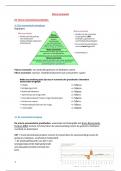
We can display the quintile distribution of personal income through a Lorenz
curve. > page 410 for this curve and page 411 for explanation.
By plotting the quintile data from the table in figure 20.1, we obtain the Lorenz
curve.
The brown area between the diagonal line and the Lorenz curve is determined by
the extent that the Lorenz curve sags away from the diagonal and indicates the
degree of income inequality.
The income inequality described by the Lorenz curve can be transformed into a
Gini ratio - a numerical measure of the overall dispersion of income:
Gini Ratio = area between Lorenz curve and diagonal
-----------------------------------------------------------------
Total area below the diagonal
= A (Brown area)
----------------------
A + B (brown + green area)
Lower Gini ratios denote less inequality; higher ratios indicate more inequality.
The Gini coefficient for complete income equality is zero and for complete
inequality is 1.
Income mobility: the movement of individuals or house-holds from one income
quintile to another over time. > The longer the time period considered, the more
equal the distribution of income becomes. The income quintiles do not include
non-cash transfers, which provide specific goods or services rather than cash.
Which contributes more to redistribution (herverdeling), government taxes or
government transfers? >> The answer is transfers.
The factors that contribute to income inequality are the following:
- Ability
People have different mental, physical, and aesthetic (stijlvol) talents.
- Education and training
Individuals differ significantly in the amount of education and training they obtain
and thus in their capacity to earn income.
- Discrimination
, Discrimination in education, hiring, training, and promotion undoubtedly causes
some income inequality.
- Preferences and risks
Incomes also differ because of differences in preferences for market work relative
to leisure, market work relative to work in the household, and types of
occupations.
- Unequal distribution of wealth
Income is a flow; it represents a stream of wage and salary earnings, along with
rent, interest, and profit. In contrast, wealth is a stock, reflecting at a particular
moment the financial and real assets an individual has accumulated over time. A
retired person may have very little income and yet own a home, mutual fund
shares, and a pension plan that add up to considerable wealth.
- Market power
In resource markets certain unions and professional groups have adopted policies
that limit the supply of their services.
- Luck, connections and misfortune
Economics misfortunes such as prolonged illness, serious accident, death of the
family breadwinner.
Rising income inequality since 1970
Causes:
- Greater demand for highly skilled workers
- Demographic changes > the entrance of large numbers of less-skilled baby
boomers.
- International trade, immigration, and decline in unionism
Equality versus efficiency
Page 417 > the marginal utility, a, from the last dollar received by Anderson is
high, and the marginal utility, b, from Brooks’ last dollar of income is low. >> This
could be a reason for equal salaries.
In the equality-efficiency trade-of, greater income equality comes at the
opportunity cost of reduced production and income. Greater production and
income comes at the expense of less equality of income.
The U.S. income-maintenance system consists of two kinds of programs:
- Social insurance
- Public assistance, or welfare
Both are known as entitlement programs.
Social insurance programs partially replace earnings that have been lost due
to retirement, disability, or temporary unemployment; they also provide health
insurance for the elderly. > Financed primarily out of Federal payroll taxes.
Public assistance programs provide benefits to people who are unable to earn
income because of permanent disabling conditions or who have no or very low
income and also have dependent children.
A prejudiced (bevooroordeelde) white employer behaves as if employing African-
American workers would add a cost. The amount of this cost - this disutility - is
reflected in a discrimination coefficient, d, measured in monetary units. The
prejudiced white employer will have no preference between African-American and
white workers when the total cost per worker is the same, that is, when:
Ww = Waa + d
Summary
Subject: Applied Economics
Chapter’s summarized: Chapter 20, 21, 22, 37, 38, 39
Chapter 20 - Income inequality, poverty, and discrimination
One way to measure income inequality is to look at the percentages of
households in a series of income categories. Another way is to divide the total
number of individuals, households, or families, into five numerically equal groups,
or quintiles, and examine the percentage of total personal income received by
each quintile. > page 410 > check incomes in different quintiles
We can display the quintile distribution of personal income through a Lorenz
curve. > page 410 for this curve and page 411 for explanation.
By plotting the quintile data from the table in figure 20.1, we obtain the Lorenz
curve.
The brown area between the diagonal line and the Lorenz curve is determined by
the extent that the Lorenz curve sags away from the diagonal and indicates the
degree of income inequality.
The income inequality described by the Lorenz curve can be transformed into a
Gini ratio - a numerical measure of the overall dispersion of income:
Gini Ratio = area between Lorenz curve and diagonal
-----------------------------------------------------------------
Total area below the diagonal
= A (Brown area)
----------------------
A + B (brown + green area)
Lower Gini ratios denote less inequality; higher ratios indicate more inequality.
The Gini coefficient for complete income equality is zero and for complete
inequality is 1.
Income mobility: the movement of individuals or house-holds from one income
quintile to another over time. > The longer the time period considered, the more
equal the distribution of income becomes. The income quintiles do not include
non-cash transfers, which provide specific goods or services rather than cash.
Which contributes more to redistribution (herverdeling), government taxes or
government transfers? >> The answer is transfers.
The factors that contribute to income inequality are the following:
- Ability
People have different mental, physical, and aesthetic (stijlvol) talents.
- Education and training
Individuals differ significantly in the amount of education and training they obtain
and thus in their capacity to earn income.
- Discrimination
, Discrimination in education, hiring, training, and promotion undoubtedly causes
some income inequality.
- Preferences and risks
Incomes also differ because of differences in preferences for market work relative
to leisure, market work relative to work in the household, and types of
occupations.
- Unequal distribution of wealth
Income is a flow; it represents a stream of wage and salary earnings, along with
rent, interest, and profit. In contrast, wealth is a stock, reflecting at a particular
moment the financial and real assets an individual has accumulated over time. A
retired person may have very little income and yet own a home, mutual fund
shares, and a pension plan that add up to considerable wealth.
- Market power
In resource markets certain unions and professional groups have adopted policies
that limit the supply of their services.
- Luck, connections and misfortune
Economics misfortunes such as prolonged illness, serious accident, death of the
family breadwinner.
Rising income inequality since 1970
Causes:
- Greater demand for highly skilled workers
- Demographic changes > the entrance of large numbers of less-skilled baby
boomers.
- International trade, immigration, and decline in unionism
Equality versus efficiency
Page 417 > the marginal utility, a, from the last dollar received by Anderson is
high, and the marginal utility, b, from Brooks’ last dollar of income is low. >> This
could be a reason for equal salaries.
In the equality-efficiency trade-of, greater income equality comes at the
opportunity cost of reduced production and income. Greater production and
income comes at the expense of less equality of income.
The U.S. income-maintenance system consists of two kinds of programs:
- Social insurance
- Public assistance, or welfare
Both are known as entitlement programs.
Social insurance programs partially replace earnings that have been lost due
to retirement, disability, or temporary unemployment; they also provide health
insurance for the elderly. > Financed primarily out of Federal payroll taxes.
Public assistance programs provide benefits to people who are unable to earn
income because of permanent disabling conditions or who have no or very low
income and also have dependent children.
A prejudiced (bevooroordeelde) white employer behaves as if employing African-
American workers would add a cost. The amount of this cost - this disutility - is
reflected in a discrimination coefficient, d, measured in monetary units. The
prejudiced white employer will have no preference between African-American and
white workers when the total cost per worker is the same, that is, when:
Ww = Waa + d