
Week 1, college 1
This course:
● Knowledge representation and agents & robotics
Intelligent agent paradigm
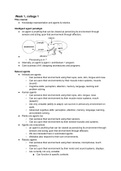
● An agent is anything that can be viewed as perceiving its environment through
sensors and acting upon that environment through effectors.
●
○ Processing is in ?
● Internally, an agent is agent = architecture + program
● Core business of AI: designing architectures and programs.
Natural agents
● Animals are agents
○ Can perceive their environment using their eyes, ears, skin, tongue and nose.
○ Can act upon their environments by their muscle motor systems, mounts
(sound)
○ Cognitive skills: perception, attention, memory, language, learning and
problem solving.
● Human agents
○ Can perceive their environment using their eyes, skin, tongue, nose.
○ Can act upon their environment by their muscle motor systems, mouth
(speech)
○ Are very versatile (ability to adapt): can survive in almost any environment on
earth.
○ Advanced cognitive skills: perception, attention, memory, language, learning,
and problem solving.
● Plants are agents too
○ Can perceive their environment using their sensors.
○ Can act upon their environment by their several muscles and systems.
● Agents are everywhere
○ an agent is anything that can be viewed as perceiving its environment through
sensors and acting upon that environment through effectors.
○ We are interested here in automated agents.
○ Websites also respond to their own environments.
● Robotic agents
○ Can perceive their environment using their cameras, microphones, touch
sensors,...
○ Can act upon their environment by their motor and sound systems, displays.
○ Are currently not very versatile:
■ Can function is specific contexts.
, ○ Do currently not yet have advanced cognitive skills:
■ Limited perception, attention, memory etc.
Intelligent agents
● Reactive:
○ Ability to receive information and respond.
● Proactive:
○ Ability to take the initiative.
● Social: ability to communicate and cooperate.
● Autonomous:
○ Agents control their own processes.
About being social
● Human interaction skills go way beyond the robot interactions skills yet.
○ But robots have their own repertoire for interaction, for example displays and
lights.
○ Robots do not try to replicate humans necessary.
Which are intelligent agents
● Plants are not really intelligent in intuition.
● It is not really clear what is intelligent and what not.
Cognitive(-affective) agents
● An agents is anything that can be (usefully) viewed as a system that has:
○ Beliefs, desires, goals, intentions, plans, expectations, hopes, fears, joy,...
○ …
Intentional systems
● First-order
○ bel(p): the agent believes that p
○ goal(p): the agent has a goal (or wants) that p
● Second-order
○ bel(a;bel(b;p)): a believes that p
○ We now use more first-order
Our notion of cognitive agent
● Agents with the following basic capabilities:
, ○ Event processing
■ Process events like percepts and messages.
○ Knowledge representation
■ Process events like percepts and messages.
■ It allows us to maintain a model of the environment and other agents.
○ Decision-making:
■ Agent is able to select an action based on its beliefs, knowledge, and
goals.
Cognitive state
● The internal state of a cognitive agent is called a cognitive state.
● Typically it includes
○ Event component
■ Percepts
■ Messages
○ Informational component:
■ Knowledge (static)
■ Beliefs (dynamic)
○ Motivational component (what the agent wants to achieve):
■ Goals
○
Environments
● It is very important to emphasize that agents are situated in an environment.
● Percepts:
○ Agents to usually not see the real state of the environment but only receive
percepts.
○ Designer:
■ The designer has to process percepts and possibly store them within
the agent’s memory.
○ Environment-properties:
■ As such it is very important to know the characteristics of an
environment, before designing an agent.
Properties of environments
● Fully/partially observable: if the environment is not completely observable the agent
will need internal states.
● Deterministic/stocastic:
○ Deterministic if completely determined by agent’s action.
, ○ If the environment is only partially observable, then it may appear stochastic
(while it is deterministic).
● Static/dynamic:
○ The environment can change while an agent is deliberating.
● Discrete/continuous: if there is a limited number of percepts and actions the
environment is discrete.
● Single/multi agents: is there just one agent or are there several interacting with each
other.
Cognitive agents and environments
● For cognitive agens we take the view the an en enviroment offers controllable entities
which are connected to cognitive agents.
● Possible view:
○ Cognitive agent is the mind
● controllable entity is the body.
●
● An action specification defines which actions are available to an agent and when.
○ It is defined by the environment.
Interaction with environment and agents
● Observation: how can the agent observe its environment?
○ Passive
■ The agent receives the results of observations without taking any
initiative or control to observe.
○ Active
■ The agent actively ini….
Summary
● The (material) world state
● Performing observations in the world
● Execution of action in the world
● Performing communication with other agents
● An agent’s own knowledge
● An agent’s own assumptions (for example beliefs)
● An agent’s own reasoning and acting processes.
● Other agent’s…
Cognitive agent programming
This course:
● Knowledge representation and agents & robotics
Intelligent agent paradigm
● An agent is anything that can be viewed as perceiving its environment through
sensors and acting upon that environment through effectors.
●
○ Processing is in ?
● Internally, an agent is agent = architecture + program
● Core business of AI: designing architectures and programs.
Natural agents
● Animals are agents
○ Can perceive their environment using their eyes, ears, skin, tongue and nose.
○ Can act upon their environments by their muscle motor systems, mounts
(sound)
○ Cognitive skills: perception, attention, memory, language, learning and
problem solving.
● Human agents
○ Can perceive their environment using their eyes, skin, tongue, nose.
○ Can act upon their environment by their muscle motor systems, mouth
(speech)
○ Are very versatile (ability to adapt): can survive in almost any environment on
earth.
○ Advanced cognitive skills: perception, attention, memory, language, learning,
and problem solving.
● Plants are agents too
○ Can perceive their environment using their sensors.
○ Can act upon their environment by their several muscles and systems.
● Agents are everywhere
○ an agent is anything that can be viewed as perceiving its environment through
sensors and acting upon that environment through effectors.
○ We are interested here in automated agents.
○ Websites also respond to their own environments.
● Robotic agents
○ Can perceive their environment using their cameras, microphones, touch
sensors,...
○ Can act upon their environment by their motor and sound systems, displays.
○ Are currently not very versatile:
■ Can function is specific contexts.
, ○ Do currently not yet have advanced cognitive skills:
■ Limited perception, attention, memory etc.
Intelligent agents
● Reactive:
○ Ability to receive information and respond.
● Proactive:
○ Ability to take the initiative.
● Social: ability to communicate and cooperate.
● Autonomous:
○ Agents control their own processes.
About being social
● Human interaction skills go way beyond the robot interactions skills yet.
○ But robots have their own repertoire for interaction, for example displays and
lights.
○ Robots do not try to replicate humans necessary.
Which are intelligent agents
● Plants are not really intelligent in intuition.
● It is not really clear what is intelligent and what not.
Cognitive(-affective) agents
● An agents is anything that can be (usefully) viewed as a system that has:
○ Beliefs, desires, goals, intentions, plans, expectations, hopes, fears, joy,...
○ …
Intentional systems
● First-order
○ bel(p): the agent believes that p
○ goal(p): the agent has a goal (or wants) that p
● Second-order
○ bel(a;bel(b;p)): a believes that p
○ We now use more first-order
Our notion of cognitive agent
● Agents with the following basic capabilities:
, ○ Event processing
■ Process events like percepts and messages.
○ Knowledge representation
■ Process events like percepts and messages.
■ It allows us to maintain a model of the environment and other agents.
○ Decision-making:
■ Agent is able to select an action based on its beliefs, knowledge, and
goals.
Cognitive state
● The internal state of a cognitive agent is called a cognitive state.
● Typically it includes
○ Event component
■ Percepts
■ Messages
○ Informational component:
■ Knowledge (static)
■ Beliefs (dynamic)
○ Motivational component (what the agent wants to achieve):
■ Goals
○
Environments
● It is very important to emphasize that agents are situated in an environment.
● Percepts:
○ Agents to usually not see the real state of the environment but only receive
percepts.
○ Designer:
■ The designer has to process percepts and possibly store them within
the agent’s memory.
○ Environment-properties:
■ As such it is very important to know the characteristics of an
environment, before designing an agent.
Properties of environments
● Fully/partially observable: if the environment is not completely observable the agent
will need internal states.
● Deterministic/stocastic:
○ Deterministic if completely determined by agent’s action.
, ○ If the environment is only partially observable, then it may appear stochastic
(while it is deterministic).
● Static/dynamic:
○ The environment can change while an agent is deliberating.
● Discrete/continuous: if there is a limited number of percepts and actions the
environment is discrete.
● Single/multi agents: is there just one agent or are there several interacting with each
other.
Cognitive agents and environments
● For cognitive agens we take the view the an en enviroment offers controllable entities
which are connected to cognitive agents.
● Possible view:
○ Cognitive agent is the mind
● controllable entity is the body.
●
● An action specification defines which actions are available to an agent and when.
○ It is defined by the environment.
Interaction with environment and agents
● Observation: how can the agent observe its environment?
○ Passive
■ The agent receives the results of observations without taking any
initiative or control to observe.
○ Active
■ The agent actively ini….
Summary
● The (material) world state
● Performing observations in the world
● Execution of action in the world
● Performing communication with other agents
● An agent’s own knowledge
● An agent’s own assumptions (for example beliefs)
● An agent’s own reasoning and acting processes.
● Other agent’s…
Cognitive agent programming



