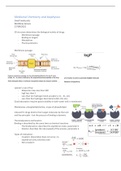
Medicinal chemistry and biophysics
Small molecules
Matthew Groves
27/09/2021
3D structure determines the biological activity of drugs:
- Membrane passage
- Binding to targets
- Metabolism
- Pharmacokinetics
Membrane passage:
Lipinski’s rule of five:
- Molecular mass less than 500
- logP less than 5
- Less than ten hydrogen bond acceptors (-O-, -N-, etc)
- Less than five hydrogen bond donors (NH, OH, etc)
Good absorption requires good solubility in both water and in membranes
Membranes: phosphatidylcholine, a type of phospholipid.
Induced fit: drugs bind to their target molecules by the Lock
and Key principle – but the process of binding is dynamic.
Thermodynamics and kinetics:
Binding is described by the same laws as chemical reactions
- Thermodynamics: describes the equilibrium state, parameter K
- Kinetics: describes the rate (speed) of the process, parameter k
Types of interaction:
- Covalent: dissociation does not occur, no
equilibrium only a (kinetic) rate
- Non-covalent:
,Energetics of drugs: target interaction
Each new interaction provides a CHANGE in (ΔG) the Gibb’s free energy. Gibbs free energy (G) is the
energy required to build the system from nothing. Energy required to create state from vacuum.
Important descriptor of the change that occur over a binding or reaction process.
Thermodynamics and kinetics:
Enthalpy (ΔH) and entropy (ΔS) are the driving forces of a reaction.
Entropy is a measure of the ordering of the system.
Kinetics:
The speed of the reaction depends on the activation energy.
Kd = exp (ΔG/R.T) R = gas constant, T = temperature
Non-covalent binding is achieved by many simultaneous interactions between the ligand and the
macromolecule.
Electrostatic interactions (ion-ion):
- Opposite charges attract
- Equal charges repel
Typical interaction energy 4-8 kcal/mol, geometry plays an important role, contributes to enthalpy.
Other types of electrostatic interactions: ion-ion dipole interactions
Hydrogen bonds, 1-7 kcal/mol. Acceptors O/N/F, donors OH/NH. Contributes to enthalpy. Not distant
dependent
Hydrophobic interactions: entropy (solvation) is the driving force (1 kcal/mol). Assembly with
minimal disruption of the solvent, hydrogen bonding networks. Contributes to the entropy, geometry
less important.
Role of entropy in binding:
- Reduced ligand flexibility > lower entropy
- Removal of solvation shell around both bindings partners > increases entropy
The contribution of one H-bridge to binding:
NH allows H-bridges, O gives repulsion, and CH2 gives no effect.
Contribution of hydrophobic interactions to binding:
There is no strong correlation but the trend seems to be that more ‘buried’ (large) hydrophobic
surface leads to stronger binding.
Enthalpy-entropy compensation:
Weaker ionic interactions (ΔH) can be compensated for by improved hydrophobics (ΔS) and vice
versa.
Modifications are cumulative:
Different optimization routes may lead to the same molecule. The effect of two independent
substituents is cumulative. We refer to a ΔΔG (a change in the ΔG).
,For distribution over the body the drug must pass through membranes. Membranes are composed of
lipids. Biological activity requires an interaction between drug and target (binding). The 3D structure
of a drug influences the biological activity and membrane passage. In addition, the metabolism and
pharmacokinetics are determined by the 3D structure of the drug.
Biologically active compounds must traverse membranes and bind to receptors. Types of interactions
are covalent and non-covalent. Interactions (drug hit – lead) are described by thermodynamics and
kinetics.
MedChem I
Alexander Dömling
28/09/2021
Pharmacological properties: target binding, target residence time, target
selectivity. Involving the selective binding of the drug to achieve biological effect.
Drug-like properties: bioavailability, permeability, stability, solubility. Ensures
that the drug is exerting its biological effects in the complex human body with
acceptable toxicities.
Evolution of drug discovery technologies over time: pharmacology screening had changed from
direct testing in living systems to in vitro high-throughput screening. Initial leads (hits) for
optimization have changed from natural products and natural ligands to large libraries of diverse
structures. Compounds design has been enhanced from structure-activity relationships by the
addition of x-ray crystallography and NMR binding studies and computational modelling. Lead
optimization chemistry has been enhanced from one-at-a-time synthesis by the addition of parallel
synthesis. Traditional sequential experiments have been enhanced with parallel experiments, such as
microtiter plate formats. Miniaturisation + automation > acceleration.
Drug-like properties:
- Structural: hydrogen bonding, polar surface area, lipophilicity, shape, molecular weight,
reactivity, pKa
- Physicochemical: influenced by the physical environment. Solubility, permeability, chemical
stability
- Biochemical: influenced by proteins. Metabolism (phase I and II), protein/tissue binding,
transport (uptake, efflux)
- Pharmacokinetics (PK) and toxicity: influenced by the living system. Clearance, half-life,
bioavailability, drug-drug interaction, LD50
, DMTA
Lifetime of drug:
- Pre-clinical R&D: discovery and optimization, GMP development, IND
- Clinical R&D: phase I-V, NDA
- Marketing phase: post-clinical R&D, new indications for clinical R&D
- Generic phase: after 20 years, all companies can make en sell the medication
Reasons of failing of drugs: pharmacokinetics, animal
toxicity, miscellaneous, adverse effects in man,
commercial reasons, lack of efficacy.
Underlying biology poorly understood
Most drugs fail in later clinical development.
Development attrition is reduced by improving drug
properties (40 > 10%). Drugs failing is biggest in the
transition between phase II and III clinical trails
Drug discovery and development (DD&D)
costs dramatically increase:
Poor properties can cause poor discovery:
Low or inconsistent bioactivity responses for in vitro bioassays can be due to precipitation, owing to
low solubility of the compound in the bioassay medium or in dilution prior to the assay.
Low activity in bioassays may be due to chemical instability of the compound in the test matrix.
An unexpectedly high drop in activity can result when transitioning from enzyme or receptor activity
assays to cell-based assays. This can be due to poor permeability of the compounds through the cell
membrane, which must be penetrated for the compound to reach intracellular targets.
Small molecules
Matthew Groves
27/09/2021
3D structure determines the biological activity of drugs:
- Membrane passage
- Binding to targets
- Metabolism
- Pharmacokinetics
Membrane passage:
Lipinski’s rule of five:
- Molecular mass less than 500
- logP less than 5
- Less than ten hydrogen bond acceptors (-O-, -N-, etc)
- Less than five hydrogen bond donors (NH, OH, etc)
Good absorption requires good solubility in both water and in membranes
Membranes: phosphatidylcholine, a type of phospholipid.
Induced fit: drugs bind to their target molecules by the Lock
and Key principle – but the process of binding is dynamic.
Thermodynamics and kinetics:
Binding is described by the same laws as chemical reactions
- Thermodynamics: describes the equilibrium state, parameter K
- Kinetics: describes the rate (speed) of the process, parameter k
Types of interaction:
- Covalent: dissociation does not occur, no
equilibrium only a (kinetic) rate
- Non-covalent:
,Energetics of drugs: target interaction
Each new interaction provides a CHANGE in (ΔG) the Gibb’s free energy. Gibbs free energy (G) is the
energy required to build the system from nothing. Energy required to create state from vacuum.
Important descriptor of the change that occur over a binding or reaction process.
Thermodynamics and kinetics:
Enthalpy (ΔH) and entropy (ΔS) are the driving forces of a reaction.
Entropy is a measure of the ordering of the system.
Kinetics:
The speed of the reaction depends on the activation energy.
Kd = exp (ΔG/R.T) R = gas constant, T = temperature
Non-covalent binding is achieved by many simultaneous interactions between the ligand and the
macromolecule.
Electrostatic interactions (ion-ion):
- Opposite charges attract
- Equal charges repel
Typical interaction energy 4-8 kcal/mol, geometry plays an important role, contributes to enthalpy.
Other types of electrostatic interactions: ion-ion dipole interactions
Hydrogen bonds, 1-7 kcal/mol. Acceptors O/N/F, donors OH/NH. Contributes to enthalpy. Not distant
dependent
Hydrophobic interactions: entropy (solvation) is the driving force (1 kcal/mol). Assembly with
minimal disruption of the solvent, hydrogen bonding networks. Contributes to the entropy, geometry
less important.
Role of entropy in binding:
- Reduced ligand flexibility > lower entropy
- Removal of solvation shell around both bindings partners > increases entropy
The contribution of one H-bridge to binding:
NH allows H-bridges, O gives repulsion, and CH2 gives no effect.
Contribution of hydrophobic interactions to binding:
There is no strong correlation but the trend seems to be that more ‘buried’ (large) hydrophobic
surface leads to stronger binding.
Enthalpy-entropy compensation:
Weaker ionic interactions (ΔH) can be compensated for by improved hydrophobics (ΔS) and vice
versa.
Modifications are cumulative:
Different optimization routes may lead to the same molecule. The effect of two independent
substituents is cumulative. We refer to a ΔΔG (a change in the ΔG).
,For distribution over the body the drug must pass through membranes. Membranes are composed of
lipids. Biological activity requires an interaction between drug and target (binding). The 3D structure
of a drug influences the biological activity and membrane passage. In addition, the metabolism and
pharmacokinetics are determined by the 3D structure of the drug.
Biologically active compounds must traverse membranes and bind to receptors. Types of interactions
are covalent and non-covalent. Interactions (drug hit – lead) are described by thermodynamics and
kinetics.
MedChem I
Alexander Dömling
28/09/2021
Pharmacological properties: target binding, target residence time, target
selectivity. Involving the selective binding of the drug to achieve biological effect.
Drug-like properties: bioavailability, permeability, stability, solubility. Ensures
that the drug is exerting its biological effects in the complex human body with
acceptable toxicities.
Evolution of drug discovery technologies over time: pharmacology screening had changed from
direct testing in living systems to in vitro high-throughput screening. Initial leads (hits) for
optimization have changed from natural products and natural ligands to large libraries of diverse
structures. Compounds design has been enhanced from structure-activity relationships by the
addition of x-ray crystallography and NMR binding studies and computational modelling. Lead
optimization chemistry has been enhanced from one-at-a-time synthesis by the addition of parallel
synthesis. Traditional sequential experiments have been enhanced with parallel experiments, such as
microtiter plate formats. Miniaturisation + automation > acceleration.
Drug-like properties:
- Structural: hydrogen bonding, polar surface area, lipophilicity, shape, molecular weight,
reactivity, pKa
- Physicochemical: influenced by the physical environment. Solubility, permeability, chemical
stability
- Biochemical: influenced by proteins. Metabolism (phase I and II), protein/tissue binding,
transport (uptake, efflux)
- Pharmacokinetics (PK) and toxicity: influenced by the living system. Clearance, half-life,
bioavailability, drug-drug interaction, LD50
, DMTA
Lifetime of drug:
- Pre-clinical R&D: discovery and optimization, GMP development, IND
- Clinical R&D: phase I-V, NDA
- Marketing phase: post-clinical R&D, new indications for clinical R&D
- Generic phase: after 20 years, all companies can make en sell the medication
Reasons of failing of drugs: pharmacokinetics, animal
toxicity, miscellaneous, adverse effects in man,
commercial reasons, lack of efficacy.
Underlying biology poorly understood
Most drugs fail in later clinical development.
Development attrition is reduced by improving drug
properties (40 > 10%). Drugs failing is biggest in the
transition between phase II and III clinical trails
Drug discovery and development (DD&D)
costs dramatically increase:
Poor properties can cause poor discovery:
Low or inconsistent bioactivity responses for in vitro bioassays can be due to precipitation, owing to
low solubility of the compound in the bioassay medium or in dilution prior to the assay.
Low activity in bioassays may be due to chemical instability of the compound in the test matrix.
An unexpectedly high drop in activity can result when transitioning from enzyme or receptor activity
assays to cell-based assays. This can be due to poor permeability of the compounds through the cell
membrane, which must be penetrated for the compound to reach intracellular targets.