

2.1 Problem 3: Can’t Get You Out of My Head
Robinson: Cognitive Psychology – Applying the Science of the Mind
Recalling a Life: Developmental Aspects of Autobiographical Memory
Galton-Crovitz cue-word technique = participants presented w/word cues, asked to retrieve
an autobiographical memory associated w/each cue, write a short description of it and date
the event
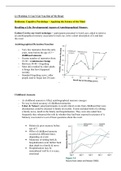
Autobiographical Retention Function
- Very few memories from the early
years, none before the age of 3 =
childhood amnesia
- Greater number of memories from
10-30 = reminiscence bump
- Between 30-40 = forgetting
- Most info recalled by older adults
is things that have happened
recently
- Standard forgetting curve: older
people tend to forget last 20 years
Childhood Amnesia
- As childhood amnesia is lifted, autobiographical memory emerges
- No way to check accuracy of childhood memories
- Usher & Neisser: asked participants to recall critical events from childhood that were
documented, could be checked w/family & records. Events included birth of a sibling,
a family move, death in the family and hospitalisation. They were also asked how
frequently they rehearsed this info & whether they had been exposed to pictures of it.
Memory was tested w/a set of basic questions about the event.
Relatively poor memory before
age of 5
Offset of childhood amnesia
occurred at different times,
depending on event
Memories of sibling birth &
hospitalisation went further back
than death in a family & move
Hospitalisation may be
remembered well bc it is scary,
emotional
, Sibling birth may be remembered well bc it is a story that will be told again
and again (language development is major factor of autobiographical memory)
Effect of rehearsal depended on child’s age at the time of experience
If child was 3 or younger, family stories & photos led to fewer memories
If child was 4/5, they made memories stronger
A 3 year old’s memory may be more fragile, memories could be confused by
stories & photos
Emergence of Autobiographical Memory
Brain Development
- Immaturity of developing infant brain. Neurological structures needed for processing
not fully formed, hippocampal regions (needed for forming new memories) are
underdeveloped, prefrontal cortex still developing
- Infants have early developing procedural system that allows them to succeed on
relatively simple memory tasks & a later-developing system that serves as a basis for
more complex memories. Later-developing system serves as basis for
autobiographical memories
However, this explanation could be over-simplified. Would only explain childhood
amnesia for events that occur extremely early in life.
Children themselves also don’t exhibit childhood amnesia; little kids can remember
things from when they were younger. Therefore, their basic brain ‘machinery’ must
be in place, so cause of childhood amnesia can’t be purely neurological
Development of Language
- Pillemer & White: children begin to remember events as soon as they are able to
describe them. Children make most linguistic strides between ages 2 and 4
- Narrative style = the way that families reminisce about, or narrate, past events.
When conversing w/daughters, parents adopt an elaborative style (long, detailed
discussions of past events)
When conversing w/sons, parents adopt a pragmatic style (less detail)
Style of reminiscing influences quality of childhood memories; elaborative >
pragmatic. Females usually seen to be better at autobiographical recall
- Parents play a large role in development of autobiographical memory
Development of Cognitive Self
- Howe & Courage: didn’t believe that language was critical in emergence of
autobiographical memory. They view language as the mechanism that allows
autobiographical memory to be ‘let out’, but not the basis of development.
Determining factor was child’s sense of self (self-concept) = knowledge that one is a
person w/unique characteristics, and that one thinks & knows things about the world,
independent. This becomes important organiser of autobiographical experiences
- Wang: cross-cultural differences in development of sense of self & effect on
childhood memories
Western memories more individualistic – based on the self. Westerners also had
earlier childhood memories than Easterners did
Eastern memories more collectivistic – based on others, relationships
Robinson: Cognitive Psychology – Applying the Science of the Mind
Recalling a Life: Developmental Aspects of Autobiographical Memory
Galton-Crovitz cue-word technique = participants presented w/word cues, asked to retrieve
an autobiographical memory associated w/each cue, write a short description of it and date
the event
Autobiographical Retention Function
- Very few memories from the early
years, none before the age of 3 =
childhood amnesia
- Greater number of memories from
10-30 = reminiscence bump
- Between 30-40 = forgetting
- Most info recalled by older adults
is things that have happened
recently
- Standard forgetting curve: older
people tend to forget last 20 years
Childhood Amnesia
- As childhood amnesia is lifted, autobiographical memory emerges
- No way to check accuracy of childhood memories
- Usher & Neisser: asked participants to recall critical events from childhood that were
documented, could be checked w/family & records. Events included birth of a sibling,
a family move, death in the family and hospitalisation. They were also asked how
frequently they rehearsed this info & whether they had been exposed to pictures of it.
Memory was tested w/a set of basic questions about the event.
Relatively poor memory before
age of 5
Offset of childhood amnesia
occurred at different times,
depending on event
Memories of sibling birth &
hospitalisation went further back
than death in a family & move
Hospitalisation may be
remembered well bc it is scary,
emotional
, Sibling birth may be remembered well bc it is a story that will be told again
and again (language development is major factor of autobiographical memory)
Effect of rehearsal depended on child’s age at the time of experience
If child was 3 or younger, family stories & photos led to fewer memories
If child was 4/5, they made memories stronger
A 3 year old’s memory may be more fragile, memories could be confused by
stories & photos
Emergence of Autobiographical Memory
Brain Development
- Immaturity of developing infant brain. Neurological structures needed for processing
not fully formed, hippocampal regions (needed for forming new memories) are
underdeveloped, prefrontal cortex still developing
- Infants have early developing procedural system that allows them to succeed on
relatively simple memory tasks & a later-developing system that serves as a basis for
more complex memories. Later-developing system serves as basis for
autobiographical memories
However, this explanation could be over-simplified. Would only explain childhood
amnesia for events that occur extremely early in life.
Children themselves also don’t exhibit childhood amnesia; little kids can remember
things from when they were younger. Therefore, their basic brain ‘machinery’ must
be in place, so cause of childhood amnesia can’t be purely neurological
Development of Language
- Pillemer & White: children begin to remember events as soon as they are able to
describe them. Children make most linguistic strides between ages 2 and 4
- Narrative style = the way that families reminisce about, or narrate, past events.
When conversing w/daughters, parents adopt an elaborative style (long, detailed
discussions of past events)
When conversing w/sons, parents adopt a pragmatic style (less detail)
Style of reminiscing influences quality of childhood memories; elaborative >
pragmatic. Females usually seen to be better at autobiographical recall
- Parents play a large role in development of autobiographical memory
Development of Cognitive Self
- Howe & Courage: didn’t believe that language was critical in emergence of
autobiographical memory. They view language as the mechanism that allows
autobiographical memory to be ‘let out’, but not the basis of development.
Determining factor was child’s sense of self (self-concept) = knowledge that one is a
person w/unique characteristics, and that one thinks & knows things about the world,
independent. This becomes important organiser of autobiographical experiences
- Wang: cross-cultural differences in development of sense of self & effect on
childhood memories
Western memories more individualistic – based on the self. Westerners also had
earlier childhood memories than Easterners did
Eastern memories more collectivistic – based on others, relationships



