LECTURES
Accounting provides information to summarize all kind of actions, decisions, results,
transactions into figures to steer the business and inform stakeholders.
Specification of content = accounting
Accounting information systems = organization
Standard setters make a rule based on how users of accounting information get the
most relevant and reliable information.
Financial accounting external financial reporting and bookkeeping (for
stakeholders)
Management accounting internal information for decision-making, performance
evaluation, and control.
To discuss:
- Formal relations
- Norms for contents
Balance sheet: overview of the firm’s situation at a point in time
Assets: what the firm owns, what it has done with the funds it received
Liabilities: what the firm owes, where the funds came from. Split into equity (funds
from owners) and other liabilities
Profit and loss statement: the results of a company over a period of time.
Cash flow statement: the flow of money into and out of the company over a period
of time.
Cashflow total = cash in – cash out
Equity is the value for the owners (stockholders, shareholders). So, if you earn
money as a firm, EQUITY increases. This should be visible in higher assets [e.g.,
cash (you received money)] or lower liabilities [e.g., you used profits to repay a loan].
Changes in other assets and liabilities correct for the fact that not all value changes
are identical to cash flow changes!
,The basic relationships:
“Revenues” in the income statement are:
- cash receipts, or
- increases in other assets, or
- decreases in liabilities
Thus, also increase in equity (Credit)
“Expenses” in income statement are:
- cash expenditures, or
- decreases in other assets, or
- increases in liabilities
Thus, also decrease in equity (Debit)
Basic relations including transactions with owners:
The basic accounting equation:
Assets = liabilities + owner’s equity
Assets = liabilities + owner’s capital – owner’s drawings + revenues – expenses
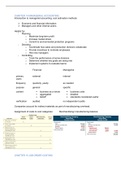
Expanded accounting equation:
,Journal for a transaction
Form: name account (debited)
To: name account (credited)
Profit and loss statement provides stakeholders with info on how the firm has
performed during a period!
Assets = liabilities + equity
Actual closing: get overview by following steps
Close assets and liabilities to balance sheet
Close revenues and expenses to P&L
Close P&L to Equity
Close Equity to balance sheet
Trial balance: Overview of all net debits and credits of all accounts.
Way to find errors and get a current overview.
Provide services
Accounts receivable | To: sale revenue
Moment of payment insurance
Prepaid insurance (asset) | To: cash (no P&L effect)
Adjustment at the end of each month for part of the insurance premium
Insurance expense (P&L) | To: prepaid insurance
Depreciation of a machine
Depreciation expense (P&L) | To: Accumulated depreciation (correction on
value of asset of the machine)
, Wages are not yet paid but of course work relates to this period Allocate fraction to
this period
Wages expense (P&L) | To: Wages payable (liability)
Balance sheet:
- Helpful to evaluate liquidity, can the firm pay what it has to pay?
- Rule of thumb < 1 year, held for less than one operating cycle
Four basic questions financial
statement analysis:
- Can the firm meet its short-term
obligations?
- Can the firm meet its long-term
obligations?
- How profitable is the firm? / How
does it make its profits?
- What is the value of a share / the
entire firm?
Accounting provides information to summarize all kind of actions, decisions, results,
transactions into figures to steer the business and inform stakeholders.
Specification of content = accounting
Accounting information systems = organization
Standard setters make a rule based on how users of accounting information get the
most relevant and reliable information.
Financial accounting external financial reporting and bookkeeping (for
stakeholders)
Management accounting internal information for decision-making, performance
evaluation, and control.
To discuss:
- Formal relations
- Norms for contents
Balance sheet: overview of the firm’s situation at a point in time
Assets: what the firm owns, what it has done with the funds it received
Liabilities: what the firm owes, where the funds came from. Split into equity (funds
from owners) and other liabilities
Profit and loss statement: the results of a company over a period of time.
Cash flow statement: the flow of money into and out of the company over a period
of time.
Cashflow total = cash in – cash out
Equity is the value for the owners (stockholders, shareholders). So, if you earn
money as a firm, EQUITY increases. This should be visible in higher assets [e.g.,
cash (you received money)] or lower liabilities [e.g., you used profits to repay a loan].
Changes in other assets and liabilities correct for the fact that not all value changes
are identical to cash flow changes!
,The basic relationships:
“Revenues” in the income statement are:
- cash receipts, or
- increases in other assets, or
- decreases in liabilities
Thus, also increase in equity (Credit)
“Expenses” in income statement are:
- cash expenditures, or
- decreases in other assets, or
- increases in liabilities
Thus, also decrease in equity (Debit)
Basic relations including transactions with owners:
The basic accounting equation:
Assets = liabilities + owner’s equity
Assets = liabilities + owner’s capital – owner’s drawings + revenues – expenses
Expanded accounting equation:
,Journal for a transaction
Form: name account (debited)
To: name account (credited)
Profit and loss statement provides stakeholders with info on how the firm has
performed during a period!
Assets = liabilities + equity
Actual closing: get overview by following steps
Close assets and liabilities to balance sheet
Close revenues and expenses to P&L
Close P&L to Equity
Close Equity to balance sheet
Trial balance: Overview of all net debits and credits of all accounts.
Way to find errors and get a current overview.
Provide services
Accounts receivable | To: sale revenue
Moment of payment insurance
Prepaid insurance (asset) | To: cash (no P&L effect)
Adjustment at the end of each month for part of the insurance premium
Insurance expense (P&L) | To: prepaid insurance
Depreciation of a machine
Depreciation expense (P&L) | To: Accumulated depreciation (correction on
value of asset of the machine)
, Wages are not yet paid but of course work relates to this period Allocate fraction to
this period
Wages expense (P&L) | To: Wages payable (liability)
Balance sheet:
- Helpful to evaluate liquidity, can the firm pay what it has to pay?
- Rule of thumb < 1 year, held for less than one operating cycle
Four basic questions financial
statement analysis:
- Can the firm meet its short-term
obligations?
- Can the firm meet its long-term
obligations?
- How profitable is the firm? / How
does it make its profits?
- What is the value of a share / the
entire firm?