

Summary OML
College 1: Introduction & Sustainable
strategy
Chapter 1 Introduction objectives
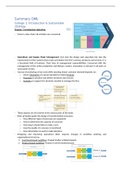
- Porters value chain: All activities are connected.
- Operations and Supply Chain Management: Not only the design and operation but also the
improvement of the systems that create and deliver the firm’s primary products and services. It is
a functional field of business. Clear lines of management responsibilities. Concerned with the
management of the entire production and delivery system. Innovation is relevant in all parts at
some point in time.
- Success of producing at low costs while meeting (mass) customer demand depends on:
o Clever integration of a great operations-related strategy.
o Processes to produce and deliver products and services.
o Analytics to support the decisions needed to manage the firm.
- These aspects are all covered in the various parts of the book:
- Basic principles guide the design of transformation processes:
o How different types of processes are organized
o How to determine the capacity of a process
o How long it should take to make a unit
o How the quality of a process is monitored
o How information is used to make decisions
- Designing and improving operations often requires changes in workflow ordering and
organizational structure:
1. Functional-based workflow: Product B after A (Batch-based).
2. Product-based workflow: Product A and B simultaneously.
,- Producing and delivering goods is different compared with services:
- Product-service bundling: Selling a product with a service or integrating products and services.
- Various OSCM concepts have become popular through time:
- Current Issues in operations and supply chain management :
o Coordinating the relationships between mutually supportive but separate organizations.
o Optimizing global supplier, production, and distribution networks.
o Managing customer touch points.
o Raising senior management awareness of OSCM as a significant competitive weapon
- Efficiency: Doing something at the lowest possible cost (is doing things right).
- Effectiveness: Doing the right things to create the most value for the company.
o Value: Quality divided by price.
o Quality: The attractiveness of the product, considering its features and durability.
- From a marketing point of view, value is the benefits perceived by the customer minus the costs
of acquisition and use of a product.
- Benchmarking based on management efficiency ratios (the higher, the better):
Annual Credit Sales
o Firms prefer cash over credits: Receivable Turnover=
Average Account Receivables
Cost Of Goods Sold (COGS)
o Firms prefer low inventory costs: Receivable Turnover=
Average Inventory Value
o Firms prefer low asset value compared with revenues:
Revenue (¿ Sales)
Asset Turnover=
Total assets
- Summary of Chapter 1:
o Various processes are associated with OSCM and used to implement the strategy of the
firm.
o Analytics are used to support the ongoing decisions needed to manage the firm.
o OSCM hands on people specialize in managing the production and delivery of goods and
services.
o Firms face increasing pressure on mass customization and quality in combination with
efficiency and speed that is reflected in OSCM.
o Currently, supply chain control, servitization, sustainability and Industry 4.0 are of
paramount importance.
o Efficiency ratio’s help benchmarking firm practices to meet goals
Chapter 2: Sustainable operations and supply strategy
,- Sustainable strategy is aimed at pleasing not only shareholders but also other stakeholders:
o The firm’s strategy describes how it will create and sustain value for its current
shareholders.
Shareholders: Individuals or companies that legally own one or more shares of stock
in the company.
Stakeholders: Individuals or organizations who are directly or indirectly influenced by
the actions of the firm.
o Adding a sustainability requirement means meeting value goals without compromising the
ability of future generations to meet their own needs.
o It might even be the case that pleasing other stakeholders might in the end also please
shareholders.
o Triple bottom line: Evaluating the firm against social, economic, and environmental criteria.
- OSC managers also face the dilemma of using less materials vs. biodegrable vs. recycling
processes:
- The Operations and Supply Chain Strategy is focused on operations effectiveness:
o Operations and supply chain strategy: setting broad policies and plans for using the
resources of a firm.
o OSC strategy must be integrated with corporate strategy.
Corporate strategy: Provides overall direction and coordinates operational goals with
those of the larger organization.
o Operations effectiveness: Performing activities in a manner that best implements strategic
priorities at a minimum cost.
o But is also strongly related to the business strategy.
o Business strategies aimed at creating value for customers :
Cost excellence
Product differentiation
Focus
- The business strategy reflects competitive dimensions:
o Price: Make the product or deliver the service cheap.
o Quality: Make a great product or delivery a great service.
o Delivery Speed: Make the product or deliver the service quickly.
o Delivery Reliability: Deliver it when promised.
o Coping with Changes in Demand: Change volume.
o Flexibility and New-Product Introduction Speed
- Managers face trade-offs:
o Management must decide which parameters of performance are critical and concentrate
resources on those characteristics. For example, a firm that is focused on low-cost
production may not be capable of quickly introducing new products or producing in a
sustainable way.
, o Straddling: Seeking to match a successful competitor while maintaining its existing
position. It adds features, services, or technology to existing activities, but is often a risky
strategy.
- Such trade-offs require a focus on:
o Order qualifiers: Those dimensions that are necessary for a firm’s products to be
considered for purchase by customers. Features customers will not forego.
o Order winners: Criteria used by customers to differentiate the products and services of one
firm from those of other firms. Features that customers use to compare which product
they will purchase.
- Use risk mitigation strategies to confine the impact of disruptive events:
- Operational effectiveness is measured through productivity calculations:
- Summary of Chapter 2:
o A strategy that is sustainable needs to create value beyond stakeholder value.
o Operations and supply chain strategy involves setting the broad policies for using a firm’s
resources.
Coordinates operational goals with those of the corporate and business strategy.
o Operations and supply chain strategies need to be evaluated relative to their riskiness.
o Supply chain disruptions are unplanned and unanticipated events that disrupt the normal
flow of goods and materials.
Mitigations strategies reduce the impact of risks.
o Productivity measures are used to ensure that the firm makes the best use of its resources.
College 1: Introduction & Sustainable
strategy
Chapter 1 Introduction objectives
- Porters value chain: All activities are connected.
- Operations and Supply Chain Management: Not only the design and operation but also the
improvement of the systems that create and deliver the firm’s primary products and services. It is
a functional field of business. Clear lines of management responsibilities. Concerned with the
management of the entire production and delivery system. Innovation is relevant in all parts at
some point in time.
- Success of producing at low costs while meeting (mass) customer demand depends on:
o Clever integration of a great operations-related strategy.
o Processes to produce and deliver products and services.
o Analytics to support the decisions needed to manage the firm.
- These aspects are all covered in the various parts of the book:
- Basic principles guide the design of transformation processes:
o How different types of processes are organized
o How to determine the capacity of a process
o How long it should take to make a unit
o How the quality of a process is monitored
o How information is used to make decisions
- Designing and improving operations often requires changes in workflow ordering and
organizational structure:
1. Functional-based workflow: Product B after A (Batch-based).
2. Product-based workflow: Product A and B simultaneously.
,- Producing and delivering goods is different compared with services:
- Product-service bundling: Selling a product with a service or integrating products and services.
- Various OSCM concepts have become popular through time:
- Current Issues in operations and supply chain management :
o Coordinating the relationships between mutually supportive but separate organizations.
o Optimizing global supplier, production, and distribution networks.
o Managing customer touch points.
o Raising senior management awareness of OSCM as a significant competitive weapon
- Efficiency: Doing something at the lowest possible cost (is doing things right).
- Effectiveness: Doing the right things to create the most value for the company.
o Value: Quality divided by price.
o Quality: The attractiveness of the product, considering its features and durability.
- From a marketing point of view, value is the benefits perceived by the customer minus the costs
of acquisition and use of a product.
- Benchmarking based on management efficiency ratios (the higher, the better):
Annual Credit Sales
o Firms prefer cash over credits: Receivable Turnover=
Average Account Receivables
Cost Of Goods Sold (COGS)
o Firms prefer low inventory costs: Receivable Turnover=
Average Inventory Value
o Firms prefer low asset value compared with revenues:
Revenue (¿ Sales)
Asset Turnover=
Total assets
- Summary of Chapter 1:
o Various processes are associated with OSCM and used to implement the strategy of the
firm.
o Analytics are used to support the ongoing decisions needed to manage the firm.
o OSCM hands on people specialize in managing the production and delivery of goods and
services.
o Firms face increasing pressure on mass customization and quality in combination with
efficiency and speed that is reflected in OSCM.
o Currently, supply chain control, servitization, sustainability and Industry 4.0 are of
paramount importance.
o Efficiency ratio’s help benchmarking firm practices to meet goals
Chapter 2: Sustainable operations and supply strategy
,- Sustainable strategy is aimed at pleasing not only shareholders but also other stakeholders:
o The firm’s strategy describes how it will create and sustain value for its current
shareholders.
Shareholders: Individuals or companies that legally own one or more shares of stock
in the company.
Stakeholders: Individuals or organizations who are directly or indirectly influenced by
the actions of the firm.
o Adding a sustainability requirement means meeting value goals without compromising the
ability of future generations to meet their own needs.
o It might even be the case that pleasing other stakeholders might in the end also please
shareholders.
o Triple bottom line: Evaluating the firm against social, economic, and environmental criteria.
- OSC managers also face the dilemma of using less materials vs. biodegrable vs. recycling
processes:
- The Operations and Supply Chain Strategy is focused on operations effectiveness:
o Operations and supply chain strategy: setting broad policies and plans for using the
resources of a firm.
o OSC strategy must be integrated with corporate strategy.
Corporate strategy: Provides overall direction and coordinates operational goals with
those of the larger organization.
o Operations effectiveness: Performing activities in a manner that best implements strategic
priorities at a minimum cost.
o But is also strongly related to the business strategy.
o Business strategies aimed at creating value for customers :
Cost excellence
Product differentiation
Focus
- The business strategy reflects competitive dimensions:
o Price: Make the product or deliver the service cheap.
o Quality: Make a great product or delivery a great service.
o Delivery Speed: Make the product or deliver the service quickly.
o Delivery Reliability: Deliver it when promised.
o Coping with Changes in Demand: Change volume.
o Flexibility and New-Product Introduction Speed
- Managers face trade-offs:
o Management must decide which parameters of performance are critical and concentrate
resources on those characteristics. For example, a firm that is focused on low-cost
production may not be capable of quickly introducing new products or producing in a
sustainable way.
, o Straddling: Seeking to match a successful competitor while maintaining its existing
position. It adds features, services, or technology to existing activities, but is often a risky
strategy.
- Such trade-offs require a focus on:
o Order qualifiers: Those dimensions that are necessary for a firm’s products to be
considered for purchase by customers. Features customers will not forego.
o Order winners: Criteria used by customers to differentiate the products and services of one
firm from those of other firms. Features that customers use to compare which product
they will purchase.
- Use risk mitigation strategies to confine the impact of disruptive events:
- Operational effectiveness is measured through productivity calculations:
- Summary of Chapter 2:
o A strategy that is sustainable needs to create value beyond stakeholder value.
o Operations and supply chain strategy involves setting the broad policies for using a firm’s
resources.
Coordinates operational goals with those of the corporate and business strategy.
o Operations and supply chain strategies need to be evaluated relative to their riskiness.
o Supply chain disruptions are unplanned and unanticipated events that disrupt the normal
flow of goods and materials.
Mitigations strategies reduce the impact of risks.
o Productivity measures are used to ensure that the firm makes the best use of its resources.




