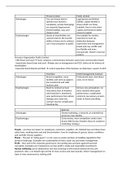
Be able to create a customer profile (traditional segmentation and persona)
- Segment the market (based on numerous variables)
Psychographic (needs & wishes), behavioral (occasions for travel & frequency, what they
expect & spending) & demographical (education, generation)
- Decide which segments you want to focus on (target groups)
- Make a traditional customer profile & persona of that target group
- Differences between traditional (group share same characteristics) & persona (fictional
character representing group)
Understand the impact of customer needs on a service concept
- Service concepts are created with the goal of satisfying a customer’s
needs and producing a service that provides benefit and value to the
customer.
- The customer need plays an important role on the service concept because
here the company determines their strategy and activities and try to
achieve the customers satisfaction.
- Basic needs & wishes (2 levels) Provide these to the customers
Be able to explain what a service concept is
- The service you sell to the customer
The service concept defines the how and the what of service design, and helps mediate
between customer needs and an organization's strategic intent. We define the service
concept and describe how it can be used to enhance a variety of service design processes.
,Recognize different aspects of a service concept
1. Service operation: the way in which the service is delivered;
2. User experience: the user’s direct experience of the service;
3. Service outcome: the benefits and results of the service for the
user;
4. Value: the benefits the user perceives as inherent in the service,
weighed against the cost of the service.
Core service - The core service of a company is what is essential to the
customer’s needs. The core service of a company are the central
component that supplies the principal, problem-solving benefits customers
seek. These are the bare minimum that a customer expects the company
to deliver.
Facilitating services The facilitating services are supplementary services
that are needed for service delivery. These include
1. Information -> information provides customers peace. Without
information, customers are left in the dark about what the company
entails
2. Invoicing -> customers want to know what they are paying for, how
much, when and how
3. Feedback -> customers want feedback on their product or service.
They want to know where their purchase is, if the transaction
succeeded or not and how long before they get their purchase
Enhancing services The enhancing services enhance the value and
appeal of the company and its products or services to make it more
attractive for customers. These include:
1. Hospitality -> making the customer feel welcome and wanted
2. Empathy -> empathy reflects the company’s ability and willingness
to listen to a customer’s needs and relate to their problems, needs
or frustrations
3. Availability -> the company should be accessible via telephone or
email to give information or advice
4. Safekeeping -> refers to keeping customer’s records safe and
private. If a company cannot do this, the customer will lose all trust
Be able to use an example to show the influence of customer needs on a service concept
, Session objectives:
- Able to explain a service blueprint, its function and its structure
The service blueprint is a technique originally used for service design, but has also found
applications in diagnosing problems with operational efficiency. The technique was first described
by G. Lynn Shostack, a bank executive, in the Harvard Business Review in 1984.
A simple way to think about blueprints is as a process chart which consists of inputs, process and
outputs.
Inputs (raw materials) → Process (transformation) → Outputs (finished goods)
A service blueprint is always constructed from the customer's perspective. A typical service
blueprint identifies:[2]
Customer Actions: The steps that customers take as part of the service delivery
process.
Front-stage (Visible Contact Employee) Actions: Steps taken by contact
employees as part of the face-to-face service encounter.
Back-stage (Invisible Contact Employee) Actions: (The 'line of visibility' separates
the front-stage and back-stage actions). Non-visible steps taken by contact
employees behind the line of visibility. e.g. taking a hotel or restaurant reservation
by telephone.
Support Processes: Activities carried out by employees who are not contact
employees, but whose actions are required for the service to be delivered.
Physical Evidence: Tangible elements associated with each step that has the
potential to influence customer perceptions of the service encounter e.g.
uniforms, delivery vans
Inventory (if required): the amount of inventory build up required for each step
Line of Visibility: Line that separates front-stage and back-stage actions
Optional inclusions – depending on intended application:[3]
Line of Interaction which separates customer actions from service provider
actions
Line of Internal Interaction which separates the back office and the support
process
Line of Implementation which separates management zone from the support
zone. That is management are responsible for planning and controlling while
support activities include preparation.
Yet other scholars and practitioners have recommended adding different lines including
Line of Order Penetration which separates customer-induced activities from
customer-independent activities
Minimum expected wait times
Potential bottlenecks and/or fail points
Service blueprint = A service blueprint is a diagram that visualizes the
relationships between different service components — people, props (physical or
digital evidence), and processes — that are directly tied to touchpoints in a
specific customer journey
Helps to discover weaknesses & identify
opportunities for optimization.
Figure 1: ADD UPWARDS (OUT OF ORG) AND
- Segment the market (based on numerous variables)
Psychographic (needs & wishes), behavioral (occasions for travel & frequency, what they
expect & spending) & demographical (education, generation)
- Decide which segments you want to focus on (target groups)
- Make a traditional customer profile & persona of that target group
- Differences between traditional (group share same characteristics) & persona (fictional
character representing group)
Understand the impact of customer needs on a service concept
- Service concepts are created with the goal of satisfying a customer’s
needs and producing a service that provides benefit and value to the
customer.
- The customer need plays an important role on the service concept because
here the company determines their strategy and activities and try to
achieve the customers satisfaction.
- Basic needs & wishes (2 levels) Provide these to the customers
Be able to explain what a service concept is
- The service you sell to the customer
The service concept defines the how and the what of service design, and helps mediate
between customer needs and an organization's strategic intent. We define the service
concept and describe how it can be used to enhance a variety of service design processes.
,Recognize different aspects of a service concept
1. Service operation: the way in which the service is delivered;
2. User experience: the user’s direct experience of the service;
3. Service outcome: the benefits and results of the service for the
user;
4. Value: the benefits the user perceives as inherent in the service,
weighed against the cost of the service.
Core service - The core service of a company is what is essential to the
customer’s needs. The core service of a company are the central
component that supplies the principal, problem-solving benefits customers
seek. These are the bare minimum that a customer expects the company
to deliver.
Facilitating services The facilitating services are supplementary services
that are needed for service delivery. These include
1. Information -> information provides customers peace. Without
information, customers are left in the dark about what the company
entails
2. Invoicing -> customers want to know what they are paying for, how
much, when and how
3. Feedback -> customers want feedback on their product or service.
They want to know where their purchase is, if the transaction
succeeded or not and how long before they get their purchase
Enhancing services The enhancing services enhance the value and
appeal of the company and its products or services to make it more
attractive for customers. These include:
1. Hospitality -> making the customer feel welcome and wanted
2. Empathy -> empathy reflects the company’s ability and willingness
to listen to a customer’s needs and relate to their problems, needs
or frustrations
3. Availability -> the company should be accessible via telephone or
email to give information or advice
4. Safekeeping -> refers to keeping customer’s records safe and
private. If a company cannot do this, the customer will lose all trust
Be able to use an example to show the influence of customer needs on a service concept
, Session objectives:
- Able to explain a service blueprint, its function and its structure
The service blueprint is a technique originally used for service design, but has also found
applications in diagnosing problems with operational efficiency. The technique was first described
by G. Lynn Shostack, a bank executive, in the Harvard Business Review in 1984.
A simple way to think about blueprints is as a process chart which consists of inputs, process and
outputs.
Inputs (raw materials) → Process (transformation) → Outputs (finished goods)
A service blueprint is always constructed from the customer's perspective. A typical service
blueprint identifies:[2]
Customer Actions: The steps that customers take as part of the service delivery
process.
Front-stage (Visible Contact Employee) Actions: Steps taken by contact
employees as part of the face-to-face service encounter.
Back-stage (Invisible Contact Employee) Actions: (The 'line of visibility' separates
the front-stage and back-stage actions). Non-visible steps taken by contact
employees behind the line of visibility. e.g. taking a hotel or restaurant reservation
by telephone.
Support Processes: Activities carried out by employees who are not contact
employees, but whose actions are required for the service to be delivered.
Physical Evidence: Tangible elements associated with each step that has the
potential to influence customer perceptions of the service encounter e.g.
uniforms, delivery vans
Inventory (if required): the amount of inventory build up required for each step
Line of Visibility: Line that separates front-stage and back-stage actions
Optional inclusions – depending on intended application:[3]
Line of Interaction which separates customer actions from service provider
actions
Line of Internal Interaction which separates the back office and the support
process
Line of Implementation which separates management zone from the support
zone. That is management are responsible for planning and controlling while
support activities include preparation.
Yet other scholars and practitioners have recommended adding different lines including
Line of Order Penetration which separates customer-induced activities from
customer-independent activities
Minimum expected wait times
Potential bottlenecks and/or fail points
Service blueprint = A service blueprint is a diagram that visualizes the
relationships between different service components — people, props (physical or
digital evidence), and processes — that are directly tied to touchpoints in a
specific customer journey
Helps to discover weaknesses & identify
opportunities for optimization.
Figure 1: ADD UPWARDS (OUT OF ORG) AND