

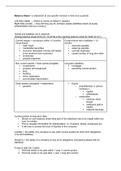
Balance Sheet = a statement at one specific moment in time (not a period)
Left Side (debit) → Where is money invested in (assets)
Right Side (credit) → How did they pay for all these assets (liabilities (bank) & equity
(shareholders and own money))
Assets and liabilities are in balance!
Closing balance sheet 2019 (31-12-2019) is the opening balance sheet for 2020 (01-01)
Current assets = conversion within 12 months Current (short term) liabilities < 12
(more liquid) months
cash; bank accounts payable
marketable securities sales tax payable
accounts receivable (money still needs accrued expenses
to be received from customer) current portion of long term debt
inventories
prepaid expenses
Non current assets = fixed assets (tangible) Long term liabilities
investments mortgage
property and equipment excluding current portion
land
building
china, glassware
accumulated depreciation
Other assets (intangible = trademarks) Equity
goodwill o proprietorship (1 person
company)
capital
withdrawals
o corporation
common stock
issued
additional paid-in
capital
retained earnings
Current portion of long term debt
Shows on your balance sheet what part of the debt/loan has to be repaid within the
next 12 months
This is valuable information for stakeholders: i.e. investors, banks, employees etc.
It will help to assess the level of liquidity in the company
Liquidity = the ability of a company to pay (with current assets) its short term obligations
(=current liabilities)
Solvency = the ability of a company to pay all its obligations (comparing assets with all
liabilities)
A loan is split into 2 parts:
1. Part that needs to be paid within 1 year = current portion
2. Part that needs to be paid after 1 year = long term portion
Left Side (debit) → Where is money invested in (assets)
Right Side (credit) → How did they pay for all these assets (liabilities (bank) & equity
(shareholders and own money))
Assets and liabilities are in balance!
Closing balance sheet 2019 (31-12-2019) is the opening balance sheet for 2020 (01-01)
Current assets = conversion within 12 months Current (short term) liabilities < 12
(more liquid) months
cash; bank accounts payable
marketable securities sales tax payable
accounts receivable (money still needs accrued expenses
to be received from customer) current portion of long term debt
inventories
prepaid expenses
Non current assets = fixed assets (tangible) Long term liabilities
investments mortgage
property and equipment excluding current portion
land
building
china, glassware
accumulated depreciation
Other assets (intangible = trademarks) Equity
goodwill o proprietorship (1 person
company)
capital
withdrawals
o corporation
common stock
issued
additional paid-in
capital
retained earnings
Current portion of long term debt
Shows on your balance sheet what part of the debt/loan has to be repaid within the
next 12 months
This is valuable information for stakeholders: i.e. investors, banks, employees etc.
It will help to assess the level of liquidity in the company
Liquidity = the ability of a company to pay (with current assets) its short term obligations
(=current liabilities)
Solvency = the ability of a company to pay all its obligations (comparing assets with all
liabilities)
A loan is split into 2 parts:
1. Part that needs to be paid within 1 year = current portion
2. Part that needs to be paid after 1 year = long term portion



