Chapter 11: Crustal deformation and mountain building
Mountain building, or orogeny, the process of forming a mountain belt, not only raises the surface of the
crust, a process called uplift, but it also causes rocks to undergo deformation, a process by which rocks
bend, break or flow in response to stress (compression, tension or shearing). Deformation yields joints
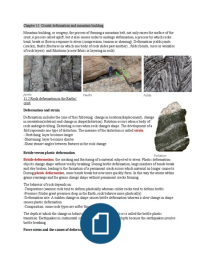
(cracks), faults (fractures on which one body of rock slides past another) , folds (bends, cures or wrinkles
of rock layers) and foliations (a new fabric or layering in rock).
Joints Faults Folds
11.2 Rock deformation in the Earths’
crust
Deformation and strain
Deformation includes the (one of the) following: change in location(displacement), change
in orientation(rotation) and change in shape(distortion). Rotation occurs when a body of
rock undergoes tilting. Distorting occurs when rock changes shape. The development of a
fold represents one type of distortion. The measure of the distortion is called strain.
- Stretching: layer becomes longer
-Shortening: layer becomes shorter
-Shear strain= angles between features in the rock change
Brittle versus plastic deformation
Foliation
Brittle deformation: the cracking and fracturing of a material subjected to stress. Plastic deformation:
objects change shape without visibly breaking. During brittle deformation, large numbers of bonds break
and stay broken, leading to the formation of a permanent crack across which material no longer connects.
During plastic deformation, some bonds break but new ones quickly form. In this way the atoms within
grains rearrange and the grains change shape without permanent cracks forming.
The behavior of rock depends on:
-Temperature (warmer rock tend to deform plastically whereas colder rocks tend to deform brittle.
-Pressure (Under great pressures deep in the Earth, rock behaves more plastically)
-Deformation rate: A sudden change in shape causes brittle deformation whereas a slow change in shape
causes plastic deformation.
-Composition: some rock types are softer than others
The depth at which the change in behavior (plastic/brittle) takes place is called the brittle-plastic
transition. Earthquakes in continental crust happen only above this depth because the earthquakes involve
brittle breaking.
Force stress and the causes of deformation
, We define the stress action on a plane as the force applied per unit area of the plane. During mountain
building, the force of one plate interacting with another applies across the broad area of contact between
the two plates, so the deformation resulting at any specific location actually reflects the stress developed
at that location, not on the total force produced by the plate interaction.
Pressure refers to a special stress condition that happens when the same push acts on all sides of an
object.
NOTE: stress specifically refers to the amount of force applied per unit area of the rock, whereas strain
specifically refers to a change in shape of rock.
11.3 Brittle structures
Joints
We refer to natural cracks as joints. Rock bodies do not slide past each other on joints. Since joints are
roughly planar structures, we define their orientation by their strike and dip. To describe the orientation of
a geologic structure, geologists picture the structure as a simple geometric shape, then specify the angles
that the shape makes with respect to a horizontal plane, a vertical
plane and the north direction.
Strike (strekking)= The strike is the angle between an imaginary
horizontal line on the structure and the direction to the true
north.
Dip= The dip is the angle of the structure’s slope- more precisely
it is the angle between a horizontal plane and the dip line an
imaginary line parallel to the steepest slope on the structure) as
measured in a vertical plane perpendicular to the strike
Joints develop in response to tensile stress in brittle rock:
- Rock cools and contracts
- Rock formerly at depth undergoes a decrease in pressure
as overlying rock erodes away and thus change shape by expanding vertically and contracting
horizontally.
- When brittle rock layers bend
Systematic joints are long planar cracks that occur fairly regularly through a rock body whereas
nonsystematic joints are short cracks that occur in a range of orientations, are randomly spaced, and may
be irregular or curved.
A group of systematic joints is called a joint set.
If groundwater seeps through joints underground for a long period of time, minerals such as quartz or
calcite may precipitate and fill the joints. Such mineral-filled joints are a type of vein and look like white
stripes cutting across a body of rock.
Faults: surfaces to slip
A fault is a fracture on which sliding occurs and slip events, or faulting, can generate earthquakes. Faults
are like joints more or less planar structures so we represent their orientation by strike and dip. Some
intersect the ground surface while others are at depth, called blind faults. Geologistst refer to the
intersection of a fault with the land surface as fault trace or fault line. Fault classification focusus on two
characteristics of faults: (1) the dip, or slope (2) the shear sense across the fault – direction of the material
on one side of the fault moved relative to the material on the other side.
Mountain building, or orogeny, the process of forming a mountain belt, not only raises the surface of the
crust, a process called uplift, but it also causes rocks to undergo deformation, a process by which rocks
bend, break or flow in response to stress (compression, tension or shearing). Deformation yields joints
(cracks), faults (fractures on which one body of rock slides past another) , folds (bends, cures or wrinkles
of rock layers) and foliations (a new fabric or layering in rock).
Joints Faults Folds
11.2 Rock deformation in the Earths’
crust
Deformation and strain
Deformation includes the (one of the) following: change in location(displacement), change
in orientation(rotation) and change in shape(distortion). Rotation occurs when a body of
rock undergoes tilting. Distorting occurs when rock changes shape. The development of a
fold represents one type of distortion. The measure of the distortion is called strain.
- Stretching: layer becomes longer
-Shortening: layer becomes shorter
-Shear strain= angles between features in the rock change
Brittle versus plastic deformation
Foliation
Brittle deformation: the cracking and fracturing of a material subjected to stress. Plastic deformation:
objects change shape without visibly breaking. During brittle deformation, large numbers of bonds break
and stay broken, leading to the formation of a permanent crack across which material no longer connects.
During plastic deformation, some bonds break but new ones quickly form. In this way the atoms within
grains rearrange and the grains change shape without permanent cracks forming.
The behavior of rock depends on:
-Temperature (warmer rock tend to deform plastically whereas colder rocks tend to deform brittle.
-Pressure (Under great pressures deep in the Earth, rock behaves more plastically)
-Deformation rate: A sudden change in shape causes brittle deformation whereas a slow change in shape
causes plastic deformation.
-Composition: some rock types are softer than others
The depth at which the change in behavior (plastic/brittle) takes place is called the brittle-plastic
transition. Earthquakes in continental crust happen only above this depth because the earthquakes involve
brittle breaking.
Force stress and the causes of deformation
, We define the stress action on a plane as the force applied per unit area of the plane. During mountain
building, the force of one plate interacting with another applies across the broad area of contact between
the two plates, so the deformation resulting at any specific location actually reflects the stress developed
at that location, not on the total force produced by the plate interaction.
Pressure refers to a special stress condition that happens when the same push acts on all sides of an
object.
NOTE: stress specifically refers to the amount of force applied per unit area of the rock, whereas strain
specifically refers to a change in shape of rock.
11.3 Brittle structures
Joints
We refer to natural cracks as joints. Rock bodies do not slide past each other on joints. Since joints are
roughly planar structures, we define their orientation by their strike and dip. To describe the orientation of
a geologic structure, geologists picture the structure as a simple geometric shape, then specify the angles
that the shape makes with respect to a horizontal plane, a vertical
plane and the north direction.
Strike (strekking)= The strike is the angle between an imaginary
horizontal line on the structure and the direction to the true
north.
Dip= The dip is the angle of the structure’s slope- more precisely
it is the angle between a horizontal plane and the dip line an
imaginary line parallel to the steepest slope on the structure) as
measured in a vertical plane perpendicular to the strike
Joints develop in response to tensile stress in brittle rock:
- Rock cools and contracts
- Rock formerly at depth undergoes a decrease in pressure
as overlying rock erodes away and thus change shape by expanding vertically and contracting
horizontally.
- When brittle rock layers bend
Systematic joints are long planar cracks that occur fairly regularly through a rock body whereas
nonsystematic joints are short cracks that occur in a range of orientations, are randomly spaced, and may
be irregular or curved.
A group of systematic joints is called a joint set.
If groundwater seeps through joints underground for a long period of time, minerals such as quartz or
calcite may precipitate and fill the joints. Such mineral-filled joints are a type of vein and look like white
stripes cutting across a body of rock.
Faults: surfaces to slip
A fault is a fracture on which sliding occurs and slip events, or faulting, can generate earthquakes. Faults
are like joints more or less planar structures so we represent their orientation by strike and dip. Some
intersect the ground surface while others are at depth, called blind faults. Geologistst refer to the
intersection of a fault with the land surface as fault trace or fault line. Fault classification focusus on two
characteristics of faults: (1) the dip, or slope (2) the shear sense across the fault – direction of the material
on one side of the fault moved relative to the material on the other side.