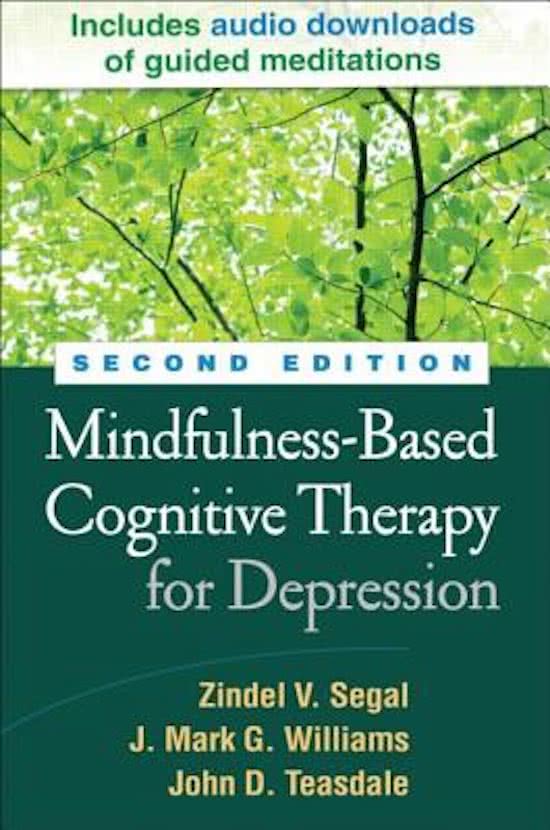
Mindfulness-based Cognitive Therapy for Depression
Summary
Introduction
John Kabat-Zinn (Mindfulness-based Stress Reduction)- “The application of
mindfulness in the domain of mental health would transform the field: seeking to
understand how these ancient wisdom practices could address
Part I
The challenge of depression
Chapter 1: Depression casts a long shadow
Depression is a disorder of mood that affects a person’s capacity to think clearly;
undermines motivation to act; alters intimate bodily functioning, such as
sleeping and eating; and leaves a person feeling stranded in the midst of searing
mental pain and suffering he or she feels unable to do anything about.
Antidepressant drugs work by increasing the efficiency of the connections
between brain cells and making greater quantities of neurotransmitters, such as
norepinephrine or serotonin, available at the synapse.
Approaches of psychological treatments of depression were
1. Behavioural emphasized the need to increase depressed persons’
participation in reinforcing or pleasure-giving activities, while social skills training
corrected behavioural deficits that increased depressed persons’ social isolation
and rejection.
2. Cognitive therapy brought together a number of behavioural and cognitive
techniques with the joint aim of changing the way a person’s thoughts, images,
and interpretation of events contribute to the onset and maintenance of the
emotional and behavioural disturbances associated with depression.
3. Interpersonal psychotherapy stressed that learning to resolve interpersonal
disputes and change roles would alleviate depression
‘Has the problem been solved?’
No, the return of new episodes of depression had become the new problem
Why hasn’t this been noticed before?
1. Data came from the earlier part of the20th century: middle aged people, so no
recurrence patterns
2. No studies in which patients of depression had been followed for a longer
period
At least 50% of patients who recover from an initial episode of depression will
have at least one subsequent depressive episode, and those patients with a
history of two or more past episodes will have a 70-80% likelihood of recurrence
in their lives.
, The evidence seems to suggest that if one relied on medication, there was a
need for a longer-term approach.
Patients receiving medication stayed well for a longer period of time than those
receiving only maintenance IPT.
Chapter 2: Why Do People Who Have Recovered From Depression
Relapse?
Negative thinking itself can cause a depression. In addition, even if such thinking
had not been the first cause of an episode, it could certainly maintain the
episode once it had started.
Cognitive therapy by Beck (1960-’70) Beck encouraged his patients to ‘catch’
whatever thoughts were going through their minds when their mood shifted.
Why did it become so successful?
1, Beck used evidence from clinical and the experimental laboratory to
substantiate his ideas, drawing in a wide range of clinicians and scientists
2. He incorporated many behavioural techniques that shared features with the
widely used behavioural therapies for anxiety-based problems
3. Also, Beck insisted on carefully assessing both processes and outcomes with
valid and reliable measures, on applying the therapy to an important clinical
problem that structured psychotherapies had neglected, and on evaluating the
treatment against the standard existing treatment (antidepressant medication)
What made Segal, Williams and Teasdale look for an alternative approach?
1. They had become aware of the sheer enormity of the problem of depression,
compared with the scarce resources of psychotherapy. The number of cognitive
therapist was not going to meet the demand. It needed to be cost-efficient
2. ‘Maintenance’ cognitive therapy would not be the answer because treating
acute depression with ‘standard’ cognitive therapy already prevented relapse in
many patients.
Studies appeared to provide evidence that psychological treatments could play a
major role in dealing with the increased burden of depression faced by
individuals and society
But from a cognitive therapists’ view how was the risk of relapse explained?
Maybe it was not about the effect of thinking on mood, but the effect that mood
has on thinking.
Perhaps the important difference between individuals who had recovered from
depression and those who had never been depressed was not in how they
thought about things when their moods were fine, but in what came to mind
when they were feeling sad. Whereas most people might be able to ignore the
occasional sad mood, in previously depressed persons a slight lowering of mood
might bring about a large and potentially devastating change in thought
patterns. These thought patterns would most often involve global, negative self-
judgments such as “I am worthless” and “I am stupid”.
Summary
Introduction
John Kabat-Zinn (Mindfulness-based Stress Reduction)- “The application of
mindfulness in the domain of mental health would transform the field: seeking to
understand how these ancient wisdom practices could address
Part I
The challenge of depression
Chapter 1: Depression casts a long shadow
Depression is a disorder of mood that affects a person’s capacity to think clearly;
undermines motivation to act; alters intimate bodily functioning, such as
sleeping and eating; and leaves a person feeling stranded in the midst of searing
mental pain and suffering he or she feels unable to do anything about.
Antidepressant drugs work by increasing the efficiency of the connections
between brain cells and making greater quantities of neurotransmitters, such as
norepinephrine or serotonin, available at the synapse.
Approaches of psychological treatments of depression were
1. Behavioural emphasized the need to increase depressed persons’
participation in reinforcing or pleasure-giving activities, while social skills training
corrected behavioural deficits that increased depressed persons’ social isolation
and rejection.
2. Cognitive therapy brought together a number of behavioural and cognitive
techniques with the joint aim of changing the way a person’s thoughts, images,
and interpretation of events contribute to the onset and maintenance of the
emotional and behavioural disturbances associated with depression.
3. Interpersonal psychotherapy stressed that learning to resolve interpersonal
disputes and change roles would alleviate depression
‘Has the problem been solved?’
No, the return of new episodes of depression had become the new problem
Why hasn’t this been noticed before?
1. Data came from the earlier part of the20th century: middle aged people, so no
recurrence patterns
2. No studies in which patients of depression had been followed for a longer
period
At least 50% of patients who recover from an initial episode of depression will
have at least one subsequent depressive episode, and those patients with a
history of two or more past episodes will have a 70-80% likelihood of recurrence
in their lives.
, The evidence seems to suggest that if one relied on medication, there was a
need for a longer-term approach.
Patients receiving medication stayed well for a longer period of time than those
receiving only maintenance IPT.
Chapter 2: Why Do People Who Have Recovered From Depression
Relapse?
Negative thinking itself can cause a depression. In addition, even if such thinking
had not been the first cause of an episode, it could certainly maintain the
episode once it had started.
Cognitive therapy by Beck (1960-’70) Beck encouraged his patients to ‘catch’
whatever thoughts were going through their minds when their mood shifted.
Why did it become so successful?
1, Beck used evidence from clinical and the experimental laboratory to
substantiate his ideas, drawing in a wide range of clinicians and scientists
2. He incorporated many behavioural techniques that shared features with the
widely used behavioural therapies for anxiety-based problems
3. Also, Beck insisted on carefully assessing both processes and outcomes with
valid and reliable measures, on applying the therapy to an important clinical
problem that structured psychotherapies had neglected, and on evaluating the
treatment against the standard existing treatment (antidepressant medication)
What made Segal, Williams and Teasdale look for an alternative approach?
1. They had become aware of the sheer enormity of the problem of depression,
compared with the scarce resources of psychotherapy. The number of cognitive
therapist was not going to meet the demand. It needed to be cost-efficient
2. ‘Maintenance’ cognitive therapy would not be the answer because treating
acute depression with ‘standard’ cognitive therapy already prevented relapse in
many patients.
Studies appeared to provide evidence that psychological treatments could play a
major role in dealing with the increased burden of depression faced by
individuals and society
But from a cognitive therapists’ view how was the risk of relapse explained?
Maybe it was not about the effect of thinking on mood, but the effect that mood
has on thinking.
Perhaps the important difference between individuals who had recovered from
depression and those who had never been depressed was not in how they
thought about things when their moods were fine, but in what came to mind
when they were feeling sad. Whereas most people might be able to ignore the
occasional sad mood, in previously depressed persons a slight lowering of mood
might bring about a large and potentially devastating change in thought
patterns. These thought patterns would most often involve global, negative self-
judgments such as “I am worthless” and “I am stupid”.