Governance & Strategy lectures – Joyce Rommens
Lecture 1: Introduction to the course (S. van Haperen)
Learning goals:
- Governance is multi-level
- Governance is about getting things done in networks
Targets for this meeting:
- Describe contemporary challenges in healthcare governance
- Explain how the (national) institutional context matters for goals and challenges in healthcare governance and
strategy
Course aim: to provide you with theoretical lenses as well as practical knowledge of governance and
strategy in healthcare organisations.
Video
Social context:
- Demographic challenges
- Labour shortages
- Ideal of “staying healthy in own home”
- “Denmark is international frontrunner”
- “A dementia-friendly nation”
Organisational:
- “Efficiency”,
- “Increased number of home care visits per nurse”
- “Early detection”
- Implement “assisted living technology”
- “Elderly don’t ask same amount of help”
Daily practice:
- “Patient turning system”
- “Monitor risks”
- Checklists on iPad
- “Citizens do exercises independently”
- “The new system has saved my world”
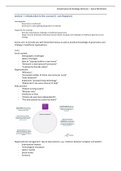
Organisational management: day-to-day practices, e.g., relations between caregiver and patient.
- International treaties
- Technological innovation
- Labour market
- Social norms
- Economy
, Governance & Strategy lectures – Joyce Rommens
Multi-level governance:
- Macro: socio-political context, culture, technology, law
- Meso: institutions and organisational management
- Micro: day-to-day practices, relations between caregiver and patient
Governance is about getting things done in a network/hierarchy. Two examples of governance:
1. Dual hospital governance
2. Multi-problem households
Lecture 1: Governance care during the emerging pandemic (B. de Graaff)
“I found the start very tough, also because of the quick changes. I no longer recognized my own
department, and we suddenly no longer saw our regular patients. You could no longer rely on your
clinical experience. [...] Normally I can close myself off from work, but now I did take it home with
me.” (Interview nurse, May 14, 2020)
Learning how to dance with the virus:
- Dancing with a virus: focus on situated, reflexive responses of organisations and the
resilience of institutional arrangements
- Question: adaptive governance of care during a ‘chronic’ crisis?
, Governance & Strategy lectures – Joyce Rommens
- Empirical focus: the regional networks of acute care delivery (ROAZ), in interaction with
national and local level
Adaptive governance? Resilience at the ROAZ? A mixed picture:
- The ROAZ has become the ‘spider in the web’ of acute care during the pandemic: links with
long-term care, data infrastructure
- Focus on hospitals and IC as central value: little input from other sectors, patients, nurses
(work floor)
- Adjustment interferences with the existing system: fair share, relation to regular and
postponed care (logic of guided planning vs. logic of market and logic of professionalism),
also relocation of care.
Lecture 2: Working with layers (H. van de Bovenkamp)
Van de Bovenkamp et al. (2016), Stoopendaal & van de Bovenkamp (2015)
Targets for this meeting:
- Explain the concepts of institutional work and institutional layering
- Reflect on the complexities that follow from a layered system for a healthcare manager
- Students can analyse a case using the theoretical concepts and complexities discussed
Introduction institutions and institutional theory as a theoretical lens to study governance & strategy
Institutions are partly rules or regulations, but also key institutions in society. It is not just an
organisation or body but also an institution in society. It relates to rules (formal or informal) or
regulations that structure our society in a way.
Institutions viewed as: relatively enduring features of political and social life (e.g., rules, norms,
procedures) that structure behaviour and that cannot be changed easily or instantaneously (Mahoney
& Thelen 2010, p.4)
Institutions set incentives and constraints for action: they determine the rules of the game. How
decisions are made and how governance functions in practice. It can help to determine strategies on
how to influence the context.
Institutional theory can help us understand how governance works.
Incremental institutional change and institutional work
Institutional theory helps to explain why it is difficult to implement change. Even if all parties agree
that we should work together more or abolish certain rules in practice, it is still difficult.
, Governance & Strategy lectures – Joyce Rommens
Literature is varied in nature:
- Different stands focus on different elements and have different assumptions
- Sociological (informal rules), rational choice (economical), historical institutionalism
- Focus on explaining continuity: why is it difficult to change
Institutional change:
- When institutional theory focuses on change: exogenous shocks
- Call for a need to focus on incremental change which can have both endogenous and
exogenous sources
How can theory help to understand healthcare governance?
Theory on incremental change (Mahoney & Thelen, 2010):
- Institutions as distributional instruments laden with power implications
- Institutional change and stability requires work
- Dynamic nature opens many internal and external possibilities for change
Different types of institutional change:
- Displacement: the removal of existing rules and the introduction of new ones (difficult to do
in practice)
- Layering: the introduction of new rules on top of or alongside existing ones (happens if
actors want to change but there is resistance in the system to let go existing rules)
- Drift: the changed impact of existing rules due to shifts in the environment (maybe some
rules become less important)
- Conversion: the changed enactment of existing rules due to their strategic redeployment
(actors strategically using certain rules to get things done)
Institutional work (Lawrence et al., 2011):
- Activities of actors to change or maintain institutions has been conceptualized as institutional
work:
- Daily coping and keeping up with institutional structures thereby creating, disrupting,
and maintaining institutions
- To study institutional change: need a focus on institutional work
The Dutch healthcare system have elements of all these arrangements. The system is considered a
regulated market. This is a case of institutional layering.
History of governance of quality in hospitals in the Netherlands, case of institutional layering:
Lecture 1: Introduction to the course (S. van Haperen)
Learning goals:
- Governance is multi-level
- Governance is about getting things done in networks
Targets for this meeting:
- Describe contemporary challenges in healthcare governance
- Explain how the (national) institutional context matters for goals and challenges in healthcare governance and
strategy
Course aim: to provide you with theoretical lenses as well as practical knowledge of governance and
strategy in healthcare organisations.
Video
Social context:
- Demographic challenges
- Labour shortages
- Ideal of “staying healthy in own home”
- “Denmark is international frontrunner”
- “A dementia-friendly nation”
Organisational:
- “Efficiency”,
- “Increased number of home care visits per nurse”
- “Early detection”
- Implement “assisted living technology”
- “Elderly don’t ask same amount of help”
Daily practice:
- “Patient turning system”
- “Monitor risks”
- Checklists on iPad
- “Citizens do exercises independently”
- “The new system has saved my world”
Organisational management: day-to-day practices, e.g., relations between caregiver and patient.
- International treaties
- Technological innovation
- Labour market
- Social norms
- Economy
, Governance & Strategy lectures – Joyce Rommens
Multi-level governance:
- Macro: socio-political context, culture, technology, law
- Meso: institutions and organisational management
- Micro: day-to-day practices, relations between caregiver and patient
Governance is about getting things done in a network/hierarchy. Two examples of governance:
1. Dual hospital governance
2. Multi-problem households
Lecture 1: Governance care during the emerging pandemic (B. de Graaff)
“I found the start very tough, also because of the quick changes. I no longer recognized my own
department, and we suddenly no longer saw our regular patients. You could no longer rely on your
clinical experience. [...] Normally I can close myself off from work, but now I did take it home with
me.” (Interview nurse, May 14, 2020)
Learning how to dance with the virus:
- Dancing with a virus: focus on situated, reflexive responses of organisations and the
resilience of institutional arrangements
- Question: adaptive governance of care during a ‘chronic’ crisis?
, Governance & Strategy lectures – Joyce Rommens
- Empirical focus: the regional networks of acute care delivery (ROAZ), in interaction with
national and local level
Adaptive governance? Resilience at the ROAZ? A mixed picture:
- The ROAZ has become the ‘spider in the web’ of acute care during the pandemic: links with
long-term care, data infrastructure
- Focus on hospitals and IC as central value: little input from other sectors, patients, nurses
(work floor)
- Adjustment interferences with the existing system: fair share, relation to regular and
postponed care (logic of guided planning vs. logic of market and logic of professionalism),
also relocation of care.
Lecture 2: Working with layers (H. van de Bovenkamp)
Van de Bovenkamp et al. (2016), Stoopendaal & van de Bovenkamp (2015)
Targets for this meeting:
- Explain the concepts of institutional work and institutional layering
- Reflect on the complexities that follow from a layered system for a healthcare manager
- Students can analyse a case using the theoretical concepts and complexities discussed
Introduction institutions and institutional theory as a theoretical lens to study governance & strategy
Institutions are partly rules or regulations, but also key institutions in society. It is not just an
organisation or body but also an institution in society. It relates to rules (formal or informal) or
regulations that structure our society in a way.
Institutions viewed as: relatively enduring features of political and social life (e.g., rules, norms,
procedures) that structure behaviour and that cannot be changed easily or instantaneously (Mahoney
& Thelen 2010, p.4)
Institutions set incentives and constraints for action: they determine the rules of the game. How
decisions are made and how governance functions in practice. It can help to determine strategies on
how to influence the context.
Institutional theory can help us understand how governance works.
Incremental institutional change and institutional work
Institutional theory helps to explain why it is difficult to implement change. Even if all parties agree
that we should work together more or abolish certain rules in practice, it is still difficult.
, Governance & Strategy lectures – Joyce Rommens
Literature is varied in nature:
- Different stands focus on different elements and have different assumptions
- Sociological (informal rules), rational choice (economical), historical institutionalism
- Focus on explaining continuity: why is it difficult to change
Institutional change:
- When institutional theory focuses on change: exogenous shocks
- Call for a need to focus on incremental change which can have both endogenous and
exogenous sources
How can theory help to understand healthcare governance?
Theory on incremental change (Mahoney & Thelen, 2010):
- Institutions as distributional instruments laden with power implications
- Institutional change and stability requires work
- Dynamic nature opens many internal and external possibilities for change
Different types of institutional change:
- Displacement: the removal of existing rules and the introduction of new ones (difficult to do
in practice)
- Layering: the introduction of new rules on top of or alongside existing ones (happens if
actors want to change but there is resistance in the system to let go existing rules)
- Drift: the changed impact of existing rules due to shifts in the environment (maybe some
rules become less important)
- Conversion: the changed enactment of existing rules due to their strategic redeployment
(actors strategically using certain rules to get things done)
Institutional work (Lawrence et al., 2011):
- Activities of actors to change or maintain institutions has been conceptualized as institutional
work:
- Daily coping and keeping up with institutional structures thereby creating, disrupting,
and maintaining institutions
- To study institutional change: need a focus on institutional work
The Dutch healthcare system have elements of all these arrangements. The system is considered a
regulated market. This is a case of institutional layering.
History of governance of quality in hospitals in the Netherlands, case of institutional layering: