ECONOMICS - Mary S. Morgan
What is economics (engineering science)?
Tool-based discipline;
intertwined with political/social sciences
real-life events in history affect economics and vice versa:
- 2 World Wars
- Great depression
- Stagflation
- Neoclassical paradigm
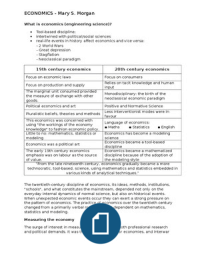
19th century economics 20th century economics
Focus on economic laws Focus on consumers
Relies on tacit knowledge and human
Focus on production and supply
input
The marginal unit consumed provided
Monodisciplinary: the birth of the
the measure of exchange with other
neoclassical economic paradigm
goods.
Political economics and art Positive and Normative Science
Less interventionist modes were in
Pluralistic beliefs, theories and methods
favour
This economics was concerned with
Language of economics:
using "the workings of the economy
▪ Maths ▪ Statistics ▪ English
knowledge" to fashion economic policy,
Little to no: mathematics, statistics or Economics has become a modeling
modeling science
Economics became a tool-based
Economics was a political art
discipline
The early 19th century economics Economics became a mathematized
emphasis was on labour as the source discipline because of the adoption of
of value. the modeling style
“From the late nineteenth century, economics gradually became a more
technocratic, tool-based, science, using mathematics and statistics embedded in
various kinds of analytical techniques.”
The twentieth-century discipline of economics, its ideas, methods, institutions,
"schools", and what constitutes the mainstream, depended not only on the
everyday internal dynamics of normal science, but also on historical events.
When unexpected economic events occur they can exert a strong pressure on
the pattern of economics. The practice of economics over the twentieth century
changed from a primarily verbal method to one dependent on mathematics,
statistics and modeling.
Measuring the economy
The surge of interest in measurement had roots in both professional research
and political demands. It was the requirement of war economies, and interwar
What is economics (engineering science)?
Tool-based discipline;
intertwined with political/social sciences
real-life events in history affect economics and vice versa:
- 2 World Wars
- Great depression
- Stagflation
- Neoclassical paradigm
19th century economics 20th century economics
Focus on economic laws Focus on consumers
Relies on tacit knowledge and human
Focus on production and supply
input
The marginal unit consumed provided
Monodisciplinary: the birth of the
the measure of exchange with other
neoclassical economic paradigm
goods.
Political economics and art Positive and Normative Science
Less interventionist modes were in
Pluralistic beliefs, theories and methods
favour
This economics was concerned with
Language of economics:
using "the workings of the economy
▪ Maths ▪ Statistics ▪ English
knowledge" to fashion economic policy,
Little to no: mathematics, statistics or Economics has become a modeling
modeling science
Economics became a tool-based
Economics was a political art
discipline
The early 19th century economics Economics became a mathematized
emphasis was on labour as the source discipline because of the adoption of
of value. the modeling style
“From the late nineteenth century, economics gradually became a more
technocratic, tool-based, science, using mathematics and statistics embedded in
various kinds of analytical techniques.”
The twentieth-century discipline of economics, its ideas, methods, institutions,
"schools", and what constitutes the mainstream, depended not only on the
everyday internal dynamics of normal science, but also on historical events.
When unexpected economic events occur they can exert a strong pressure on
the pattern of economics. The practice of economics over the twentieth century
changed from a primarily verbal method to one dependent on mathematics,
statistics and modeling.
Measuring the economy
The surge of interest in measurement had roots in both professional research
and political demands. It was the requirement of war economies, and interwar