

1 Philosophy of Science MASTER SUMMARY
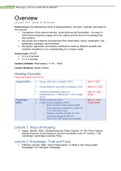
Overview
Lecturer: Prof. James W. McAllister
Course focus: the philosophical study of presuppositions, concepts, methods, and output of
the sciences
Comparison of the natural sciences, social sciences and humanities – the ways in
which these disciplines engage with their objects and the forms of knowledge that
they produce
Key issues and problems of present-day PoS (observation, theory, explanation, law,
falsification, paradigm, and revolution)
Recognize, appreciate, and assess contributions made by different scientific and
academic disciplines to our understanding of a complex reality
Course load: 5 ECTS
12 x 2 hr lectures
4 x 2 hr tutorials
Lecture schedule: Wednesdays, 17:15 – 19:00
Lecture literature: weekly articles
Grading Overview
Final exam MUST be min 5,5
Tutorial (40%) Group video clip on debate (10%) April 1, 2021
Group reflective document on debate (10%) March 31, 2021
Individual philosophy essay on April 15, 2021
Falsificationism: 1,000 words + 10% margin 23:59
(20%)
Final Exam 15 MC questions (33%) May 27, 2021
(60%) 2 open essay questions (67%) 16:00-19:00
o Both questions bear equal weight
o Each question consists of 3 parts (A-
C) on the same topic
o Relative weights of parts A-C are
indicated alongside the text
o Word limit: 500 words per question
Lecture 1: Ways of Knowing
Kagan, Jerome. 2009. “Characterizing the Three Cultures.” In The Three Cultures:
Natural Sciences, Social Sciences, and the Humanities in the 21st Century, 1-50.
Cambridge: Cambridge University Press.
Lecture 2: Knowledge, Truth and Facts
Pritchard, Duncan. 2006. “Some Preliminaries.” In What Is This Thing Called
Knowledge? 3-9. Abingdon: Routledge.
,2 Philosophy of Science MASTER SUMMARY
Lecture 3: Scientific Laws and Induction
Balashov, Yuri V. 2003. “Laws of Nature.” In Encyclopedia of Science and Religion,
edited by J. Wentzel Vrede van Huyssteen: 508-513. New York: Macmillan
Reference.
Anwer, Ahmed Jamal. 1995. “Some Approaches to the Problem of Induction.” Indian
Philosophical Quarterly 22 (1995): 247-258.
Lecture 4: Explanations and Causes
Strevens, Michael. 2006. “Scientific Explanation.” In Encyclopedia of Philosophy,
edited by Donald M. Borchert, 2nd ed. Detroit, Mich.: Macmillan Reference.
Lecture 5: Falsificationism
Caldwell, Bruce J. 1991. “Clarifying Popper.” Journal of Economic Literature 29
(1991): 1-13.
Lecture 6: Paradigms and Revolutions
Hoyningen-Huene, Paul. 1998. “On Thomas Kuhn’s Philosophical Significance.”
Configurations 6 (1998): 1-14.
MIDTERMS: NO CLASSES (Study Weeks: March 15 – 26)
Lecture 7: Q & A Session
Lecture 8: Methodology of Analogies and Models
Bailer-Jones, Daniela M. 2002. “Models, Metaphors and Analogies.” In The Blackwell
Guide to the Philosophy of Science, edited by Peter Machamer and Michael
Silberstein: 108-127. Oxford: Blackwell.
Lecture 9: Quantitative and Qualitative Approaches
Gerring, John and Craig W. Thomas. 2011. “Quantitative and Qualitative: A Question
of Comparability.” In International Encyclopedia of Political Science, edited by
Bertrand Badie, Dirk Berg-Schlosser and Leonardo Morlino: 2189-2196. Los
Angeles, Cal.: Sage.
Lecture 10: Rationality
Todd, Peter M. and Gerd Gigerenzer. 2000. “Précis of Simple Heuristics that Make
Us Smart.” Behavioral and Brain Sciences 23 (2000): 727-741.
Lecture 11: Interpretation and Understanding
Bransen, Jan. 2001. “Verstehen and Erklaren, Philosophy of.” In International
Encyclopedia of the Social and Behavioral Sciences, edited by Neil J. Smelser and
Paul B. Baltes: 16,165-16,170. Oxford: Elsevier.
May 5: No Class – Liberation Day
Lecture 12: Absolutism and Relativism
Lukes, Steven. 2000. “Different Cultures, Different Rationalities?” History of the
Human Sciences 13 (2000): 3-18.
,3 Philosophy of Science MASTER SUMMARY
Lecture 13: Q&A Session
, 4 Philosophy of Science MASTER SUMMARY
Lecture Notes
Lecture 1: Ways of Knowing
February 9, 2022
Knowledge takes many forms: there are many ways of knowing about a subject matter.
Some knowledge is in the form of high-level abstract principles, for example, whereas
other knowledge gives you details of individual events. These ways of knowing are
distributed among academic disciplines: the knowledge that we get from sociology is
different from that which we get from history, for example. In order to recognise and use
knowledge, and especially in order to be able to combine knowledge from different
disciplines, it is useful to survey some of the kinds of knowledge that exist. In this lecture,
we will focus on the difference between the nomothetic and idiographic approaches to
knowledge and the variety of the scientific and academic disciplines.
Part 1: Introducing the course
Why PoS?
Reflect on your scientific practice
o How do different disciplines conceptualize the world? And how does this
impact the way we experience the world?
Natural sciences
Social sciences
Economics
Anthropology
o What does it mean to have knowledge?
o How do scientists reason?
Develop solutions to problems yet unknown (e.g., the current pandemic)
o Ascent to abstraction – advantaged perspectives
Philosophy of science is a climb to a higher level of abstraction
Speaking and reasoning in a less concrete fashion; thinking in a
general way when solving problems
Equipping you to meet problems coming over the horizon
Structure of course:
11 web lectures, grouped into 5 thematic parts
1. The basics: epistemology (lecture 1&2)
2. Some scientific devices: conceptual devices of the sciences that scientists
use to make sense of the world (lecture 3&4)
3. Models of scientific practice: how science works (lecture 5&6)
4. Methodological tool-box: conceptual instruments of the sciences (lecture 7&8)
5. Rationality and culture (lecture 9&10&11)
2 live question periods (exam weeks)
Part 2: Ways of knowing
How to tackle the readings:
Won’t be covered in-depth in the web lectures
Overview
Lecturer: Prof. James W. McAllister
Course focus: the philosophical study of presuppositions, concepts, methods, and output of
the sciences
Comparison of the natural sciences, social sciences and humanities – the ways in
which these disciplines engage with their objects and the forms of knowledge that
they produce
Key issues and problems of present-day PoS (observation, theory, explanation, law,
falsification, paradigm, and revolution)
Recognize, appreciate, and assess contributions made by different scientific and
academic disciplines to our understanding of a complex reality
Course load: 5 ECTS
12 x 2 hr lectures
4 x 2 hr tutorials
Lecture schedule: Wednesdays, 17:15 – 19:00
Lecture literature: weekly articles
Grading Overview
Final exam MUST be min 5,5
Tutorial (40%) Group video clip on debate (10%) April 1, 2021
Group reflective document on debate (10%) March 31, 2021
Individual philosophy essay on April 15, 2021
Falsificationism: 1,000 words + 10% margin 23:59
(20%)
Final Exam 15 MC questions (33%) May 27, 2021
(60%) 2 open essay questions (67%) 16:00-19:00
o Both questions bear equal weight
o Each question consists of 3 parts (A-
C) on the same topic
o Relative weights of parts A-C are
indicated alongside the text
o Word limit: 500 words per question
Lecture 1: Ways of Knowing
Kagan, Jerome. 2009. “Characterizing the Three Cultures.” In The Three Cultures:
Natural Sciences, Social Sciences, and the Humanities in the 21st Century, 1-50.
Cambridge: Cambridge University Press.
Lecture 2: Knowledge, Truth and Facts
Pritchard, Duncan. 2006. “Some Preliminaries.” In What Is This Thing Called
Knowledge? 3-9. Abingdon: Routledge.
,2 Philosophy of Science MASTER SUMMARY
Lecture 3: Scientific Laws and Induction
Balashov, Yuri V. 2003. “Laws of Nature.” In Encyclopedia of Science and Religion,
edited by J. Wentzel Vrede van Huyssteen: 508-513. New York: Macmillan
Reference.
Anwer, Ahmed Jamal. 1995. “Some Approaches to the Problem of Induction.” Indian
Philosophical Quarterly 22 (1995): 247-258.
Lecture 4: Explanations and Causes
Strevens, Michael. 2006. “Scientific Explanation.” In Encyclopedia of Philosophy,
edited by Donald M. Borchert, 2nd ed. Detroit, Mich.: Macmillan Reference.
Lecture 5: Falsificationism
Caldwell, Bruce J. 1991. “Clarifying Popper.” Journal of Economic Literature 29
(1991): 1-13.
Lecture 6: Paradigms and Revolutions
Hoyningen-Huene, Paul. 1998. “On Thomas Kuhn’s Philosophical Significance.”
Configurations 6 (1998): 1-14.
MIDTERMS: NO CLASSES (Study Weeks: March 15 – 26)
Lecture 7: Q & A Session
Lecture 8: Methodology of Analogies and Models
Bailer-Jones, Daniela M. 2002. “Models, Metaphors and Analogies.” In The Blackwell
Guide to the Philosophy of Science, edited by Peter Machamer and Michael
Silberstein: 108-127. Oxford: Blackwell.
Lecture 9: Quantitative and Qualitative Approaches
Gerring, John and Craig W. Thomas. 2011. “Quantitative and Qualitative: A Question
of Comparability.” In International Encyclopedia of Political Science, edited by
Bertrand Badie, Dirk Berg-Schlosser and Leonardo Morlino: 2189-2196. Los
Angeles, Cal.: Sage.
Lecture 10: Rationality
Todd, Peter M. and Gerd Gigerenzer. 2000. “Précis of Simple Heuristics that Make
Us Smart.” Behavioral and Brain Sciences 23 (2000): 727-741.
Lecture 11: Interpretation and Understanding
Bransen, Jan. 2001. “Verstehen and Erklaren, Philosophy of.” In International
Encyclopedia of the Social and Behavioral Sciences, edited by Neil J. Smelser and
Paul B. Baltes: 16,165-16,170. Oxford: Elsevier.
May 5: No Class – Liberation Day
Lecture 12: Absolutism and Relativism
Lukes, Steven. 2000. “Different Cultures, Different Rationalities?” History of the
Human Sciences 13 (2000): 3-18.
,3 Philosophy of Science MASTER SUMMARY
Lecture 13: Q&A Session
, 4 Philosophy of Science MASTER SUMMARY
Lecture Notes
Lecture 1: Ways of Knowing
February 9, 2022
Knowledge takes many forms: there are many ways of knowing about a subject matter.
Some knowledge is in the form of high-level abstract principles, for example, whereas
other knowledge gives you details of individual events. These ways of knowing are
distributed among academic disciplines: the knowledge that we get from sociology is
different from that which we get from history, for example. In order to recognise and use
knowledge, and especially in order to be able to combine knowledge from different
disciplines, it is useful to survey some of the kinds of knowledge that exist. In this lecture,
we will focus on the difference between the nomothetic and idiographic approaches to
knowledge and the variety of the scientific and academic disciplines.
Part 1: Introducing the course
Why PoS?
Reflect on your scientific practice
o How do different disciplines conceptualize the world? And how does this
impact the way we experience the world?
Natural sciences
Social sciences
Economics
Anthropology
o What does it mean to have knowledge?
o How do scientists reason?
Develop solutions to problems yet unknown (e.g., the current pandemic)
o Ascent to abstraction – advantaged perspectives
Philosophy of science is a climb to a higher level of abstraction
Speaking and reasoning in a less concrete fashion; thinking in a
general way when solving problems
Equipping you to meet problems coming over the horizon
Structure of course:
11 web lectures, grouped into 5 thematic parts
1. The basics: epistemology (lecture 1&2)
2. Some scientific devices: conceptual devices of the sciences that scientists
use to make sense of the world (lecture 3&4)
3. Models of scientific practice: how science works (lecture 5&6)
4. Methodological tool-box: conceptual instruments of the sciences (lecture 7&8)
5. Rationality and culture (lecture 9&10&11)
2 live question periods (exam weeks)
Part 2: Ways of knowing
How to tackle the readings:
Won’t be covered in-depth in the web lectures



