Cells
Methods of studying cells
Microscopes
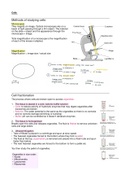
They magnify an image. Optical microscopes rely on a
beam of light passing through a thin object. The material
on the slide = object and the appearance through the
microscope = image.
Total magnification of a microscope is the magnification
of each of the lenses multiplied.
Magnification
Magnification = image size / actual size
Cell fractionation
The process where cells are broken open to access organelles.
1. The tissue is placed in a cold, isotonic buffer solution
• Cold: to reduce activity of hydrolytic enzymes that may digest organelles after
lysosomes are broken
• Isotonic: The water potential is the same as the organelles so there is no osmosis
and no osmotic damage (shrinking or bursting)
• Buffer: pH can be controlled so it doesn’t denature enzymes
2. The tissue is homogenised
Breaks open the cells and releases organelles. The fluid is filtered to remove unbroken
cells and large debris
3. Ultracentrifugation
• Tube of filtrate is placed in a centrifuge and spun at slow speed
• The heaviest organelles forced to the bottom where they form a pellet
• The fluid at the top, supernatant, is removed and placed into a fresh tube and spun
faster than before
• The next heaviest organelles are forced to the bottom to form a pellet etc
You then study the pellet of organelles.
Organelles in size order:
• Nuclei
• Mitochondria
• Lysosomes
• Ribosomes
, Electron microscope
• Electrons fired through the electron gun. There is a positively
charged anode which controls the beam.
• There is a vacuum so the electrons travel in a straight line
• Camera at the base to view the image
• More dense tissue will block more electrons to give a darker
image on the fluorescent screen.
Electron microscopes have much higher resolution than optical
microscopes because electrons have a shorter wavelength.
Magnification: how many times enlarged the image is compared
to the real object
Resolution: ability to distinguish between two points
TEM method:
1. Slice the specimen very thin so the electrons can pass
through
2. Fire the electrons through
3. Look at image on the screen
Problems:
• Artefacts: things you can see that aren’t part of the specimen because there are complex
preparation techniques. Early scientists could only distinguish artefacts from organelles by
repeatedly preparing specimens in different ways and if an object was seen in all specimens it
was likely to be an organelle.
• Misleading sections: slicing the cell means there are unusual shapes and sizes in the image
• Expensive, e.g. the vacuum
• Not in colour
• Can only look at dead material because you have to slice the cell and its in a vacuum
2 types of electron microscopy:
TEM - transmission SEM - scanning
Electron beam through thin section of specimen Beam of electrons reflected off the surface of a
specimen, so don’t need thin section
2D images with higher resolution 3D images with lower resolution
Electron vs optical
Similarities: they both…
• magnify
• Use lenses
Differences:
electron Optical
Beam of electrons Light
Vacuum No vacuum
Methods of studying cells
Microscopes
They magnify an image. Optical microscopes rely on a
beam of light passing through a thin object. The material
on the slide = object and the appearance through the
microscope = image.
Total magnification of a microscope is the magnification
of each of the lenses multiplied.
Magnification
Magnification = image size / actual size
Cell fractionation
The process where cells are broken open to access organelles.
1. The tissue is placed in a cold, isotonic buffer solution
• Cold: to reduce activity of hydrolytic enzymes that may digest organelles after
lysosomes are broken
• Isotonic: The water potential is the same as the organelles so there is no osmosis
and no osmotic damage (shrinking or bursting)
• Buffer: pH can be controlled so it doesn’t denature enzymes
2. The tissue is homogenised
Breaks open the cells and releases organelles. The fluid is filtered to remove unbroken
cells and large debris
3. Ultracentrifugation
• Tube of filtrate is placed in a centrifuge and spun at slow speed
• The heaviest organelles forced to the bottom where they form a pellet
• The fluid at the top, supernatant, is removed and placed into a fresh tube and spun
faster than before
• The next heaviest organelles are forced to the bottom to form a pellet etc
You then study the pellet of organelles.
Organelles in size order:
• Nuclei
• Mitochondria
• Lysosomes
• Ribosomes
, Electron microscope
• Electrons fired through the electron gun. There is a positively
charged anode which controls the beam.
• There is a vacuum so the electrons travel in a straight line
• Camera at the base to view the image
• More dense tissue will block more electrons to give a darker
image on the fluorescent screen.
Electron microscopes have much higher resolution than optical
microscopes because electrons have a shorter wavelength.
Magnification: how many times enlarged the image is compared
to the real object
Resolution: ability to distinguish between two points
TEM method:
1. Slice the specimen very thin so the electrons can pass
through
2. Fire the electrons through
3. Look at image on the screen
Problems:
• Artefacts: things you can see that aren’t part of the specimen because there are complex
preparation techniques. Early scientists could only distinguish artefacts from organelles by
repeatedly preparing specimens in different ways and if an object was seen in all specimens it
was likely to be an organelle.
• Misleading sections: slicing the cell means there are unusual shapes and sizes in the image
• Expensive, e.g. the vacuum
• Not in colour
• Can only look at dead material because you have to slice the cell and its in a vacuum
2 types of electron microscopy:
TEM - transmission SEM - scanning
Electron beam through thin section of specimen Beam of electrons reflected off the surface of a
specimen, so don’t need thin section
2D images with higher resolution 3D images with lower resolution
Electron vs optical
Similarities: they both…
• magnify
• Use lenses
Differences:
electron Optical
Beam of electrons Light
Vacuum No vacuum