Addiction
Case 2
Addiction is learned behavior
Problem statement: “How can an addiction be developed by learning and memory?”
Learning goals:
I. What is conditioning?
II. What is the influence of the surroundings and the routines on addiction?
III. What is drug craving and what are the theories about this?
IV. Can we unlearn addiction? And what are related implications for treatment?
V. What is the effect of triggers and cues on addiction?
What is conditioning?
Conditioning is a form of learning in which either (1) a given stimulus (or signal) becomes increasingly
effective in evoking a response or (2) a response occurs with increasing regularity in a well-specified
and stable environment. The type of reinforcement used will determine the outcome.
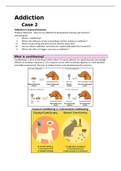
Classical conditioning vs. Instrumental conditioning:
, What is the influence of the surroundings and the routines on
addiction?i
In this article: The accustomed dose taken in a strange environment caused fatal complications
because the conditioned tolerance failed to operate how can this happen?
Mechanisms leading directly to drug-related death:
1. Drug bought on the black market active substance differs from the accustomed level.
2. The patient which has stopped for a while, attempt to continue addictive behavior with the
same dose used immediately before withdrawal (most frequently)
3. The use of drugs in combination also increases the danger of a fatal overdose.
Another explanatory:
Situation-specific tolerance is capable of preventing the fatal consequence of a fatal-sized
opiate overdose.
o Example with rats: the effect was smaller in the accustomed environment, because
they were ‘expecting’ its effect.
Among 10 heroin overdose survivors in 7 out of 10 the drug was administered in an environment
NOT previously associated with drug use.
O’Brien showed the conditioned tolerance phenomenon on 4 different occasions:
1. The subjects were given a moderate dose (4mg) in an infusion without knowing what they
were being given and when.
2. The subject injected the same doses themselves.
3. +4 The same process was repeated with salt (one was given and one did it themselves).
When they were given the opiate without prior indication, the subjects showed a significantly
greater physiological reaction following the full effect of the drug than when they knew what they
were receiving (when they injected it themselves). The anticipation and preparation for taking the
drug triggers responses contrary to the drug effect in persons already showing drug tolerance. The
anticipation preceding the administration of opiate, acting as a conditioned stimulus, reduced the
action of the drug and so contributed to the development of a mechanism corresponding to
tolerance.
Conclusion
The fatal consequence of the heroin injection may have been caused by the failure in the action of
conditioned tolerance.
When a conditioned place preference arises, the user has to take a bigger dose each time to
achieve the same effect
o Users who don’t have secondary conditioning with environmental stimuli since he or
she constantly changes the place where the drug is taken.
When the drug is taken in a strange environment the conditioned tolerance does not operate
since the organism is not "expecting" the drug.
o The end result is that the otherwise accustomed dose leads to an overdose and
thereby to death.
The term overdose is misleading: it is not about different quantity.
What is drug craving and what are the theories about this? ii
Different definitions of craving throughout the years:
Kerr (1889): craving is “pathological depravity of the appetite center”.
Case 2
Addiction is learned behavior
Problem statement: “How can an addiction be developed by learning and memory?”
Learning goals:
I. What is conditioning?
II. What is the influence of the surroundings and the routines on addiction?
III. What is drug craving and what are the theories about this?
IV. Can we unlearn addiction? And what are related implications for treatment?
V. What is the effect of triggers and cues on addiction?
What is conditioning?
Conditioning is a form of learning in which either (1) a given stimulus (or signal) becomes increasingly
effective in evoking a response or (2) a response occurs with increasing regularity in a well-specified
and stable environment. The type of reinforcement used will determine the outcome.
Classical conditioning vs. Instrumental conditioning:
, What is the influence of the surroundings and the routines on
addiction?i
In this article: The accustomed dose taken in a strange environment caused fatal complications
because the conditioned tolerance failed to operate how can this happen?
Mechanisms leading directly to drug-related death:
1. Drug bought on the black market active substance differs from the accustomed level.
2. The patient which has stopped for a while, attempt to continue addictive behavior with the
same dose used immediately before withdrawal (most frequently)
3. The use of drugs in combination also increases the danger of a fatal overdose.
Another explanatory:
Situation-specific tolerance is capable of preventing the fatal consequence of a fatal-sized
opiate overdose.
o Example with rats: the effect was smaller in the accustomed environment, because
they were ‘expecting’ its effect.
Among 10 heroin overdose survivors in 7 out of 10 the drug was administered in an environment
NOT previously associated with drug use.
O’Brien showed the conditioned tolerance phenomenon on 4 different occasions:
1. The subjects were given a moderate dose (4mg) in an infusion without knowing what they
were being given and when.
2. The subject injected the same doses themselves.
3. +4 The same process was repeated with salt (one was given and one did it themselves).
When they were given the opiate without prior indication, the subjects showed a significantly
greater physiological reaction following the full effect of the drug than when they knew what they
were receiving (when they injected it themselves). The anticipation and preparation for taking the
drug triggers responses contrary to the drug effect in persons already showing drug tolerance. The
anticipation preceding the administration of opiate, acting as a conditioned stimulus, reduced the
action of the drug and so contributed to the development of a mechanism corresponding to
tolerance.
Conclusion
The fatal consequence of the heroin injection may have been caused by the failure in the action of
conditioned tolerance.
When a conditioned place preference arises, the user has to take a bigger dose each time to
achieve the same effect
o Users who don’t have secondary conditioning with environmental stimuli since he or
she constantly changes the place where the drug is taken.
When the drug is taken in a strange environment the conditioned tolerance does not operate
since the organism is not "expecting" the drug.
o The end result is that the otherwise accustomed dose leads to an overdose and
thereby to death.
The term overdose is misleading: it is not about different quantity.
What is drug craving and what are the theories about this? ii
Different definitions of craving throughout the years:
Kerr (1889): craving is “pathological depravity of the appetite center”.