Alle theory Merle lectures + readings
Marketing communications week 1 hoorcollege
Course content:
1. Marketing communications, IMC, and ethical considerations + communication theory and
process
2. Roles of the media
3. Advertising I + advertising II
4. P.R. and product placement
5. Sales promotions + digital marketing
6. Student presentations
Marketing communications
- Describe all the promotional elements of marketing mix which involve the communications
between an organization and its target audiences on all matters that affect marketing
performance.
- Can be understood through the comprehension of the communications process.
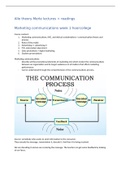
Source: somebody who wants to send information to the consumer.
They encode the message, transmission it, decode it. And then it is being received.
We are decoding it and we are receiving the message. The teacher can get some feedback by looking
at our faces.
,Noise can be anything
- Someone hates advertising
- Didn’t understood the message message gets lost
- Bombarded with too many messages
You see lots of lots of different messages per day.
- 5000 different messages (doesn’t have to be from 5000 different brands)
Sometimes the message doesn’t even go to the consumer.
The communication process
The 4 main components of the communication process:
1. The sender is the originator of the message.
2. The message is the actual information and impressions that the sender wishes to
communicate.
3. The media are the vehicles or channels used to communicate the message.
4. The receivers are the people who receive the message.
a. Target audience
b. Potential new customers
Attention needs to be paid to:
- The vast amount of promotional messages a consumer receives daily
o Brain is limited of the consumer. How should the brand stand out from the rest?
- Noise
- Feedback
o How do we measure our success rate? Is this impressions? Is this the click through
rate? Is this being the highest place on the google research?
o Anything we do, we want to get some feedback.
- The way audiences perceive and interpret the message
o Open messages
Do I have an advertisement that is open for invitation
Or closed? Very direct in communication style.
o Contemporary audiences
These interact differently, you need to be part of the context to understand
it.
Advertising example: Non should not be attempted by men (AXE deodorant). If you were the
perfume, than the person becomes irresistible for women. Nun/non has ‘wasknijper’ op so that you
doesn’t smell the smell of the deodorant of AXE.
- Do people know the effect of AXE? (AXE-effect)? No? Than the meaning if completely lost on
you.
Example: on 4th October, WhatsApp, Facebook, and Instagram went down. For the end consumer
(because we are all addicted) it was also disappointed. Everyone went to Twitter. Twitter said ‘hello
literally everyone’. McDonalds answered with ‘hi what can I get u’. Twix answered with hello and Dell
answered with ‘Did the left or right Twix tweet this?’. Etc.
- The way we communicate with consumers has changed.
Communications decisions
1. Marketing strategy
2. Positioning statement
a. Unique selling point
, b. Which value do we create for consumers
3. Communications decisions
a. Identify target audience
b. Set communications objectives
c. Create message
d. Select promotional mix
i. Do we need advertising, direct communication, PR? Etc.
e. Set promotional budget
4. Execute IMC strategy
5. Evaluate IMC strategy
Target marketing communications strategies
- Mass marketing
o Broad-brush, unfocused attempt to appeal to an entire market with one basic
marketing strategy.
Example: Coca Cola
- Segmented – customized
o The division of the marketplace into distinct subgroups or segments.
- Niche marketing
o Concentrating all marketing efforts on a small but specific and well-defined segment.
Example: people with special needs
- Micromarketing
o Local marketing
Local marketing involves tailoring brands and promotions to the needs and
wants of local markets.
o Individual marketing
Entails the products and marketing programs being tailored to the needs and
preferences of individual consumers
Market segmentation variables for consumer markets
Further segmentations for contemporary consumer markets
- Post-modern audiences
o Cynical
o Skeptical towards marketing communications’ claims
o Resistant towards mainstream marketing communications’ techniques
- Brand communities
o Are specialized, non-geographically bound communities, based on a structured set of
social relations among admirers of a brand.
o Exhibit shared consciousness, rituals and traditions, and a sense of moral
responsibility.
- On-line communities
o Are groups of people that primarily interact via communication media such as
newsletters, email, online social networks, or instant messages, rather than face to
face, for social, professional, educational or other purposes.
Communications objectives:
- Awareness
- Knowledge
- Liking
o Positive emotions leads to ad liking!
, - Preference
- Conviction
- Purchase
- Supermarket is open 24 hours a day create this awareness by consumers
o Make sure they even consider us as a choice.
Marketing communications week 1 hoorcollege
Course content:
1. Marketing communications, IMC, and ethical considerations + communication theory and
process
2. Roles of the media
3. Advertising I + advertising II
4. P.R. and product placement
5. Sales promotions + digital marketing
6. Student presentations
Marketing communications
- Describe all the promotional elements of marketing mix which involve the communications
between an organization and its target audiences on all matters that affect marketing
performance.
- Can be understood through the comprehension of the communications process.
Source: somebody who wants to send information to the consumer.
They encode the message, transmission it, decode it. And then it is being received.
We are decoding it and we are receiving the message. The teacher can get some feedback by looking
at our faces.
,Noise can be anything
- Someone hates advertising
- Didn’t understood the message message gets lost
- Bombarded with too many messages
You see lots of lots of different messages per day.
- 5000 different messages (doesn’t have to be from 5000 different brands)
Sometimes the message doesn’t even go to the consumer.
The communication process
The 4 main components of the communication process:
1. The sender is the originator of the message.
2. The message is the actual information and impressions that the sender wishes to
communicate.
3. The media are the vehicles or channels used to communicate the message.
4. The receivers are the people who receive the message.
a. Target audience
b. Potential new customers
Attention needs to be paid to:
- The vast amount of promotional messages a consumer receives daily
o Brain is limited of the consumer. How should the brand stand out from the rest?
- Noise
- Feedback
o How do we measure our success rate? Is this impressions? Is this the click through
rate? Is this being the highest place on the google research?
o Anything we do, we want to get some feedback.
- The way audiences perceive and interpret the message
o Open messages
Do I have an advertisement that is open for invitation
Or closed? Very direct in communication style.
o Contemporary audiences
These interact differently, you need to be part of the context to understand
it.
Advertising example: Non should not be attempted by men (AXE deodorant). If you were the
perfume, than the person becomes irresistible for women. Nun/non has ‘wasknijper’ op so that you
doesn’t smell the smell of the deodorant of AXE.
- Do people know the effect of AXE? (AXE-effect)? No? Than the meaning if completely lost on
you.
Example: on 4th October, WhatsApp, Facebook, and Instagram went down. For the end consumer
(because we are all addicted) it was also disappointed. Everyone went to Twitter. Twitter said ‘hello
literally everyone’. McDonalds answered with ‘hi what can I get u’. Twix answered with hello and Dell
answered with ‘Did the left or right Twix tweet this?’. Etc.
- The way we communicate with consumers has changed.
Communications decisions
1. Marketing strategy
2. Positioning statement
a. Unique selling point
, b. Which value do we create for consumers
3. Communications decisions
a. Identify target audience
b. Set communications objectives
c. Create message
d. Select promotional mix
i. Do we need advertising, direct communication, PR? Etc.
e. Set promotional budget
4. Execute IMC strategy
5. Evaluate IMC strategy
Target marketing communications strategies
- Mass marketing
o Broad-brush, unfocused attempt to appeal to an entire market with one basic
marketing strategy.
Example: Coca Cola
- Segmented – customized
o The division of the marketplace into distinct subgroups or segments.
- Niche marketing
o Concentrating all marketing efforts on a small but specific and well-defined segment.
Example: people with special needs
- Micromarketing
o Local marketing
Local marketing involves tailoring brands and promotions to the needs and
wants of local markets.
o Individual marketing
Entails the products and marketing programs being tailored to the needs and
preferences of individual consumers
Market segmentation variables for consumer markets
Further segmentations for contemporary consumer markets
- Post-modern audiences
o Cynical
o Skeptical towards marketing communications’ claims
o Resistant towards mainstream marketing communications’ techniques
- Brand communities
o Are specialized, non-geographically bound communities, based on a structured set of
social relations among admirers of a brand.
o Exhibit shared consciousness, rituals and traditions, and a sense of moral
responsibility.
- On-line communities
o Are groups of people that primarily interact via communication media such as
newsletters, email, online social networks, or instant messages, rather than face to
face, for social, professional, educational or other purposes.
Communications objectives:
- Awareness
- Knowledge
- Liking
o Positive emotions leads to ad liking!
, - Preference
- Conviction
- Purchase
- Supermarket is open 24 hours a day create this awareness by consumers
o Make sure they even consider us as a choice.