OFI READINGS
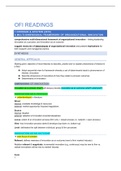
1 CROSSAN & APAYDIN (2010)
A MULTI-DIMENSIONAL FRAMEWORK OF ORGANIZATIONAL INNOVATION
comprehensive multi-dimensional framework of organizational innovation – linking leadership,
innovation as a process, and innovation as an outcome
suggest measures of determinants of organizational innovation and present implications for
both research and managerial practice
SYNTHESIS
GENERAL APPROACH
Starting point: objective of most theories to describe, predict and/ or explain phenomena of interest in
a field
Adopt sequential view for framework whereby a set of determinants leads to phenomenon of
interest, innovation
Describe dimensions of innovations & how they relate to process/ outcomes
Determinants of innovation
DIMENSIONS OF INNOVATION
Innovation as a process (how?) will always precede innovation as an outcome (what?/ what kind?)
INNOVATION AS A PROCESS
underdeveloped in literature
Driver:
internal: available knowledge & resources
external: market opportunity/ imposed regulations
Source
internal: ideation
external: adoption of innovation invented elsewhere
Locus: extent of an innovation process (firm only = closed process vs. network = open process)
View: how innovation process starts & develops (top-down vs. bottom-up)
Level: delineates the split between individual, group & firm processes
INNOVATION AS AN OUTCOME
main focus of scholars
Referent: defines newness of innovation as an outcome (new to firm/ market/ industry)
Relation referent & magnitude: incremental innovation (e.g. continuous) may be new to firm vs.
radical innovations will be new to market/ industry
Form:
1
, 1. Product/ service innovation: novelty & meaningfulness of new products introduced to the
market in a timely fashion
2. Process innovation: intro of new production methods, new management approaches & new
technology that can be used to improve production and management processes
3. Business model innovation: how company creates, sells & delivers to its customers
Magnitude: degree of newness of the innovation outcomes with respect to an appropriate referent:
incremental vs. radical
Relation form & magnitude:
incremental innovation is often associated with product or process innovation
radical innovation is more often associated with business model innovation
Type:
1. Technical e.g. products, processes, technologies used to produce products/ render services
directly related to the basic work activity of an innovation
2. Administrative: indirectly related to the basic work activity and more directly related to is
managerial aspects such as organizational structure, administrative processes and human
resources
Nature: tacit vs. explicit applied to how & what!
2
,DETERMINANTS OF INNOVATION
3 distinct meta-theoretical constructs
1. Innovation Leadership supported by upper echelon theory (used to connect agents’
characteristics & behaviour with organizational outcomes – cannot sufficiently cover
managerial levels & business processes
2. Managerial levers supported by dynamic capabilities theory (concerned with organizational
R&C)
3. Business processes supported by process theory (fully incorporating the role of the agent/
investigating how organizational processes transform inputs into outputs)
INNOVATION LEADERSHIP
Individual level (CEO):
Group level (Top Management Team (TMT) & Board Governance) variables
Upper echelon theory suggests that composition and characteristics of TMT yield stronger
explanation of organizational outcomes than a leader’s characteristics alone e.g. amount of education
and age; tenure; diversity of background & experience; extra-industry ties
Multiple roles of leaders: support & guidance + support create conditions for the subsequent
implementation of innovation
Managerial Levers
Direct: decision & actions taken by leaders to deliver innovation
Indirect: (senior executives) guide innovation champions at the middle management level in
their implementation of the Business Processes that support innovation
link individual/ group determinants with organizational factors & provide the necessary (usually
missed) connection between leadership intentions and organizational results
3
, Intense & rapid competitive moves require firms to continuously innovate to create new advantages =
dynamic capabilities are a source of competitive advantage, which must be commensurate with the
dynamic nature of the environment
5 types of managerial levers enable core innovation processes
1. Missions/ goals/ strategies: establish direction for the organization to follow
2. Structures & Systems: provide necessary support for innovation practices
3. Resource allocation:
a. include absolute & relative R&D intensity
b. include commitment to differentiated funding
c. include annual turnover of resources
4. Organizational learning & knowledge management tools:
a. help maintain innovation processes
b. organizational complexity and administrative intensity, specialization & centralization,
formalization, stratification, type of innovation, number of employees
5. Culture:
a. help maintain innovation processes
b. by having clearly stated, attainable, valuable shared vision, promoting autonomy,
calculated risk & motivation
Business Processes = how organizational processes convert inputs into outputs
1. Initiation & decision making: awareness & attitude towards new ideas; concept generation;
innovation can be initiated in an organization either by generation or adoption.
2. Portfolio Management: making strategic, technological & resource choices that govern project
selection and the future shape of the organization
3. Development & implementation: follows innovation generation/ adoption decision.
Implementation includes trials & production
4. Project Management: concerned with the processes that turn the inputs into a marketable
innovation and comprise both sequential and concurrent activities
5. Commercialization: final innovation processes that involve management & administrative
cores of the organization
Typical process theory: similar inputs transformed by similar processes will lead to similar outcomes/
constant necessary conditions for the outcome to be reached process level explanation identifies
generative mechanism that cause observed events to happen in the real world, and in particular
circumstance/ contingencies when causal mechanisms operate
DISCUSSION
INNOVATION & FIRM PERFORMANCE
Innovation capability is the most important determinant of firm performance
Understanding how innovation capability delivers innovation outcomes and ultimately firm
performance is paramount to managing firm innovation
Including both of them in a model would reveal the role of outcomes as a mediator between
innovation determinants and firm performance
TOWARDS A MULTI-LEVEL APPROACH
Way of combining micro & macro levels of theorizing could be practice-based view (PBV), which
could combine the individual, firm, contextual & process variables prevalent in the literature
4
1 CROSSAN & APAYDIN (2010)
A MULTI-DIMENSIONAL FRAMEWORK OF ORGANIZATIONAL INNOVATION
comprehensive multi-dimensional framework of organizational innovation – linking leadership,
innovation as a process, and innovation as an outcome
suggest measures of determinants of organizational innovation and present implications for
both research and managerial practice
SYNTHESIS
GENERAL APPROACH
Starting point: objective of most theories to describe, predict and/ or explain phenomena of interest in
a field
Adopt sequential view for framework whereby a set of determinants leads to phenomenon of
interest, innovation
Describe dimensions of innovations & how they relate to process/ outcomes
Determinants of innovation
DIMENSIONS OF INNOVATION
Innovation as a process (how?) will always precede innovation as an outcome (what?/ what kind?)
INNOVATION AS A PROCESS
underdeveloped in literature
Driver:
internal: available knowledge & resources
external: market opportunity/ imposed regulations
Source
internal: ideation
external: adoption of innovation invented elsewhere
Locus: extent of an innovation process (firm only = closed process vs. network = open process)
View: how innovation process starts & develops (top-down vs. bottom-up)
Level: delineates the split between individual, group & firm processes
INNOVATION AS AN OUTCOME
main focus of scholars
Referent: defines newness of innovation as an outcome (new to firm/ market/ industry)
Relation referent & magnitude: incremental innovation (e.g. continuous) may be new to firm vs.
radical innovations will be new to market/ industry
Form:
1
, 1. Product/ service innovation: novelty & meaningfulness of new products introduced to the
market in a timely fashion
2. Process innovation: intro of new production methods, new management approaches & new
technology that can be used to improve production and management processes
3. Business model innovation: how company creates, sells & delivers to its customers
Magnitude: degree of newness of the innovation outcomes with respect to an appropriate referent:
incremental vs. radical
Relation form & magnitude:
incremental innovation is often associated with product or process innovation
radical innovation is more often associated with business model innovation
Type:
1. Technical e.g. products, processes, technologies used to produce products/ render services
directly related to the basic work activity of an innovation
2. Administrative: indirectly related to the basic work activity and more directly related to is
managerial aspects such as organizational structure, administrative processes and human
resources
Nature: tacit vs. explicit applied to how & what!
2
,DETERMINANTS OF INNOVATION
3 distinct meta-theoretical constructs
1. Innovation Leadership supported by upper echelon theory (used to connect agents’
characteristics & behaviour with organizational outcomes – cannot sufficiently cover
managerial levels & business processes
2. Managerial levers supported by dynamic capabilities theory (concerned with organizational
R&C)
3. Business processes supported by process theory (fully incorporating the role of the agent/
investigating how organizational processes transform inputs into outputs)
INNOVATION LEADERSHIP
Individual level (CEO):
Group level (Top Management Team (TMT) & Board Governance) variables
Upper echelon theory suggests that composition and characteristics of TMT yield stronger
explanation of organizational outcomes than a leader’s characteristics alone e.g. amount of education
and age; tenure; diversity of background & experience; extra-industry ties
Multiple roles of leaders: support & guidance + support create conditions for the subsequent
implementation of innovation
Managerial Levers
Direct: decision & actions taken by leaders to deliver innovation
Indirect: (senior executives) guide innovation champions at the middle management level in
their implementation of the Business Processes that support innovation
link individual/ group determinants with organizational factors & provide the necessary (usually
missed) connection between leadership intentions and organizational results
3
, Intense & rapid competitive moves require firms to continuously innovate to create new advantages =
dynamic capabilities are a source of competitive advantage, which must be commensurate with the
dynamic nature of the environment
5 types of managerial levers enable core innovation processes
1. Missions/ goals/ strategies: establish direction for the organization to follow
2. Structures & Systems: provide necessary support for innovation practices
3. Resource allocation:
a. include absolute & relative R&D intensity
b. include commitment to differentiated funding
c. include annual turnover of resources
4. Organizational learning & knowledge management tools:
a. help maintain innovation processes
b. organizational complexity and administrative intensity, specialization & centralization,
formalization, stratification, type of innovation, number of employees
5. Culture:
a. help maintain innovation processes
b. by having clearly stated, attainable, valuable shared vision, promoting autonomy,
calculated risk & motivation
Business Processes = how organizational processes convert inputs into outputs
1. Initiation & decision making: awareness & attitude towards new ideas; concept generation;
innovation can be initiated in an organization either by generation or adoption.
2. Portfolio Management: making strategic, technological & resource choices that govern project
selection and the future shape of the organization
3. Development & implementation: follows innovation generation/ adoption decision.
Implementation includes trials & production
4. Project Management: concerned with the processes that turn the inputs into a marketable
innovation and comprise both sequential and concurrent activities
5. Commercialization: final innovation processes that involve management & administrative
cores of the organization
Typical process theory: similar inputs transformed by similar processes will lead to similar outcomes/
constant necessary conditions for the outcome to be reached process level explanation identifies
generative mechanism that cause observed events to happen in the real world, and in particular
circumstance/ contingencies when causal mechanisms operate
DISCUSSION
INNOVATION & FIRM PERFORMANCE
Innovation capability is the most important determinant of firm performance
Understanding how innovation capability delivers innovation outcomes and ultimately firm
performance is paramount to managing firm innovation
Including both of them in a model would reveal the role of outcomes as a mediator between
innovation determinants and firm performance
TOWARDS A MULTI-LEVEL APPROACH
Way of combining micro & macro levels of theorizing could be practice-based view (PBV), which
could combine the individual, firm, contextual & process variables prevalent in the literature
4