

Experimental psychology
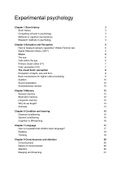
Chapter 1 Short history 3
Short history 3
Competing schools in psychology 3
Methods in cognitive neuroscience 3
Research methods in psychology 3
Chapter 4 Sensation and Perception 5
How to measure sensory capacities? Weber-Fechner law 5
Signal Detection theory: (SDT) 5
Vision 6
The eye 6
Cells within the eye 6
Primary visual cortex (V1) 7
Color perception (V4) 7
The visual brain: perception 8
Perception of depth, size and form 8
Brain mechanisms for higher-order processing 9
Audition 10
Sound localization 10
Somatosensory senses 10
Chapter 5 Memory 12
Sensory memory 12
Short-term memory 12
Long-term memory 12
Why do we forget? 13
Amnesia 13
Chapter 6 Condition and learning 15
Classical conditioning 15
Operant conditioning 15
Cognition in SR-learning 16
Chapter 7 Language 17
How is it possible that children learn language? 17
Reading 18
Thinking 18
Chapter 8 Consciousness and attention 20
Consciousness 20
Nature of consciousness 20
Attention 20
Sleeping and Dreaming 21
,Chapter 10 Emotion and Motivation 23
Emotions 23
Motivation 24
, Chapter 1 Short history
Short history
Neuroscience: investigate the relationship between mental processes and their biological
foundations in the central nervous system. Neuropsychological patients are used as a test of
theoretical hypotheses.
Hermann von Helmholtz: first psychologist to conduct experiments (conduction velocity
and nerve impulse).
Gustav Fechner: discovered mathematical relationship between the physical and
perceptual world (just noticeable difference)
Darwin: evolution theory (we all share the same ancestors, justified comparative psy)
Franciscus Donders: mental chronometry - how much time does the brain need to decide
(subtracted time for making decision and for stimulus discrimination etc. ki - ku - ke )
Competing schools in psychology
1. Structuralism: Wilhelm Wundt. Psychology is the science of immediate experience.
Combining sensations, images and feelings gives rise to a conscious experience.
2. Behaviorism: John Watson. Psychology is the study of observable behaviour. Mental
behaviour cant be studied scientifically. Operational definition: needs to be measured
(hunger=duration of food deprivation measured in hours.)
1. Classic conditioning: Ivan Pavlov. Learning happens unconsciously (dog and bell)
2. Operant conditioning: Skinner. Reward and punishment, also study the external
environment.
Gestalt psychology: Max Wertheimer. The whole is more than the sum of its parts.
Rejected structuralism because experience is more than a function of sensations (like two
dots popping up that seems to be one dot that's moving), and behaviorism because complex
behaviours are more than the sum of its components.
Perception is a construction, not a reflection of the sensation.
Methods in cognitive neuroscience
1. Experimental research with behavioural measures (RT)
2. Non-invasive brain imaging techniques (EEG, MEG, fMRI)
3. Blocking normal brain functioning through pharmacological substances (TMS)
4. Patients with focal lesions
5. Computer simulations
Research methods in psychology
Behaviour can be explained on various levels: biological factors (chemical imbalance),
individual factors (taught) , cultural and social factors.
Descriptive research:
-naturalistic observation,
-case studies (detailed study on one subject),
-interview,
-questionnaires,
-poll (sample of representatives),
-correlational research: a statistical measure and varies between -1 and +1.
Positive correlation: 0-1 both change in the same direction
Negative correlation: -1-0 change in opposite directions
0 means no correlation at all.
Chapter 1 Short history 3
Short history 3
Competing schools in psychology 3
Methods in cognitive neuroscience 3
Research methods in psychology 3
Chapter 4 Sensation and Perception 5
How to measure sensory capacities? Weber-Fechner law 5
Signal Detection theory: (SDT) 5
Vision 6
The eye 6
Cells within the eye 6
Primary visual cortex (V1) 7
Color perception (V4) 7
The visual brain: perception 8
Perception of depth, size and form 8
Brain mechanisms for higher-order processing 9
Audition 10
Sound localization 10
Somatosensory senses 10
Chapter 5 Memory 12
Sensory memory 12
Short-term memory 12
Long-term memory 12
Why do we forget? 13
Amnesia 13
Chapter 6 Condition and learning 15
Classical conditioning 15
Operant conditioning 15
Cognition in SR-learning 16
Chapter 7 Language 17
How is it possible that children learn language? 17
Reading 18
Thinking 18
Chapter 8 Consciousness and attention 20
Consciousness 20
Nature of consciousness 20
Attention 20
Sleeping and Dreaming 21
,Chapter 10 Emotion and Motivation 23
Emotions 23
Motivation 24
, Chapter 1 Short history
Short history
Neuroscience: investigate the relationship between mental processes and their biological
foundations in the central nervous system. Neuropsychological patients are used as a test of
theoretical hypotheses.
Hermann von Helmholtz: first psychologist to conduct experiments (conduction velocity
and nerve impulse).
Gustav Fechner: discovered mathematical relationship between the physical and
perceptual world (just noticeable difference)
Darwin: evolution theory (we all share the same ancestors, justified comparative psy)
Franciscus Donders: mental chronometry - how much time does the brain need to decide
(subtracted time for making decision and for stimulus discrimination etc. ki - ku - ke )
Competing schools in psychology
1. Structuralism: Wilhelm Wundt. Psychology is the science of immediate experience.
Combining sensations, images and feelings gives rise to a conscious experience.
2. Behaviorism: John Watson. Psychology is the study of observable behaviour. Mental
behaviour cant be studied scientifically. Operational definition: needs to be measured
(hunger=duration of food deprivation measured in hours.)
1. Classic conditioning: Ivan Pavlov. Learning happens unconsciously (dog and bell)
2. Operant conditioning: Skinner. Reward and punishment, also study the external
environment.
Gestalt psychology: Max Wertheimer. The whole is more than the sum of its parts.
Rejected structuralism because experience is more than a function of sensations (like two
dots popping up that seems to be one dot that's moving), and behaviorism because complex
behaviours are more than the sum of its components.
Perception is a construction, not a reflection of the sensation.
Methods in cognitive neuroscience
1. Experimental research with behavioural measures (RT)
2. Non-invasive brain imaging techniques (EEG, MEG, fMRI)
3. Blocking normal brain functioning through pharmacological substances (TMS)
4. Patients with focal lesions
5. Computer simulations
Research methods in psychology
Behaviour can be explained on various levels: biological factors (chemical imbalance),
individual factors (taught) , cultural and social factors.
Descriptive research:
-naturalistic observation,
-case studies (detailed study on one subject),
-interview,
-questionnaires,
-poll (sample of representatives),
-correlational research: a statistical measure and varies between -1 and +1.
Positive correlation: 0-1 both change in the same direction
Negative correlation: -1-0 change in opposite directions
0 means no correlation at all.




