
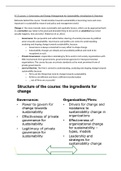
9/11 Lecture 1: Governance and Change Management for Sustainability: Introduction & Overview
Rationale behind the course: Transformation towards sustainability is becoming more and more
important in sustainability research and policy and management world.
Change Is ‘the move towards more sustainable and equitable futures, which can be approached both
in a normative way (what is the good and desirable thing to do) and in an analytical way (what
actually happens, how and why)’ (Patterson et al, 2016).
- Governance: the purposeful and authoritative steering of societal processes by political
actors towards sustainability. Governance and politics are central to understanding,
analysing and shaping change towards sustainability, because
o Governance is always connected in every effort to shape change
o Sustainability changes are deeply and unavoidably political and need to be
recognised as such.
- Private Governance: cooperative rulemaking by firms and/or civil society organisations with
little involvement from governments, governmental agencies for intergovernmental
organisations. The course focuses on private standards as the most prominent form of
private governments.
- Level of the firm: The firm is central to understanding, analysing and shaping change towards
sustainability because
o Firms are the things that need to change towards sustainability
o All firms are different and have a different transformation
o … not all firms are successful
,
,9/11 Lecture 2: The power to govern for sustainability transformations
Conceptualising business power in sustainability governance
violent vs. soft forms of power, different expressions of power (Hiroshima bomb, I have a dream
speech)
Power is the ability of (business) actors to successfully pursue a desired political objective. Power has
three faces:
- Instrumental power:
o Concept: ‘The ability of A to make B do something that they would otherwise not do’.
o Key form of Influence via
political lobbying at national/international level
by (big) individual firms or umbrella organisations.
o Key sources of influence are
presence of organisational & financial resources
established channels of access & influence (network/personal contact with
politicians revolving doors: government people that become lobbyists)
provision of policy relevant knowledge & expertise.
- Structural power: Influence on the input side (before decision making)
o Concept, two ways:
Ability to keep things off the agenda (agenda-setting power)
Ability to create (private) rules and standards (rule-setting power), when
large actors can set standards/rules because they have large market power.
o Key forms of influence via
Implicit/explicit threats of relocation of investments
Problem: untransparent dimension of power and difficult to research in its
agenda-setting form.
o Key sources of influences
Level of market concentration
Importance to economic growth, employment and innovation
Dependence of political elites on economic success for political legitimacy
and electoral success
o Developments:
growth in foreign direct investment over the years
increase in market size via integration of global markets
increase in control over knowledge and innovation
- Discursive power: ability to frame norms and ideas to convince people to think your way
o Concept:
Ability to shape norms and ideas
Ability not only to pursue interests but also to create interests
o Key forms of influence
Communication strategies to chape public and elite perceptions of
environmental problems and solutions
Framing of environmental issues that require business involvement and
solutions (hunger, framing as efficiency problem vs. distribution problem)
o Key sources of influences (money)
Ability to buy media time and finance advertisements and information
campaigns & New media giants (twitter, facebook etc.)
, o Developments: Framing issues (businesses can frame themselves as the ‘good one’)
Private governance as a function of business power
- Instrumental power allows business actors to stop/relax state regulation from developing in
key issue areas, hence implicitly creating the need for private actors to step in
- Control over economy/markets/knowledge sectors allow business actors to develop own
rules and standards (often in collaboration with civil society organisations)
- Ability to frame norms and ideas allows business actors to have the consent of society for
their role as legitimate governance actors
Growth of private governance: over the years, not much happens in state regulations (top pyramid)
but a lot of business and civil society activity (bottom of pyramid)
- Fragility of business power
o Business is not a unitary actor (they are different in size, power etc.)
o Differences between large corporations and medium/small-size businesses
o Vulnerability of business to scandals and changes of societal norms and values (meat
vs. veggie also guides changes)
Conclusion & outlook
- Power can be examined in three main dimensions, instrumental, structural and discursive,
which are interrelated
- Business power across these dimensions has been growing over the years
- Such growing business power has also allowed the developments and growth of private
governance
- Business power is also fragile and can be challenged
Rationale behind the course: Transformation towards sustainability is becoming more and more
important in sustainability research and policy and management world.
Change Is ‘the move towards more sustainable and equitable futures, which can be approached both
in a normative way (what is the good and desirable thing to do) and in an analytical way (what
actually happens, how and why)’ (Patterson et al, 2016).
- Governance: the purposeful and authoritative steering of societal processes by political
actors towards sustainability. Governance and politics are central to understanding,
analysing and shaping change towards sustainability, because
o Governance is always connected in every effort to shape change
o Sustainability changes are deeply and unavoidably political and need to be
recognised as such.
- Private Governance: cooperative rulemaking by firms and/or civil society organisations with
little involvement from governments, governmental agencies for intergovernmental
organisations. The course focuses on private standards as the most prominent form of
private governments.
- Level of the firm: The firm is central to understanding, analysing and shaping change towards
sustainability because
o Firms are the things that need to change towards sustainability
o All firms are different and have a different transformation
o … not all firms are successful
,
,9/11 Lecture 2: The power to govern for sustainability transformations
Conceptualising business power in sustainability governance
violent vs. soft forms of power, different expressions of power (Hiroshima bomb, I have a dream
speech)
Power is the ability of (business) actors to successfully pursue a desired political objective. Power has
three faces:
- Instrumental power:
o Concept: ‘The ability of A to make B do something that they would otherwise not do’.
o Key form of Influence via
political lobbying at national/international level
by (big) individual firms or umbrella organisations.
o Key sources of influence are
presence of organisational & financial resources
established channels of access & influence (network/personal contact with
politicians revolving doors: government people that become lobbyists)
provision of policy relevant knowledge & expertise.
- Structural power: Influence on the input side (before decision making)
o Concept, two ways:
Ability to keep things off the agenda (agenda-setting power)
Ability to create (private) rules and standards (rule-setting power), when
large actors can set standards/rules because they have large market power.
o Key forms of influence via
Implicit/explicit threats of relocation of investments
Problem: untransparent dimension of power and difficult to research in its
agenda-setting form.
o Key sources of influences
Level of market concentration
Importance to economic growth, employment and innovation
Dependence of political elites on economic success for political legitimacy
and electoral success
o Developments:
growth in foreign direct investment over the years
increase in market size via integration of global markets
increase in control over knowledge and innovation
- Discursive power: ability to frame norms and ideas to convince people to think your way
o Concept:
Ability to shape norms and ideas
Ability not only to pursue interests but also to create interests
o Key forms of influence
Communication strategies to chape public and elite perceptions of
environmental problems and solutions
Framing of environmental issues that require business involvement and
solutions (hunger, framing as efficiency problem vs. distribution problem)
o Key sources of influences (money)
Ability to buy media time and finance advertisements and information
campaigns & New media giants (twitter, facebook etc.)
, o Developments: Framing issues (businesses can frame themselves as the ‘good one’)
Private governance as a function of business power
- Instrumental power allows business actors to stop/relax state regulation from developing in
key issue areas, hence implicitly creating the need for private actors to step in
- Control over economy/markets/knowledge sectors allow business actors to develop own
rules and standards (often in collaboration with civil society organisations)
- Ability to frame norms and ideas allows business actors to have the consent of society for
their role as legitimate governance actors
Growth of private governance: over the years, not much happens in state regulations (top pyramid)
but a lot of business and civil society activity (bottom of pyramid)
- Fragility of business power
o Business is not a unitary actor (they are different in size, power etc.)
o Differences between large corporations and medium/small-size businesses
o Vulnerability of business to scandals and changes of societal norms and values (meat
vs. veggie also guides changes)
Conclusion & outlook
- Power can be examined in three main dimensions, instrumental, structural and discursive,
which are interrelated
- Business power across these dimensions has been growing over the years
- Such growing business power has also allowed the developments and growth of private
governance
- Business power is also fragile and can be challenged



