Rsk2601-Summary .
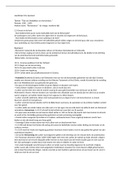
"Risk is the effect of uncertainty on objectives" The effect may be positive, negative or a deviation from the expected. Risk is often described by an event, a change in circumstances or a consequence. (ISO 31000) TOPIC 1: ERM (ENTERPRISE RISK MANAGEMENT) IN CONTEXT [SU 1] INTRO - Risk Diversity rapid changes in globalisation/markets/technology, communication speed - Expansion strategies investing in emerging markets; develop significant new products; acquisition; major org. restructuring; outsourcing key processes; major capital investment increases risk exposure. - Risk management is no longer silo-based as it affects multiple business areas - Risk-taking tendency to engage behaviours that have harmful/dangerous potential, yet could also provide a positive opportunity - Risk & opportunity competitive differentiator, heart of growth & wealth creation Benefits improved cost certainty; higher economic returns, sustainable shareholder value, increased stakeholder confidence, reduction of costly disputes & claims Controlling certain risks to maximise business opportunities Board should ensure comprehensive & consistent management - Board's role SG p8, TB p7 - ERM (strategic business risk management) aims to provide a coherent framework to holistically deal with all risks that result from operating in the ever-changing economic environment thereby improving business performance & creating value for shareholders. - Benefits of ERM improved business performance, increased organisational effectiveness & better risk reporting Increased likelihood of realising business objectivestechniques to identify, record, assess opportunity Build confidence in stakeholders & investment community Comply with relevant legal & regulatory requirements Align risk appetite & strategy Improve organisational resilience degree/flexibility to recover from & respond to change Enhance corporate governance challenge potential excessive risk taking, improve risk appetite decision-making Embed risk process throughout organisation creation of framework, policy, process, plans & training Minimise operational surprises & losses capability to identify, assess & establish responses Enhance risk response decisions risk removal, reductions, transfer, retention Optimise resources allocation Identify & manage cross-enterprise risksIntegrate risk transfer strategies & management, centralised risk reporting, Link growth, risk & return acceptable levels of risk relative to potential growth Rationalise capital assess overall capital needs & allocation Seize opportunities Improve organisational learning ERM Elements/Structure: TB Fig. 1.2 Rsk2601-Summary . - Corporate Governance rules & practices ensuring board's accountability, fairness & transparency with stakeholders Explicit & implicit contracts for distribution of responsibilities, rights & rewards between org. & stakeholders Reconciling procedures in accordance with stakeholders duties, privileges & roles Procedures for proper supervision, control & info flow. - Internal Control process, effected by board & all personnel, designed to provide reasonable assurance of objective achievement Operation effectiveness & efficiency Reliability of financial reporting Compliance with applicable law & regulations - Implementation mapping, communicating & agreeing on action parameters. Resourced internally or externally - Risk management framework basic conceptual structure assisting in integrating RM into a routine activity Composition Mandate & commitment; Design framework; Implement framework; Monitor framework; Improve framework - Risk management policy How(control); Who(responsibility, accountability), boundaries & reporting; What(intention) - Risk management process establish context, communicate & consult, identify, analyse, evaluate, treat, monitor & review - Sources of risk TOPIC 1: ERM IN CONTEXT [SU 2] CORPORATE GOVERNANCE Definition: The relationships among the management of an organisation, its board, its shareholders and other relevant stakeholders. It also refers to the specific responsibilities of boards of directors and management to maintain established relationships. - Good corporate governance contributes to shareholders’ wealth and a key factor in the investor decision-making process. higher future share prices, reducing risk (avoid/cope), trend - Impact Employ assets efficiently; Attract lower-cost capital; Comply with social obligations & laws; Overall performance - History of corporate governance in South Africa: King I Report (1994) integrated approach, guides on financial reporting & good social, ethical, environmental practices King II Report (2002) triple bottom-line principle, emphasis on non-financial indicators (social, economy, environment) King III Report (2009) annual reporting; Apply to JSE listings, banks, financial & insurance institutes, some public agents

Geschreven voor
- Instelling
- University of South Africa
- Vak
- RSK2601 - Enterprise Risk Management
Documentinformatie
- Geüpload op
- 27 november 2021
- Aantal pagina's
- 21
- Geschreven in
- 2021/2022
- Type
- SAMENVATTING
Onderwerpen
-
rsk2601
-
rsk2601 summary