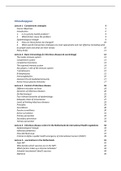
Inhoudsopgave
Lecture 1 - Containment strategies 4
Course Objectives 5
Introduction 6
1. Is it a priority health problem? 9
2. What factors cause the problem 9
Epidemiological triangle 9
3. How can these factors be changed? 10
4. What overall intervention strategies are most appropriate and cost effective (including what
do people want and what are their needs) 10
Policy briefs 11
Lecture 2 - Basic immunology (in infectious diseases & vaccinology) 12
The innate immune system 13
Complement system 13
complement functions 14
The acquired immune system 14
Key players / cells of the immune system 15
T-lymphocytes 15
B-lymphocytes 15
Immunoglobulins 16
Humoral VS cell-mediated immunity 17
Active Versus passive immunity 17
Lecture 3 - Control of infectious disease 18
Different microbes we have 18
Dynamics of infectious diseases 20
De Bof (mumps) 25
Four relevant branches of epidemiology: 26
Adequate chain of transmission 27
Levels of limiting infectious diseases 29
Principles: 29
Surveillance 30
Passive surveillance 30
Active surveilance 31
Primary prevention 32
Secondary prevention 33
Tertiary prevention 33
Lecture 4 - Infectious disease control in the Netherlands & international Health regulations 33
Epidemiological triangle 33
Influenza pandemics: 35
How did Ebola stop: 37
Criteria to define a public health emergency of international concern (PHEIC) 39
Lecture 5 – vaccinations in the Netherlands 41
Start NIP 42
Who decides which vaccines are in the NIP? 42
Which factors make up a Vaccine Schedule? 44
Schedule Inactivated (‘dead’) vaccines 44
Diphteria 45
, Pertussis (kinkhoest) 45
Tetanus 46
Haemophilus influenza type B, pneumococcal and Meningococcal disease 46
MenACWY in Dutch NIP 47
Mumps 48
measles 48
Rubella (rodehond) 49
Hepatitis B 49
Human papillomavirus (HPV) infection 49
Future vaccines and changes in NIP 50
Risks of decreasing vaccination coverage 51
Wat can we do? 51
What does not work? 51
What is the solution 51
Other interventions 51
NIP and COVID-19 52
Lecture 6: Transfusion safety and blood-borne infections 52
Part 1: Blood borne infections” 52
BBIs: infectious material 54
Part 2 – the MSM dilemma 55
Lecture 7: HIV/AIDS 58
HIV strategy 60
Lecture 8 – Malaria 62
Malaria – at risk populations 63
History of Malaria 63
containment strategies 64
CHMIs (Controlled Human Malaria Infection) – procedures 67
Malaria Vaccines – RTS, S 67
Malaria vaccines – CPS 67
Malaria vaccines – PfSPZ products 68
Malaria vaccines – PfSPZ-GA1 68
Malaria vaccines – TBV 69
Malaria vaccines – unresolved issues 69
Lecture 9 – Leishmaniasis Control 69
Visceral Leishmaniasis (Kala-azar) 70
East Africa and South Asia 70
Visceral Leishmaniasis disease control 70
Treatment 72
2. Control of reservoir hosts: 73
3. Vector control 73
4. Epidemic response 74
5. Vaccination 74
Conclusions 75
Cutaneous Leishmaniasis Control 75
Lecture 10 – pandemics; respiratory viruses 78
SARS 2003 80
Respiratory virus transmission 85
Lecture 11 - Cost effectiveness and control 87
1. Cost-minimization costs (CMA) 90
2
, 2. Cost-effectiveness analysis (CEA) 91
Cost effectiveness Plane 92
3. Cost- Utility Analysis (CUA) 93
Time trade-off 93
Quality of life 93
Blood Borne infections 94
Lecture 12 - TB Containment and control – nog uitwerken! 95
Pathodology 95
Diagnosis and treatment 96
Lecture 14 – Anti-Microbial Resistance (AMR) 106
Lecture 15 – Ebola 117
Ebola Virus Infection 118
Clinical 118
Ebola Response (in theory) – containment strategy 119
3
, Exam study material
Exam preparation
The exam will consist of both knowledge and insight questions that are based on the book
of Webber, the lectures and any additional reading material as published on
CANVAS. Questions will be both open questions, and multiple
choice questions which require explanation. A mock exam will be made available.
Exam study material
• Lectures, published on CANVAS;
• Book chapters 1 – 6, and selected diseases (see below and introductory lecture);
• Extra reading material as published on CANVAS and indicated as such
Please note that you don’t have to know everything and all details by heart, just grasp the
main messages with a focus on what is relevant for Containment.
The lectures
All lectures are part of the exam material. Questions will relate to the infectious diseases
and their epidemiology, the control strategies and what are strengths and weaknesses, the
policy framework and relevant and contextual factors that may influence control. Note
that for specific approaches: e.g. cost effectiveness, we may also ask questions about that.
Selected diseases
Below we have provided the list as copied from the introduction lecture. We do not
expect you to know all the details of the selected infectious diseases, but you do need to
know the relevant disease aspects in relation to the containment/control strategies, such
as:
• What is it (virus, bacterium, parasite, worm);
• What does it cause – disease with clinical features such as fatality, morbidity, common
symptoms;
• Diagnosis – only when very important in control, and when it is very easy or just very
difficult;
• Transmission – important routes of transmission between people (e.g. airborne,
waterborne, vector borne, etc);
• Incubation period and period of communicability – only in general terms, and in
relation to control (e.g. infectious when no symptoms? Direct transmission between
people or only through vector? Very long incubation period?);
• Occurrence and distribution – where in the world? Widely spread? Prevalence?
Endemic or epidemic?;
• Prevention and control – understand the most important elements;
4
Lecture 1 - Containment strategies 4
Course Objectives 5
Introduction 6
1. Is it a priority health problem? 9
2. What factors cause the problem 9
Epidemiological triangle 9
3. How can these factors be changed? 10
4. What overall intervention strategies are most appropriate and cost effective (including what
do people want and what are their needs) 10
Policy briefs 11
Lecture 2 - Basic immunology (in infectious diseases & vaccinology) 12
The innate immune system 13
Complement system 13
complement functions 14
The acquired immune system 14
Key players / cells of the immune system 15
T-lymphocytes 15
B-lymphocytes 15
Immunoglobulins 16
Humoral VS cell-mediated immunity 17
Active Versus passive immunity 17
Lecture 3 - Control of infectious disease 18
Different microbes we have 18
Dynamics of infectious diseases 20
De Bof (mumps) 25
Four relevant branches of epidemiology: 26
Adequate chain of transmission 27
Levels of limiting infectious diseases 29
Principles: 29
Surveillance 30
Passive surveillance 30
Active surveilance 31
Primary prevention 32
Secondary prevention 33
Tertiary prevention 33
Lecture 4 - Infectious disease control in the Netherlands & international Health regulations 33
Epidemiological triangle 33
Influenza pandemics: 35
How did Ebola stop: 37
Criteria to define a public health emergency of international concern (PHEIC) 39
Lecture 5 – vaccinations in the Netherlands 41
Start NIP 42
Who decides which vaccines are in the NIP? 42
Which factors make up a Vaccine Schedule? 44
Schedule Inactivated (‘dead’) vaccines 44
Diphteria 45
, Pertussis (kinkhoest) 45
Tetanus 46
Haemophilus influenza type B, pneumococcal and Meningococcal disease 46
MenACWY in Dutch NIP 47
Mumps 48
measles 48
Rubella (rodehond) 49
Hepatitis B 49
Human papillomavirus (HPV) infection 49
Future vaccines and changes in NIP 50
Risks of decreasing vaccination coverage 51
Wat can we do? 51
What does not work? 51
What is the solution 51
Other interventions 51
NIP and COVID-19 52
Lecture 6: Transfusion safety and blood-borne infections 52
Part 1: Blood borne infections” 52
BBIs: infectious material 54
Part 2 – the MSM dilemma 55
Lecture 7: HIV/AIDS 58
HIV strategy 60
Lecture 8 – Malaria 62
Malaria – at risk populations 63
History of Malaria 63
containment strategies 64
CHMIs (Controlled Human Malaria Infection) – procedures 67
Malaria Vaccines – RTS, S 67
Malaria vaccines – CPS 67
Malaria vaccines – PfSPZ products 68
Malaria vaccines – PfSPZ-GA1 68
Malaria vaccines – TBV 69
Malaria vaccines – unresolved issues 69
Lecture 9 – Leishmaniasis Control 69
Visceral Leishmaniasis (Kala-azar) 70
East Africa and South Asia 70
Visceral Leishmaniasis disease control 70
Treatment 72
2. Control of reservoir hosts: 73
3. Vector control 73
4. Epidemic response 74
5. Vaccination 74
Conclusions 75
Cutaneous Leishmaniasis Control 75
Lecture 10 – pandemics; respiratory viruses 78
SARS 2003 80
Respiratory virus transmission 85
Lecture 11 - Cost effectiveness and control 87
1. Cost-minimization costs (CMA) 90
2
, 2. Cost-effectiveness analysis (CEA) 91
Cost effectiveness Plane 92
3. Cost- Utility Analysis (CUA) 93
Time trade-off 93
Quality of life 93
Blood Borne infections 94
Lecture 12 - TB Containment and control – nog uitwerken! 95
Pathodology 95
Diagnosis and treatment 96
Lecture 14 – Anti-Microbial Resistance (AMR) 106
Lecture 15 – Ebola 117
Ebola Virus Infection 118
Clinical 118
Ebola Response (in theory) – containment strategy 119
3
, Exam study material
Exam preparation
The exam will consist of both knowledge and insight questions that are based on the book
of Webber, the lectures and any additional reading material as published on
CANVAS. Questions will be both open questions, and multiple
choice questions which require explanation. A mock exam will be made available.
Exam study material
• Lectures, published on CANVAS;
• Book chapters 1 – 6, and selected diseases (see below and introductory lecture);
• Extra reading material as published on CANVAS and indicated as such
Please note that you don’t have to know everything and all details by heart, just grasp the
main messages with a focus on what is relevant for Containment.
The lectures
All lectures are part of the exam material. Questions will relate to the infectious diseases
and their epidemiology, the control strategies and what are strengths and weaknesses, the
policy framework and relevant and contextual factors that may influence control. Note
that for specific approaches: e.g. cost effectiveness, we may also ask questions about that.
Selected diseases
Below we have provided the list as copied from the introduction lecture. We do not
expect you to know all the details of the selected infectious diseases, but you do need to
know the relevant disease aspects in relation to the containment/control strategies, such
as:
• What is it (virus, bacterium, parasite, worm);
• What does it cause – disease with clinical features such as fatality, morbidity, common
symptoms;
• Diagnosis – only when very important in control, and when it is very easy or just very
difficult;
• Transmission – important routes of transmission between people (e.g. airborne,
waterborne, vector borne, etc);
• Incubation period and period of communicability – only in general terms, and in
relation to control (e.g. infectious when no symptoms? Direct transmission between
people or only through vector? Very long incubation period?);
• Occurrence and distribution – where in the world? Widely spread? Prevalence?
Endemic or epidemic?;
• Prevention and control – understand the most important elements;
4