
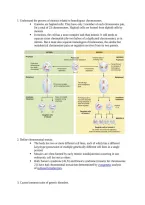
1. Understand the process of meiosis related to homologous chromosomes.
Gametes are haploid cells: They have only 1 member of each chromosome pair,
for a total of 23 chromosomes. Haploid cells are formed from diploid cells by
meiosis
In meiosis, the cell has a more complex task than mitosis. It still needs to
separate sister chromatids (the two halves of a duplicated chromosome), as in
mitosis. But it must also separate homologous chromosomes, the similar but
nonidentical chromosome pairs an organism receives from its two parents.
2. Define chromosomal mosaic.
The body has two or more different cell lines, each of which has a different
karyotype (possession of multiple genetically different cell lines in a single
person)
Mosaics are often formed by early mitotic nondisjunction occurring in one
embryonic cell but not in others
Both Turner's syndrome (45,X) and Down's syndrome (trisomy for chromosome
21) have had chromosomal mosaicism demonstrated by cytogenetic analysis
of cultured lymphocytes.
3. Causes/common traits of genetic disorders
, A. Cri du chat
Genetic disorder caused by a chromosomal deletion of the short arm of
chromosome 5
Chromosomal deletion: caused by a broken chromosome and lost DNA
Gamete with a deletion unites with a normal gamete to form a zygote
the zygote thus has ONE chromosome with the normal gene complement
and ONE with some missing genes
Many genes can be lost in a deletion—thus serious consequences result
even though one normal chromosome is present
Term literally means “cry of the cat”—describes the characteristic cry of the
affected child
Symptoms: low birth weight, severe intellectual disability, microcephaly (smaller
than normal head size), and heart defects
B. Turner Syndrome
Genetic disorder where females are born with only ONE X chromosome
(karyotype noted as 45,X)
X chromosome is usually inherited from mother, thus caused by meiotic error in
father
Symptoms:
Not considered intellectually disabled—some impairment of spatial and
mathematical reasoning ability is found
Short stature, wide spaced nipples, reduced carrying angle at elbow,
webbing of neck
Cortication of aorta, edema in feet
Underdeveloped ovaries—sterile
15-20% of spontaneous abortions with chromosome abnormalities have this
karyotype—only 0.5% survive to term
C. Fragile X
Fragile site located on the long arm of the X chromosome—caused by duplication
at fragile sites
Second most common genetic cause of intellectual disability (second to down
syndrome)
Higher incidence in males because they only have on X chromosome
Symptoms:
Intellectual disability (mental retardation)
D. Cystic Fibrosis
Autosomal recessive disorder—most lethal recessive disease in white children
Cystic fibrosis gene encodes a chloride ion that alters sodium balance
Defective transport of chloride ions leads to a salt imbalance, which
results in secretions of abnormally thick, dehydrated mucus.
Digestive organs, particularly the pancreas, become obstructed, causing
malnutrition, and the lungs become clogged with mucus, making them
highly susceptible to bacterial infections
Males and females are affected equally
Consanguinity (marriage between related individuals) can cause cystic fibrosis
Seen in siblings of affected individuals but not usually their parents



