1.4 Revision notes
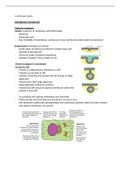
MEMBRANE TRANSPORT
Vesicular transport
Vesicle: small sac of membrane with fluid inside
- Spherical
- Eukaryotic cells
- Due to fluidity of membrane, vesicles can move and be deconstructed/reconstructed
Endocytosis (formation of vesicle):
- Small region of plasma membrane is pulled away and
pinched of through ATP
- Forms on inside of plasma membrane
- Contains contents from outside of cell
Vesicle transport & movement
Secretory cells
- Protein is synthesised by ribosomes in rER
- Proteins accumulate in rER
- Vesicles containing the protein bud off and go to Golgi
apparatus
- Vesicles fuse with Golgi apparatus
- Golgi apparatus processes proteins
- Vesicles bud off and go to plasma membrane where the
protein is secreted
- In a growing cell, plasma membrane area increases
- When vesicles fuse with plasma membrane, increases area
- rER ribosomes synthesises phospholipids and membrane proteins which are later infused
into plasma membrane via vesicles
, Exocytosis
- Vesicles release materials from cell by fusing with plasma
membrane
- Digestive enzymes are released from glands via exocytosis
(secretion)
- Exocytosis expels waste products (removal of excess water in
unicellular organisms – contractile vacuole)
Simple diffusion
Diffusion: net passive movement of particles from high
concentration to low concentration as a result of the random
motions of particles.
- will continue until gradients are in equilibrium
Occurs in partially permeable membranes
Particles move through phospholipid molecules in membrane
Facilitated diffusion
Passive movement of molecules across the cell membrane via the aid of a membrane protein
- Used to transfer molecules which are unable to cross membrane freely
o Large/polar molecules, ions
- Carrier proteins & channel proteins
Carrier proteins:
- Integral lipoproteins
- Chemically specific, only bind to/allow one type of molecule to pass through
- Can move molecules against concentration gradient using ATP (active transport)
- Slower rate of transport than channel proteins
Channel proteins:
- Integral lipoproteins
- Contain a pore that allows ions to move across membrane
- Ion-selective
- Only move along concentration
- Faster rate of transport than carrier proteins
MEMBRANE TRANSPORT
Vesicular transport
Vesicle: small sac of membrane with fluid inside
- Spherical
- Eukaryotic cells
- Due to fluidity of membrane, vesicles can move and be deconstructed/reconstructed
Endocytosis (formation of vesicle):
- Small region of plasma membrane is pulled away and
pinched of through ATP
- Forms on inside of plasma membrane
- Contains contents from outside of cell
Vesicle transport & movement
Secretory cells
- Protein is synthesised by ribosomes in rER
- Proteins accumulate in rER
- Vesicles containing the protein bud off and go to Golgi
apparatus
- Vesicles fuse with Golgi apparatus
- Golgi apparatus processes proteins
- Vesicles bud off and go to plasma membrane where the
protein is secreted
- In a growing cell, plasma membrane area increases
- When vesicles fuse with plasma membrane, increases area
- rER ribosomes synthesises phospholipids and membrane proteins which are later infused
into plasma membrane via vesicles
, Exocytosis
- Vesicles release materials from cell by fusing with plasma
membrane
- Digestive enzymes are released from glands via exocytosis
(secretion)
- Exocytosis expels waste products (removal of excess water in
unicellular organisms – contractile vacuole)
Simple diffusion
Diffusion: net passive movement of particles from high
concentration to low concentration as a result of the random
motions of particles.
- will continue until gradients are in equilibrium
Occurs in partially permeable membranes
Particles move through phospholipid molecules in membrane
Facilitated diffusion
Passive movement of molecules across the cell membrane via the aid of a membrane protein
- Used to transfer molecules which are unable to cross membrane freely
o Large/polar molecules, ions
- Carrier proteins & channel proteins
Carrier proteins:
- Integral lipoproteins
- Chemically specific, only bind to/allow one type of molecule to pass through
- Can move molecules against concentration gradient using ATP (active transport)
- Slower rate of transport than channel proteins
Channel proteins:
- Integral lipoproteins
- Contain a pore that allows ions to move across membrane
- Ion-selective
- Only move along concentration
- Faster rate of transport than carrier proteins