
NURS 4322 | MATERNAL–NEWBORN NURSING | 2026–2027
Antepartum & Prenatal Nursing Practice Questions
2026–2027 | 110 ORIGINAL PRACTICE QUESTIONS
Emphasizes prenatal screening, counseling, fetal surveillance, hypertensive disorders and pregnancy emergencies.
Independent educational study material. These are original practice questions, not official Southern Utah University, ATI,
faculty, or licensing examination materials. Similar core concepts appear in multiple files to reinforce learning.
Clinical safety note: Use institutional protocols and current professional guidance. Questions are designed for learning and
are not a substitute for medical decision-making or individualized orders.
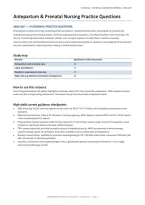
Study map
Domain Questions in this document
Antepartum and prenatal care 44
Labor and delivery 12
Newborn assessment and care 12
High-risk and obstetric/neonatal emergencies 42
How to use this resource
Cover the green answer and yellow-highlighted rationale, select A–D, then review the explanation. Mark missed concepts
and revisit the corresponding clinical area. The answer key at the end provides a rapid self-check.
High-yield current guidance checkpoints
• GBS screening: ACOG universal vaginal–rectal culture at 36 0/7–37 6/7 weeks, with intrapartum prophylaxis when
indicated.
• Maternal immunization: Tdap at 27–36 weeks in every pregnancy; Pfizer Abrysvo maternal RSV at 32 0/7–36 6/7 weeks
in the recommended U.S. season.
• Preeclampsia: systolic pressure ≥160 mm Hg or diastolic ≥110 mm Hg is severe range; monitor for headache, visual
symptoms, pulmonary edema and upper-abdominal pain.
• PPH: assess objectively and treat promptly using an integrated protocol; WHO recommends uterine massage,
oxytocic therapy, fluids, IV tranexamic acid when indicated, source assessment and escalation.
• Newborn resuscitation: ventilate for persistent apnea/gasping or HR <100 after initial steps; compress if HR stays <60
after 30 seconds of effective ventilation.
• Jaundice: use bilirubin level, postnatal age in hours, gestational age and neurotoxicity risk factors—not a single
universal phototherapy number.
INDEPENDENT PRACTICE RESOURCE • NURS 4322 • Page 1
, NURS 4322 | MATERNAL–NEWBORN NURSING | 2026–2027
Practice Questions with Answers & Rationales
Questions 1–25
1. What maternal emergency is suggested by a sudden seizure in a patient with preeclampsia?
A. Hyperemesis alone
B. Eclampsia
C. Routine labor chills
D. Gestational rhinitis
Correct Answer: B. Eclampsia
Rationale: Eclampsia is seizure activity related to hypertensive disease and demands immediate stabilization and
medication management.
Incorrect options: A (Hyperemesis alone); C (Routine labor chills); D (Gestational rhinitis). These do not best answer the clinical
cue; Eclampsia is seizure activity related to hypertensive disease and demands immediate stabilization and medication
management.
2. Why is a 1-hour or diagnostic glucose assessment offered during pregnancy?
A. To detect gestational diabetes that may affect mother and fetus
B. To measure maternal iron stores
C. To exclude all congenital anomalies
D. To diagnose fetal blood type
Correct Answer: A. To detect gestational diabetes that may affect mother and fetus
Rationale: Screening identifies impaired glucose regulation linked to macrosomia, birth complications, and
newborn hypoglycemia.
Incorrect options: B (To measure maternal iron stores); C (To exclude all congenital anomalies); D (To diagnose fetal blood type).
These do not best answer the clinical cue; Screening identifies impaired glucose regulation linked to macrosomia, birth
complications, and newborn hypoglycemia.
3. After rupture of membranes, there is severe fetal bradycardia and a cord palpable in the vagina. What is the
priority?
A. Ask the patient to bear down repeatedly
B. Relieve cord compression and arrange emergent birth
C. Apply strong fundal pressure
D. Attempt routine ambulation
Correct Answer: B. Relieve cord compression and arrange emergent birth
Rationale: Cord prolapse can rapidly compromise fetal oxygen delivery; immediate decompression and delivery
planning are vital.
Incorrect options: A (Ask the patient to bear down repeatedly); C (Apply strong fundal pressure); D (Attempt routine ambulation).
These do not best answer the clinical cue; Cord prolapse can rapidly compromise fetal oxygen delivery; immediate
decompression and delivery planning are vital.
4. Which blood pressure meets a severe-range threshold in pregnancy?
A. 118/74 mm Hg
B. 138/84 mm Hg
C. 124/78 mm Hg
D. 162/112 mm Hg
Correct Answer: D. 162/112 mm Hg
Rationale: Systolic at least 160 or diastolic at least 110 is severe range and warrants urgent assessment and
treatment planning.
Incorrect options: A (118/74 mm Hg); B (138/84 mm Hg); C (124/78 mm Hg). These do not best answer the clinical cue; Systolic at
least 160 or diastolic at least 110 is severe range and warrants urgent assessment and treatment planning.
INDEPENDENT PRACTICE RESOURCE • NURS 4322 • Page 2
, NURS 4322 | MATERNAL–NEWBORN NURSING | 2026–2027
5. A patient has postpartum blood loss, hypotension, and tachycardia. Which action is most appropriate?
A. Activate hemorrhage protocol, quantify loss, support circulation, and identify cause
B. Wait for a hemoglobin result before any action
C. Assume vital changes are normal
D. Offer oral water only
Correct Answer: A. Activate hemorrhage protocol, quantify loss, support circulation, and identify cause
Rationale: Hemorrhagic shock requires immediate coordinated assessment, source control, and resuscitation.
Incorrect options: B (Wait for a hemoglobin result before any action); C (Assume vital changes are normal); D (Offer oral water
only). These do not best answer the clinical cue; Hemorrhagic shock requires immediate coordinated assessment, source
control, and resuscitation.
6. At an initial prenatal visit, which history finding requires prompt discussion of ectopic pregnancy risk?
A. Mild morning nausea
B. Breast tenderness alone
C. Increased appetite
D. Prior tubal surgery with new unilateral pelvic pain
Correct Answer: D. Prior tubal surgery with new unilateral pelvic pain
Rationale: Tubal damage raises ectopic risk, and unilateral pain may indicate a dangerous extrauterine
implantation.
Incorrect options: A (Mild morning nausea); B (Breast tenderness alone); C (Increased appetite). These do not best answer the
clinical cue; Tubal damage raises ectopic risk, and unilateral pain may indicate a dangerous extrauterine implantation.
7. What does moderate baseline fetal heart-rate variability usually suggest?
A. Confirmed fetal acidemia
B. Confirmed maternal fever
C. Reassuring fetal autonomic function and oxygenation
D. A need for immediate cesarean in every case
Correct Answer: C. Reassuring fetal autonomic function and oxygenation
Rationale: Moderate variability is generally reassuring, although the full tracing and clinical setting always matter.
Incorrect options: A (Confirmed fetal acidemia); B (Confirmed maternal fever); D (A need for immediate cesarean in every case).
These do not best answer the clinical cue; Moderate variability is generally reassuring, although the full tracing and clinical
setting always matter.
8. Which patient statement demonstrates correct understanding of prenatal oral health?
A. Bleeding gums always signify severe preeclampsia
B. Tooth pain is a normal pregnancy symptom
C. All dental examinations must wait until postpartum
D. Routine dental care and treatment of infection are important during pregnancy
Correct Answer: D. Routine dental care and treatment of infection are important during pregnancy
Rationale: Preventive dental care and needed treatments help maintain maternal health and are generally
appropriate during pregnancy.
Incorrect options: A (Bleeding gums always signify severe preeclampsia); B (Tooth pain is a normal pregnancy symptom); C (All
dental examinations must wait until postpartum). These do not best answer the clinical cue; Preventive dental care and needed
treatments help maintain maternal health and are generally appropriate during pregnancy.
INDEPENDENT PRACTICE RESOURCE • NURS 4322 • Page 3



