
PBL 1
DNA
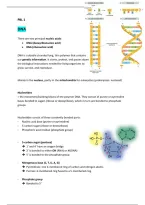
There are two principal nucleic acids:
• DNA (deoxyribonucleic acid)
• RNA (ribonucleic acid)
DNA is a double stranded long, thin polymer that contains
our genetic information. It stores, protect, and passes down
the biological instructions needed for living organisms to
grow, survive, and reproduce.
Mainly in the nucleus, partly in the mitochondria for eukaryotes (prokaryotes: nucleoid)
Nucleotides
= the monomers/building blocks of the polymer DNA. They consist of purine or pyrimidine
bases bonded to sugars (ribose or deoxyribose), which in turn are bonded to phosphate
groups
Nucleotides consist of three covalently bonded parts:
- Nucleic acid base (purine or pyrimidine)
- 5-carbon-sugar (ribose or deoxyribose)
- Phosphoric acid residue (phosphate group)
- 5-carbon sugar (pentose)
➔ 1’ and 4’ have an oxygen bridge
➔ 2’ is bonded to either OH (RNA) or H (DNA)
➔ 5’ is bonded to the phosphate group
- Nitrogenous base (C, T, U, A, G)
➔ Pyrimidines: one 6-membered ring of carbon and nitrogen atoms
➔ Purines: 6-membered ring fused to a 5-membered ring
- Phosphate group
➔ Bonded to 5’
,Nucleic acid bases (nitrogenous base)
= one- or two-ring nitrogenous aromatic compounds that make up the coding portion of
nucleic acids
Pyrimidine bases (single-ring)
= nitrogen-containing aromatic compounds that contain a six-membered ring; the parent
compounds of 3 nucleobases (C, T, U)
➔ Uracil only in RNA! Thymine mostly only in DNA!
Substitute each other!
,Nucleoside
= a purine or pyrimidine base covalently bonded to a sugar (ribose or deoxyribose)
➔ When you attach a phosphate group, it becomes a nucleotide
• Ribonucleoside = a compound formed when a nucleobase forms a glycosidic bond
with ribose
• Deoxyribonucleoside = a compound formed when a nucleobase and deoxyribose
form a glycosidic bond
The name of a nucleoside that contains a purine ends with -osine, with a pyrimidine it ends
with -idine.
When nucleotides polymerize → nucleic acids
Monomers link through the formation of two ester bonds by phosphoric acid.
There is a bond that exists between the hydroxyl groups (-OH) of the sugars in adjacent
nucleotides, this is referred to as a 3', 5'-phosphodiester bond.
The phosphoric acid is esterified to the hydroxyl groups who are bonded to the 3’ and 5’
carbons on adjacent residues.
3', 5'-phosphodiester bond = a covalent linkage in which phosphoric acid is esterified to the
3' hydroxyl of one nucleoside and the 5' hydroxyl of another nucleoside; it forms the
backbone of nucleic acids
➔ 5’ end: carries phosphate group
➔ 3’ end: has a free hydroxyl group
, Structure DNA:
DNA is composed of two polynucleotide chains
wrapped around each other forming a double helix.
The chain run in antiparallel directions: one 3’ to ‘5, the
Other 5’ to 3’.
The sugar-phosphate backbone is the outer part.
On the 5’ end there is a phosphate group and on the
3’ end there is a hydroxyl group (OH)
DNA
There are two principal nucleic acids:
• DNA (deoxyribonucleic acid)
• RNA (ribonucleic acid)
DNA is a double stranded long, thin polymer that contains
our genetic information. It stores, protect, and passes down
the biological instructions needed for living organisms to
grow, survive, and reproduce.
Mainly in the nucleus, partly in the mitochondria for eukaryotes (prokaryotes: nucleoid)
Nucleotides
= the monomers/building blocks of the polymer DNA. They consist of purine or pyrimidine
bases bonded to sugars (ribose or deoxyribose), which in turn are bonded to phosphate
groups
Nucleotides consist of three covalently bonded parts:
- Nucleic acid base (purine or pyrimidine)
- 5-carbon-sugar (ribose or deoxyribose)
- Phosphoric acid residue (phosphate group)
- 5-carbon sugar (pentose)
➔ 1’ and 4’ have an oxygen bridge
➔ 2’ is bonded to either OH (RNA) or H (DNA)
➔ 5’ is bonded to the phosphate group
- Nitrogenous base (C, T, U, A, G)
➔ Pyrimidines: one 6-membered ring of carbon and nitrogen atoms
➔ Purines: 6-membered ring fused to a 5-membered ring
- Phosphate group
➔ Bonded to 5’
,Nucleic acid bases (nitrogenous base)
= one- or two-ring nitrogenous aromatic compounds that make up the coding portion of
nucleic acids
Pyrimidine bases (single-ring)
= nitrogen-containing aromatic compounds that contain a six-membered ring; the parent
compounds of 3 nucleobases (C, T, U)
➔ Uracil only in RNA! Thymine mostly only in DNA!
Substitute each other!
,Nucleoside
= a purine or pyrimidine base covalently bonded to a sugar (ribose or deoxyribose)
➔ When you attach a phosphate group, it becomes a nucleotide
• Ribonucleoside = a compound formed when a nucleobase forms a glycosidic bond
with ribose
• Deoxyribonucleoside = a compound formed when a nucleobase and deoxyribose
form a glycosidic bond
The name of a nucleoside that contains a purine ends with -osine, with a pyrimidine it ends
with -idine.
When nucleotides polymerize → nucleic acids
Monomers link through the formation of two ester bonds by phosphoric acid.
There is a bond that exists between the hydroxyl groups (-OH) of the sugars in adjacent
nucleotides, this is referred to as a 3', 5'-phosphodiester bond.
The phosphoric acid is esterified to the hydroxyl groups who are bonded to the 3’ and 5’
carbons on adjacent residues.
3', 5'-phosphodiester bond = a covalent linkage in which phosphoric acid is esterified to the
3' hydroxyl of one nucleoside and the 5' hydroxyl of another nucleoside; it forms the
backbone of nucleic acids
➔ 5’ end: carries phosphate group
➔ 3’ end: has a free hydroxyl group
, Structure DNA:
DNA is composed of two polynucleotide chains
wrapped around each other forming a double helix.
The chain run in antiparallel directions: one 3’ to ‘5, the
Other 5’ to 3’.
The sugar-phosphate backbone is the outer part.
On the 5’ end there is a phosphate group and on the
3’ end there is a hydroxyl group (OH)



