Summary Business Research Methods
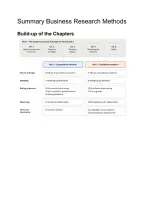
Build-up of the Chapters
,Part ONE The Research Process
Chapter 1
The Nature and Process of Business Research
What is business research?
Business research is academic research on questions about business, management and
organizations.
It is part of the social sciences (sociology, psychology, economics, etc.), so it is often
interdisciplinary.
● What makes it academic: It builds on social science theory and follows every
research step rigorously. This is what separates it from practitioner research, such as
market research by companies.
● Why research is done: a gap in the literature, conflicting studies, or a new
development in society. In short, something is not yet well understood.
● Why learn methods: to avoid mistakes in your own research, to judge other people's
research critically, and to be able to do your own project.
What influences research?
● Theory: it shapes what you study and how you interpret results.
● Existing literature: you build on what is already known.
● Role of theory: theory can come first, as something to test (deductive), or come last,
as something to build (inductive).
● Epistemology: how should we study the social world? Like the natural sciences, or
differently?
● Ontology: what is social reality? Is culture something that exists outside people, or
something people keep creating?
● Quality criteria: what counts as "good" research? Not everyone agrees the same
criteria fit every type of research.
● Ethics: ethical review limits what and whom you may study.
● Practical relevance: much research aims to help organizations. In action research,
the people being studied take part in the research.
Relevance to practice
- There is debate about rigour vs relevance: is research useful enough for managers?
Why do the two clash? The more rigorous (grondig) and theoretical research becomes, the
further it can drift from the questions managers actually face. On the other hand, very
practical work, such as consultancy, is often relevant (relevant, bruikbaar) but less
scientifically grounded.
,Key concept 1.1 – Evidence-based management
Using the best available evidence to make management decisions. It comes from medicine
and is meant to close the research–practice gap.
Four sources:
(1) the manager's own expertise
(2) local evidence
(3) the best research, found through a systematic review
(4) the views of people affected
Critique: there is no proof that it improves performance, management depends too much on
context, and it takes a narrow view of what counts as evidence.
Process of knowledge in Society
Mode 1 Mode 2
Who Universities Academics, policy-makers and
practitioners together
Driven by Academic agenda A shared practical problem
Knowledge Builds step by step; pure vs applied Cross-disciplinary, depends on
context
Sharing Mainly with other academics Fast, aimed at practical use
● Business research fits mode 2 well, but mode 2 sits alongside mode 1 rather than
replacing it.
● Grand challenges (also called wicked problems) are big global problems such as
climate change and inequality. They need interdisciplinary cooperation.
The research process: 7 elements
The book deliberately gives no fixed order, because the order depends on the research
strategy.
Explanation >>>
, 1. Literature review
● Find out what is known, which concepts, theories and methods have been used,
where the debates are, and who the key authors are.
● It must be critical, not just a summary: judge how important each study is and how it
fits your story.
2. Concepts and theories
● Concepts are labels for things that share common features (e.g. power,
bureaucracy). They are the building blocks of theory.
● In deductive research they are the starting point; in inductive research they are the
outcome.
3. Research questions
They make you say exactly what you want to know, and they guide your literature search,
design, data, analysis and writing. Without one, your research loses focus.
Key concept 1.2 – Types of research question:
1. predicting
2. explaining (causes and effects)
3. evaluating
4. describing
5. developing good practice
6. empowerment (criticized by White as too political)
7. comparison (White's alternative).
Not every study starts with a question.
Quantitative research sometimes starts with a claim that leads to hypotheses.
Qualitative research sometimes starts with a broad topic and only forms the
question later.
4. Sampling
You can almost never study every case (people, firms, newspapers), so you choose
some.
● Quantitative: a representative sample, a mini version of the population.
● Qualitative: cases that fit the purpose of the study.
In practice there is always some convenience involved (using what is available), so
explain your sampling choices.
5. Data collection
● Structured (questionnaire, structured interview): you decide in advance what you
want to know.
● Open (participant observation, semi-structured interview): ideas emerge from the
data.