
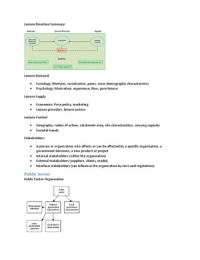
Leisure Direction Summary:
Leisure Demand:
Sociology: lifestyles, socialization, peers, socio-demographic characteristics
Psychology: Motivation, experience, flow, pure leisure
Leisure Supply
Economics: Price policy, marketing
Leisure providers, leisure sectors
Leisure Context
Geography: radius of action, catchment area, site characteristics, carrying capacity
Societal trends
Stakeholders:
A person or organization who affects or can be affected by a specific organisation, a
government decisions, a new product or project
Internal stakeholders (within the organisation)
External stakeholders (suppliers, clients, media)
Interface stakeholders (can influence the organization by laws and regulations)
Public Sector
Public Sector Organisation
, A wide range or government and government based organizations at various levels
Meant to for the general public that is owned by the government such as the movie theatre
The relevance of the Public Sector Functions
1. Coordination: bringing together private sector, governmental organizations and voluntary
organizations
2. Planning: provisions for different types of leisure, infrastructure
3. Legislation and regulation: i.e. gambling, drinking, soccer law
4. To stimulate the sector incentives from social objectives and employment
5. Marketing and Promotion: raise public awareness for healthy living
6. Intervention: intervention by market failure
7. To protect public interests: i.e. balance long (accessibility) and short-term (profit) interests
It depends on political philosophy and preferences
Public Sector and Leisure
Linked together in a complex set of relationships with their principle objective to work
towards improvement for the public good
The paradoxes (Robert, K., 2004)
1. There would be no recreational land in urban areas
2. Physical recreation would be offered mainly indoor in towns and cities
3. Access to coast and countryside would be restricted and you have to pay for access
4. Large art galleries and museums would be replaces by commercial shops
5. Full Scale High Culture: opera, ballet – couldn’t be sustained by a combination of
admission charges and commercial sponsorship
6. Soccer couldn’t be a “commercial” sport without the support of local authorities
Public Policy
The policy process is a function of 3 interrelated issues:
1. The intentions of political and other key actors
2. The way in which decisions and non-decisions are made
3. The implications of these decisions
Types of Public Policies and Leisure
Distributive Policies: Which are likely to benefit all of the population without any particular
targeting, such as funding of a sport
Redistributive policies: which are designed to focus on one particule group or section of the
population, such as the unemployment and leisure provision and those with particular needs
such as disabled people
Constituent policies: which set the procedures to be followed within society; legislation
(documentation that need to be followed, law itself)
Regulative policies: which are associated with the management of the behaviours of the
population, such as no smoking in public buildings or public places (Norms and values that
are followed)
, Partnerships: connections to the community
Are essential in the following:
o Generating ideas
o Discussing approaches
o Planning strategies
o Delivering services
Types of service provision (Local Authorities)
Need-based services: Free of charge to all citizens: education and social care
Protective services: Security – related: fire brigade
Amenity services: needs of the local government: Something that benefits the property;
desks, garbage bins, something that improves the facilities
Facility services: locations used for a specific leisure activity
Public Sector and Local Authorities
Are owned by local authorities and trade on a profit loss basis
Characteristics:
o Owned by local authorities
o Opened to all (non-exclusive)
o Run as business operations – aim to break even
o Trade on set prices according to pre-set budgets
o Facilities are adequate or improving
Objectives
o Increase health and fitness of individuals and community as a whole
o Increase social control and reduce crime
o Improve social integration
o Provider of social needs, equal opportunities and social inclusive
o Regenerate areas
o Ensure that tax payers get value for money
What are the principles on which its involvement is based?
A coordinating Function: so that they can work with other government organisations
and the private sector as well as voluntary bodies to develop a common strategy for
leisure provision to join together the multitude of provision such as in the case of
children’s play
A planning function: So that they can make provision for the types of facilities and
services required among the current and future population and the physical
infrastructure and investment that many be needed for the future.
To create legislation and also to regulate the sector: e.g. in relation to gambling and
drinking alcohol as leisure pursuits
To stimulate the sector: by providing incentive to achieve development and other social
objectives such as employment generation
Marketing and promotion: to raise public awareness of government strategies and
programmes such as healthy living
Leisure Demand:
Sociology: lifestyles, socialization, peers, socio-demographic characteristics
Psychology: Motivation, experience, flow, pure leisure
Leisure Supply
Economics: Price policy, marketing
Leisure providers, leisure sectors
Leisure Context
Geography: radius of action, catchment area, site characteristics, carrying capacity
Societal trends
Stakeholders:
A person or organization who affects or can be affected by a specific organisation, a
government decisions, a new product or project
Internal stakeholders (within the organisation)
External stakeholders (suppliers, clients, media)
Interface stakeholders (can influence the organization by laws and regulations)
Public Sector
Public Sector Organisation
, A wide range or government and government based organizations at various levels
Meant to for the general public that is owned by the government such as the movie theatre
The relevance of the Public Sector Functions
1. Coordination: bringing together private sector, governmental organizations and voluntary
organizations
2. Planning: provisions for different types of leisure, infrastructure
3. Legislation and regulation: i.e. gambling, drinking, soccer law
4. To stimulate the sector incentives from social objectives and employment
5. Marketing and Promotion: raise public awareness for healthy living
6. Intervention: intervention by market failure
7. To protect public interests: i.e. balance long (accessibility) and short-term (profit) interests
It depends on political philosophy and preferences
Public Sector and Leisure
Linked together in a complex set of relationships with their principle objective to work
towards improvement for the public good
The paradoxes (Robert, K., 2004)
1. There would be no recreational land in urban areas
2. Physical recreation would be offered mainly indoor in towns and cities
3. Access to coast and countryside would be restricted and you have to pay for access
4. Large art galleries and museums would be replaces by commercial shops
5. Full Scale High Culture: opera, ballet – couldn’t be sustained by a combination of
admission charges and commercial sponsorship
6. Soccer couldn’t be a “commercial” sport without the support of local authorities
Public Policy
The policy process is a function of 3 interrelated issues:
1. The intentions of political and other key actors
2. The way in which decisions and non-decisions are made
3. The implications of these decisions
Types of Public Policies and Leisure
Distributive Policies: Which are likely to benefit all of the population without any particular
targeting, such as funding of a sport
Redistributive policies: which are designed to focus on one particule group or section of the
population, such as the unemployment and leisure provision and those with particular needs
such as disabled people
Constituent policies: which set the procedures to be followed within society; legislation
(documentation that need to be followed, law itself)
Regulative policies: which are associated with the management of the behaviours of the
population, such as no smoking in public buildings or public places (Norms and values that
are followed)
, Partnerships: connections to the community
Are essential in the following:
o Generating ideas
o Discussing approaches
o Planning strategies
o Delivering services
Types of service provision (Local Authorities)
Need-based services: Free of charge to all citizens: education and social care
Protective services: Security – related: fire brigade
Amenity services: needs of the local government: Something that benefits the property;
desks, garbage bins, something that improves the facilities
Facility services: locations used for a specific leisure activity
Public Sector and Local Authorities
Are owned by local authorities and trade on a profit loss basis
Characteristics:
o Owned by local authorities
o Opened to all (non-exclusive)
o Run as business operations – aim to break even
o Trade on set prices according to pre-set budgets
o Facilities are adequate or improving
Objectives
o Increase health and fitness of individuals and community as a whole
o Increase social control and reduce crime
o Improve social integration
o Provider of social needs, equal opportunities and social inclusive
o Regenerate areas
o Ensure that tax payers get value for money
What are the principles on which its involvement is based?
A coordinating Function: so that they can work with other government organisations
and the private sector as well as voluntary bodies to develop a common strategy for
leisure provision to join together the multitude of provision such as in the case of
children’s play
A planning function: So that they can make provision for the types of facilities and
services required among the current and future population and the physical
infrastructure and investment that many be needed for the future.
To create legislation and also to regulate the sector: e.g. in relation to gambling and
drinking alcohol as leisure pursuits
To stimulate the sector: by providing incentive to achieve development and other social
objectives such as employment generation
Marketing and promotion: to raise public awareness of government strategies and
programmes such as healthy living



