
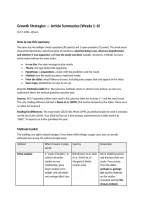
Growth Strategies — Article Summaries (Weeks 1–6)
Oct 9, 2026 · @haris
How to use this summary
The exam has 46 multiple-choice questions (85 points) and 1 open question (15 points). The mock exam
shows that the lecturer asks three kinds of questions: what the theory says, what was hypothesised
and whether it was supported, and how the study was done (sample, measures, method). So every
article below follows the same order:
• In one line: the main message in plain words.
• Theory: the logic behind the argument.
• Hypotheses / propositions: a table with the prediction and the result.
• Method: how the study was done, explained simply.
• From the slides: what Flikkema stresses, including extra papers that only appear in the slides.
• Exam traps: details that are easy to mix up.
Read the Methods toolkit first. The same few methods return in almost every lecture, so once you
understand them, the method questions become easy.
Sources. All 17 uploaded articles were read in full, plus the slides for lectures 1–7 and the mock exam.
The only reading without a full text is Bosse et al. (2009); that section is based on the slides. There were
no slides for lecture 8.
Reading list differences. The mock exam (2025) lists Minto (1998, pyramid principle) in week 4 and does
not list Lee & Kim (2024). Your 2026 list has Lee & Kim instead, and the lecture 6 slides mark it as
"NEW". So expect Lee & Kim questions this year.
Methods toolkit
The readings use eight research designs. If you know which design a paper uses, you can usually
eliminate two wrong MC options straight away.
Method What it means in plain Used by Remember
words
Meta-analysis A "study of studies". It Brinckmann et al.; Klier More statistical power
collects all earlier et al.; Palich et al.; and less bias than one
studies on one Margolis & Walsh study. Two caveats
relationship, gives (counts only) from the slides:
larger studies more garbage in, garbage
weight, and calculates out (quality depends
one average effect size. on the studies
included) and the file-
drawer problem
,Method What it means in plain Used by Remember
words
(publication bias: non-
significant studies stay
unpublished, checked
with a funnel plot). A
meta-analysis shows
strength, not causality.
Meta-regression Inside a meta-analysis: Brinckmann (H2–H4); This is how moderators
explains why effect Klier (H3); Palich are tested in a meta-
sizes differ between (restriction of range) analysis.
studies by regressing
them on study features
(e.g. new vs.
established firms).
Moderator A third variable that Lu & Beamish Moderator = "it
changes the strength or (intangible assets); depends on…".
direction of the X → Y Sapienza (age,
relationship (Baron & experience, fungibility);
Kenny, 1986). Tested Klier (cultural distance);
with an interaction Puranam (common
term X × M. ground)
Mediator A variable that sits in Oliva et al. (separation) Mediator = "it works
between: X → M → Y. It through…". Mediation
explains how X affects shows when the direct
Y. effect of X shrinks once
M is added.
Panel regression (GLS, Many firms followed Lu & Beamish (1,489 Lagged independent
random effects) over many years. GLS Japanese firms, 1986– variables (one year) to
corrects for errors that 97) support causal
are correlated over reasoning.
time.
Logit / linear Regression where the Puranam (structural The coefficient tells
probability model outcome is yes/no integration = 1/0); Lee how X changes the
(integrated or not; & Kim (failure, IPO) chance of the outcome.
failed or not).
Experiment (scenario- Researchers Collier et al. Strongest design for
based) manipulate conditions causality, but scenarios
and compare groups. A are hypothetical.
2 × 2 design = two
,Method What it means in plain Used by Remember
words
factors with two levels
each = four scenarios.
Survival analysis Models when an event Scherer et al. Fits longitudinal
happens over time customer data.
(here: a customer
leaving).
Conceptual paper with No data. The authors Sarasvathy; Sapienza; Propositions are not
propositions build theory and Jones et al.; Bosse et supported or rejected,
formulate propositions al.; Pisano & Teece; because they were
(testable statements Margolis & Walsh never tested.
for future research), (review + agenda)
not tested hypotheses.
Survey with key Questionnaire to one Oliva et al. (216 firms, Risk: common method
informants well-informed person heads of service) bias (same person
per firm. answers X and Y).
How to read results tables. A coefficient's sign (+ or −) tells the direction. Stars (*, **, ***) tell
significance: the more stars, the less likely the result is due to chance. "p < 0.05" is the usual cut-off.
When a paper (e.g. Oliva et al.) says it "failed to reject" a hypothesis, it means the hypothesis was
supported.
Lecture 1 — Business planning vs. effectuation
The tension. Should founders write a business plan first, or "storm the castle" and act? Flikkema opens
with ergobag (four founders, business plan competitions won, €46m sales in 2016) against the fact that
about 90% of start-ups fail: managed growth or luck?
Brinckmann, Grichnik & Kapsa (2010) — Should entrepreneurs plan or just storm the castle?
In one line: Business planning improves small-firm performance, but less for new firms and less in
cultures that avoid uncertainty.
Theory. The paper sets two schools of thought against each other.
• Planning school (why planning should help):
o Faster, better decisions: a plan forces founders to gather information and think through
scenarios before acting, so later decisions are quicker.
o Efficient use of scarce resources: small firms cannot afford mistakes; a plan identifies
gaps and bottlenecks early.
o Goal setting: clear goals (goal-setting theory) motivate and show which steps lead to
them.
, o Legitimacy and communication: a written plan signals professionalism to banks,
investors, employees and suppliers. This is the symbolic function.
• Learning school (why planning may hurt):
o Under high uncertainty the future cannot be predicted, so plans are quickly outdated
(link to Sarasvathy).
o Planning takes time away from acting, acquiring resources and organizing (Bhidé, 2000).
o Plans create cognitive rigidity and inertia: founders stick to the plan and miss
opportunities.
o Learning comes from trial and error and market feedback, not from desk research.
Why the moderators matter (the logic behind H2–H4).
• Firm stage (H2): new firms suffer from a liability of newness (Stinchcombe): no track record,
routines or market data. With so little information, planning is mostly guesswork. Established
small firms have historical data, so their plans are more accurate.
• Outcome vs. process (H3): the written plan (outcome) was expected to add legitimacy on top of
the learning from the process of planning. The study found no difference, so the learning benefit
seems as important as the symbolic benefit.
• Culture (H4): in cultures with high uncertainty avoidance (Hofstede), people dislike ambiguity
and follow plans rigidly once written (post-planning behaviour). That rigidity removes the
flexibility needed to react to surprises.
Research gap. Earlier studies found positive, null and negative effects and mixed new and established
firms, so no clear conclusion was possible. A meta-analysis can settle the main effect and explain the
differences with moderators.
Hypotheses (research model on slide 22):
H Prediction Result
H1 Business planning increases Supported: mean effect size
performance (+) 0.20
H2 The effect is stronger in Supported: 0.24 vs. 0.13
established small firms than in
new small firms (moderator:
stage of development)
H3 The planning outcome (written Rejected: no significant
plan) has a greater effect than difference
the planning process
H4 The effect is weaker in cultures Supported: 0.08 (high UA) vs.
with high uncertainty 0.26 (low UA)
avoidance (−)
Method (meta-analysis).
Oct 9, 2026 · @haris
How to use this summary
The exam has 46 multiple-choice questions (85 points) and 1 open question (15 points). The mock exam
shows that the lecturer asks three kinds of questions: what the theory says, what was hypothesised
and whether it was supported, and how the study was done (sample, measures, method). So every
article below follows the same order:
• In one line: the main message in plain words.
• Theory: the logic behind the argument.
• Hypotheses / propositions: a table with the prediction and the result.
• Method: how the study was done, explained simply.
• From the slides: what Flikkema stresses, including extra papers that only appear in the slides.
• Exam traps: details that are easy to mix up.
Read the Methods toolkit first. The same few methods return in almost every lecture, so once you
understand them, the method questions become easy.
Sources. All 17 uploaded articles were read in full, plus the slides for lectures 1–7 and the mock exam.
The only reading without a full text is Bosse et al. (2009); that section is based on the slides. There were
no slides for lecture 8.
Reading list differences. The mock exam (2025) lists Minto (1998, pyramid principle) in week 4 and does
not list Lee & Kim (2024). Your 2026 list has Lee & Kim instead, and the lecture 6 slides mark it as
"NEW". So expect Lee & Kim questions this year.
Methods toolkit
The readings use eight research designs. If you know which design a paper uses, you can usually
eliminate two wrong MC options straight away.
Method What it means in plain Used by Remember
words
Meta-analysis A "study of studies". It Brinckmann et al.; Klier More statistical power
collects all earlier et al.; Palich et al.; and less bias than one
studies on one Margolis & Walsh study. Two caveats
relationship, gives (counts only) from the slides:
larger studies more garbage in, garbage
weight, and calculates out (quality depends
one average effect size. on the studies
included) and the file-
drawer problem
,Method What it means in plain Used by Remember
words
(publication bias: non-
significant studies stay
unpublished, checked
with a funnel plot). A
meta-analysis shows
strength, not causality.
Meta-regression Inside a meta-analysis: Brinckmann (H2–H4); This is how moderators
explains why effect Klier (H3); Palich are tested in a meta-
sizes differ between (restriction of range) analysis.
studies by regressing
them on study features
(e.g. new vs.
established firms).
Moderator A third variable that Lu & Beamish Moderator = "it
changes the strength or (intangible assets); depends on…".
direction of the X → Y Sapienza (age,
relationship (Baron & experience, fungibility);
Kenny, 1986). Tested Klier (cultural distance);
with an interaction Puranam (common
term X × M. ground)
Mediator A variable that sits in Oliva et al. (separation) Mediator = "it works
between: X → M → Y. It through…". Mediation
explains how X affects shows when the direct
Y. effect of X shrinks once
M is added.
Panel regression (GLS, Many firms followed Lu & Beamish (1,489 Lagged independent
random effects) over many years. GLS Japanese firms, 1986– variables (one year) to
corrects for errors that 97) support causal
are correlated over reasoning.
time.
Logit / linear Regression where the Puranam (structural The coefficient tells
probability model outcome is yes/no integration = 1/0); Lee how X changes the
(integrated or not; & Kim (failure, IPO) chance of the outcome.
failed or not).
Experiment (scenario- Researchers Collier et al. Strongest design for
based) manipulate conditions causality, but scenarios
and compare groups. A are hypothetical.
2 × 2 design = two
,Method What it means in plain Used by Remember
words
factors with two levels
each = four scenarios.
Survival analysis Models when an event Scherer et al. Fits longitudinal
happens over time customer data.
(here: a customer
leaving).
Conceptual paper with No data. The authors Sarasvathy; Sapienza; Propositions are not
propositions build theory and Jones et al.; Bosse et supported or rejected,
formulate propositions al.; Pisano & Teece; because they were
(testable statements Margolis & Walsh never tested.
for future research), (review + agenda)
not tested hypotheses.
Survey with key Questionnaire to one Oliva et al. (216 firms, Risk: common method
informants well-informed person heads of service) bias (same person
per firm. answers X and Y).
How to read results tables. A coefficient's sign (+ or −) tells the direction. Stars (*, **, ***) tell
significance: the more stars, the less likely the result is due to chance. "p < 0.05" is the usual cut-off.
When a paper (e.g. Oliva et al.) says it "failed to reject" a hypothesis, it means the hypothesis was
supported.
Lecture 1 — Business planning vs. effectuation
The tension. Should founders write a business plan first, or "storm the castle" and act? Flikkema opens
with ergobag (four founders, business plan competitions won, €46m sales in 2016) against the fact that
about 90% of start-ups fail: managed growth or luck?
Brinckmann, Grichnik & Kapsa (2010) — Should entrepreneurs plan or just storm the castle?
In one line: Business planning improves small-firm performance, but less for new firms and less in
cultures that avoid uncertainty.
Theory. The paper sets two schools of thought against each other.
• Planning school (why planning should help):
o Faster, better decisions: a plan forces founders to gather information and think through
scenarios before acting, so later decisions are quicker.
o Efficient use of scarce resources: small firms cannot afford mistakes; a plan identifies
gaps and bottlenecks early.
o Goal setting: clear goals (goal-setting theory) motivate and show which steps lead to
them.
, o Legitimacy and communication: a written plan signals professionalism to banks,
investors, employees and suppliers. This is the symbolic function.
• Learning school (why planning may hurt):
o Under high uncertainty the future cannot be predicted, so plans are quickly outdated
(link to Sarasvathy).
o Planning takes time away from acting, acquiring resources and organizing (Bhidé, 2000).
o Plans create cognitive rigidity and inertia: founders stick to the plan and miss
opportunities.
o Learning comes from trial and error and market feedback, not from desk research.
Why the moderators matter (the logic behind H2–H4).
• Firm stage (H2): new firms suffer from a liability of newness (Stinchcombe): no track record,
routines or market data. With so little information, planning is mostly guesswork. Established
small firms have historical data, so their plans are more accurate.
• Outcome vs. process (H3): the written plan (outcome) was expected to add legitimacy on top of
the learning from the process of planning. The study found no difference, so the learning benefit
seems as important as the symbolic benefit.
• Culture (H4): in cultures with high uncertainty avoidance (Hofstede), people dislike ambiguity
and follow plans rigidly once written (post-planning behaviour). That rigidity removes the
flexibility needed to react to surprises.
Research gap. Earlier studies found positive, null and negative effects and mixed new and established
firms, so no clear conclusion was possible. A meta-analysis can settle the main effect and explain the
differences with moderators.
Hypotheses (research model on slide 22):
H Prediction Result
H1 Business planning increases Supported: mean effect size
performance (+) 0.20
H2 The effect is stronger in Supported: 0.24 vs. 0.13
established small firms than in
new small firms (moderator:
stage of development)
H3 The planning outcome (written Rejected: no significant
plan) has a greater effect than difference
the planning process
H4 The effect is weaker in cultures Supported: 0.08 (high UA) vs.
with high uncertainty 0.26 (low UA)
avoidance (−)
Method (meta-analysis).



