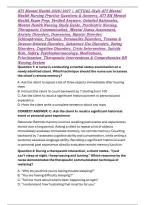
ATI Mental Health 2026/2027 | ACTUAL-Style ATI Mental
Health Nursing Practice Questions & Answers, ATI RN Mental
Health Exam Prep, Verified Answers, Detailed Rationales,
Mental Health Nursing Study Guide, Psychiatric Nursing,
Therapeutic Communication, Mental Status Assessment,
Anxiety Disorders, Depression, Bipolar Disorder,
Schizophrenia, Psychosis, Personality Disorders, Trauma &
Stressor-Related Disorders, Substance Use Disorders, Eating
Disorders, Cognitive Disorders, Crisis Intervention, Suicide
Risk, Safety, Psychopharmacology, Medications,
Prioritization, Therapeutic Interventions & Comprehensive RN
Nursing Review
Question 1: A nurse is conducting a mental status examination on a
newly admitted client. Which technique should the nurse use to assess
the client's remote memory?
A. Ask the client to repeat a list of three objects immediately after hearing
them
B. Instruct the client to count backward by 7 starting from 100
C. Ask the client to recall a significant historical event or personal past
experience
D. Have the client write a complete sentence about any topic
CORRECT ANSWER: C. Ask the client to recall a significant historical
event or personal past experience
Rationale: Remote memory involves recalling past events and experiences
stored over a long period. Asking a client to repeat a list of objects
immediately assesses immediate memory, not remote memory. Counting
backward by 7 assesses cognitive ability and concentration, while writing a
sentence assesses language ability. Recalling a significant historical event
or personal past experience directly evaluates remote memory function.
Question 2: During a therapeutic interaction, a client states, "I just
can't sleep at night. I keep tossing and turning." Which response by the
nurse demonstrates the therapeutic communication technique of
restating?
A. "Why do you think you're having trouble sleeping?"
B. "You are having difficulty sleeping?"
C. "Tell me more about what's been happening at night."
D. "I understand how frustrating that must be for you."
,CORRECT ANSWER: B. "You are having difficulty sleeping?"
Rationale: Restating involves repeating the main idea of what the client has
said using similar or identical words to convey understanding and
encourage further exploration. Option B restates the client's concern about
sleep difficulty. Option A uses a "why" question, which is nontherapeutic
and can make the client feel defensive. Option C demonstrates the
technique of clarification or exploring. Option D demonstrates empathy,
which is a different therapeutic technique.
Question 3: A client diagnosed with cancer tells the nurse, "It's just a
bad cold. The tests are probably wrong." Which defense mechanism is
the client using?
A. Rationalization
B. Repression
C. Denial
D. Displacement
CORRECT ANSWER: C. Denial
Rationale: Denial is the defense mechanism in which a person refuses to
acknowledge the reality of a painful or threatening situation, attributing
symptoms to a less serious cause. The client is refusing to accept the
cancer diagnosis by attributing the symptoms to a bad cold. Rationalization
involves creating logical explanations for unacceptable behavior.
Repression is the unconscious exclusion of unpleasant experiences from
conscious awareness. Displacement redirects emotions from the original
source to a safer substitute target.
Question 4: A psychiatric-mental health nurse is establishing a
therapeutic relationship with a client. During which phase of the nurse-
client relationship should the nurse primarily focus on establishing
trust and setting the framework for the relationship?
A. Working phase
B. Orientation phase
C. Termination phase
D. Pre-interaction phase
CORRECT ANSWER: B. Orientation phase
,Rationale: The orientation phase is the first phase of the nurse-client
relationship, where the primary focus is on establishing trust, rapport, and
setting the contractual framework for the relationship. During this phase,
the nurse and client get acquainted, boundaries are established, and
expectations are clarified. The working phase focuses on problem-solving
and achieving goals. The termination phase focuses on summarizing
progress and saying goodbye. The pre-interaction phase occurs before
meeting the client and involves self-examination by the nurse.
Question 5: A nurse is caring for a client who states, "I was attacked
last year, but I honestly cannot remember any of the details." Which
defense mechanism is the client using?
A. Suppression
B. Denial
C. Repression
D. Rationalization
CORRECT ANSWER: C. Repression
Rationale: Repression is the involuntary blocking of unpleasant memories
from conscious awareness, often seen after trauma. The client genuinely
cannot recall the traumatic event. Suppression is the voluntary exclusion of
unpleasant thoughts from awareness. Denial involves refusing to
acknowledge reality. Rationalization creates logical excuses for
unacceptable behavior.
Question 6: A 34-year-old patient admitted to an inpatient psychiatric
unit refuses to take prescribed medication, stating, "I have the right to
refuse treatment." The nurse should recognize that this right is
protected under which legal principle?
A. Informed consent and patient autonomy
B. Involuntary commitment statutes
C. Duty to warn and protect third parties
D. Mandatory reporting requirements
CORRECT ANSWER: A. Informed consent and patient autonomy
Rationale: Informed consent and patient autonomy are foundational legal
principles that protect a competent patient's right to refuse treatment,
including medication. While involuntary commitment statutes address
, admission criteria, they do not override a competent patient's right to
refuse specific treatments. The duty to warn applies only when there is a
specific, identifiable threat to a third party.
Question 7: A client on the psychiatric unit tells the nurse, "I'm not
going to take that medication. You can't make me." The client has been
admitted voluntarily and is not a danger to self or others. What is the
nurse's MOST appropriate response?
A. "If you don't take your medication, we will have to consider discharge."
B. "You have the right to refuse medication. Let's discuss your concerns
about it."
C. "I'll need to report this to the doctor so we can get an order to medicate
you against your will."
D. "Your medication is important for your recovery. I'll come back in 30
minutes and you need to take it then."
CORRECT ANSWER: B. "You have the right to refuse medication. Let's
discuss your concerns about it."
Rationale: A voluntarily admitted client who is not an imminent danger to
self or others retains the right to refuse treatment, including medication.
The nurse should respect this right while exploring the client's concerns
and providing education. Threatening discharge is coercive and
inappropriate. Involuntary medication requires a court order or emergency
situation, which does not exist here. Setting a time limit does not address
the client's right to refuse or explore their concerns.
Question 8: A psychiatric nurse is caring for a client who was
involuntarily committed after threatening to harm a family member.
The client asks, "When can I leave this place?" What is the nurse's BEST
response?
A. "You can leave whenever you feel ready to go home."
B. "The healthcare team will determine when you are no longer a danger to
others."
C. "Involuntary commitments usually last about 72 hours, so you'll likely go
home soon."
D. "Let's focus on your treatment plan rather than your discharge date."
Health Nursing Practice Questions & Answers, ATI RN Mental
Health Exam Prep, Verified Answers, Detailed Rationales,
Mental Health Nursing Study Guide, Psychiatric Nursing,
Therapeutic Communication, Mental Status Assessment,
Anxiety Disorders, Depression, Bipolar Disorder,
Schizophrenia, Psychosis, Personality Disorders, Trauma &
Stressor-Related Disorders, Substance Use Disorders, Eating
Disorders, Cognitive Disorders, Crisis Intervention, Suicide
Risk, Safety, Psychopharmacology, Medications,
Prioritization, Therapeutic Interventions & Comprehensive RN
Nursing Review
Question 1: A nurse is conducting a mental status examination on a
newly admitted client. Which technique should the nurse use to assess
the client's remote memory?
A. Ask the client to repeat a list of three objects immediately after hearing
them
B. Instruct the client to count backward by 7 starting from 100
C. Ask the client to recall a significant historical event or personal past
experience
D. Have the client write a complete sentence about any topic
CORRECT ANSWER: C. Ask the client to recall a significant historical
event or personal past experience
Rationale: Remote memory involves recalling past events and experiences
stored over a long period. Asking a client to repeat a list of objects
immediately assesses immediate memory, not remote memory. Counting
backward by 7 assesses cognitive ability and concentration, while writing a
sentence assesses language ability. Recalling a significant historical event
or personal past experience directly evaluates remote memory function.
Question 2: During a therapeutic interaction, a client states, "I just
can't sleep at night. I keep tossing and turning." Which response by the
nurse demonstrates the therapeutic communication technique of
restating?
A. "Why do you think you're having trouble sleeping?"
B. "You are having difficulty sleeping?"
C. "Tell me more about what's been happening at night."
D. "I understand how frustrating that must be for you."
,CORRECT ANSWER: B. "You are having difficulty sleeping?"
Rationale: Restating involves repeating the main idea of what the client has
said using similar or identical words to convey understanding and
encourage further exploration. Option B restates the client's concern about
sleep difficulty. Option A uses a "why" question, which is nontherapeutic
and can make the client feel defensive. Option C demonstrates the
technique of clarification or exploring. Option D demonstrates empathy,
which is a different therapeutic technique.
Question 3: A client diagnosed with cancer tells the nurse, "It's just a
bad cold. The tests are probably wrong." Which defense mechanism is
the client using?
A. Rationalization
B. Repression
C. Denial
D. Displacement
CORRECT ANSWER: C. Denial
Rationale: Denial is the defense mechanism in which a person refuses to
acknowledge the reality of a painful or threatening situation, attributing
symptoms to a less serious cause. The client is refusing to accept the
cancer diagnosis by attributing the symptoms to a bad cold. Rationalization
involves creating logical explanations for unacceptable behavior.
Repression is the unconscious exclusion of unpleasant experiences from
conscious awareness. Displacement redirects emotions from the original
source to a safer substitute target.
Question 4: A psychiatric-mental health nurse is establishing a
therapeutic relationship with a client. During which phase of the nurse-
client relationship should the nurse primarily focus on establishing
trust and setting the framework for the relationship?
A. Working phase
B. Orientation phase
C. Termination phase
D. Pre-interaction phase
CORRECT ANSWER: B. Orientation phase
,Rationale: The orientation phase is the first phase of the nurse-client
relationship, where the primary focus is on establishing trust, rapport, and
setting the contractual framework for the relationship. During this phase,
the nurse and client get acquainted, boundaries are established, and
expectations are clarified. The working phase focuses on problem-solving
and achieving goals. The termination phase focuses on summarizing
progress and saying goodbye. The pre-interaction phase occurs before
meeting the client and involves self-examination by the nurse.
Question 5: A nurse is caring for a client who states, "I was attacked
last year, but I honestly cannot remember any of the details." Which
defense mechanism is the client using?
A. Suppression
B. Denial
C. Repression
D. Rationalization
CORRECT ANSWER: C. Repression
Rationale: Repression is the involuntary blocking of unpleasant memories
from conscious awareness, often seen after trauma. The client genuinely
cannot recall the traumatic event. Suppression is the voluntary exclusion of
unpleasant thoughts from awareness. Denial involves refusing to
acknowledge reality. Rationalization creates logical excuses for
unacceptable behavior.
Question 6: A 34-year-old patient admitted to an inpatient psychiatric
unit refuses to take prescribed medication, stating, "I have the right to
refuse treatment." The nurse should recognize that this right is
protected under which legal principle?
A. Informed consent and patient autonomy
B. Involuntary commitment statutes
C. Duty to warn and protect third parties
D. Mandatory reporting requirements
CORRECT ANSWER: A. Informed consent and patient autonomy
Rationale: Informed consent and patient autonomy are foundational legal
principles that protect a competent patient's right to refuse treatment,
including medication. While involuntary commitment statutes address
, admission criteria, they do not override a competent patient's right to
refuse specific treatments. The duty to warn applies only when there is a
specific, identifiable threat to a third party.
Question 7: A client on the psychiatric unit tells the nurse, "I'm not
going to take that medication. You can't make me." The client has been
admitted voluntarily and is not a danger to self or others. What is the
nurse's MOST appropriate response?
A. "If you don't take your medication, we will have to consider discharge."
B. "You have the right to refuse medication. Let's discuss your concerns
about it."
C. "I'll need to report this to the doctor so we can get an order to medicate
you against your will."
D. "Your medication is important for your recovery. I'll come back in 30
minutes and you need to take it then."
CORRECT ANSWER: B. "You have the right to refuse medication. Let's
discuss your concerns about it."
Rationale: A voluntarily admitted client who is not an imminent danger to
self or others retains the right to refuse treatment, including medication.
The nurse should respect this right while exploring the client's concerns
and providing education. Threatening discharge is coercive and
inappropriate. Involuntary medication requires a court order or emergency
situation, which does not exist here. Setting a time limit does not address
the client's right to refuse or explore their concerns.
Question 8: A psychiatric nurse is caring for a client who was
involuntarily committed after threatening to harm a family member.
The client asks, "When can I leave this place?" What is the nurse's BEST
response?
A. "You can leave whenever you feel ready to go home."
B. "The healthcare team will determine when you are no longer a danger to
others."
C. "Involuntary commitments usually last about 72 hours, so you'll likely go
home soon."
D. "Let's focus on your treatment plan rather than your discharge date."